


This was originally posted on the offline transformerstcg.com website.
I’ve talked about the importance of variance in game design in previous articles, but for those of you who don’t want to delve through old articles, here are the key points
- Variance makes the game more exciting. Not knowing what cards you’ll draw or flip adds tension, excitement, and payoffs to the game. It also enables epic turnarounds and crazy upsets, the kind that have people telling stories “that one time when something unbelievable happened…”
- It keeps people in the game longer. You’re not mathematically eliminated because of a slight misstep on turn 2, you just need to buckle down, tighten up your play, play to your outs, and hope that the right cards show up at the right time.
- It keeps the game new player friendly. You want the better player to win more often, but if a brand-new player never wins, they’ll quickly tire of the game.
- It makes the game less taxing. The optimal strategy for a deterministic game like chess is to follow every possible line of pay until the end of the game, something that not even super computers can do. Blurring those lines of play in a haze of probability makes evaluating game states and lines of play more about heuristics and gut feel than about holding a decision tree in your head. Even more importantly, it gives players permission to NOT feel forced into pursuing every possible branch.
- It tests players adaptability. Variance forces you to evaluate novel game states on the fly and develop new plans in response.
We’ve built many sources of variance into the Transformers TCG game system as a whole (including hidden information, battle flips, and what cards you draw), but we also like to build variance into individual cards. I have three short stories of variance to go with my three preview cards today.
No Whammies
I was chatting with our fearless Brand Manager Drew Nolosco (who sits about ten feet away from me) about early Wave 5 progress, and he said that he loved press-your-luck mechanics and wanted to see more in the Transformers TCG. There are few things a designer loves more than a concrete and definitive direction (seriously, blank slates are the WORST) so I returned to my desk and came back five minutes later with something very close to this:
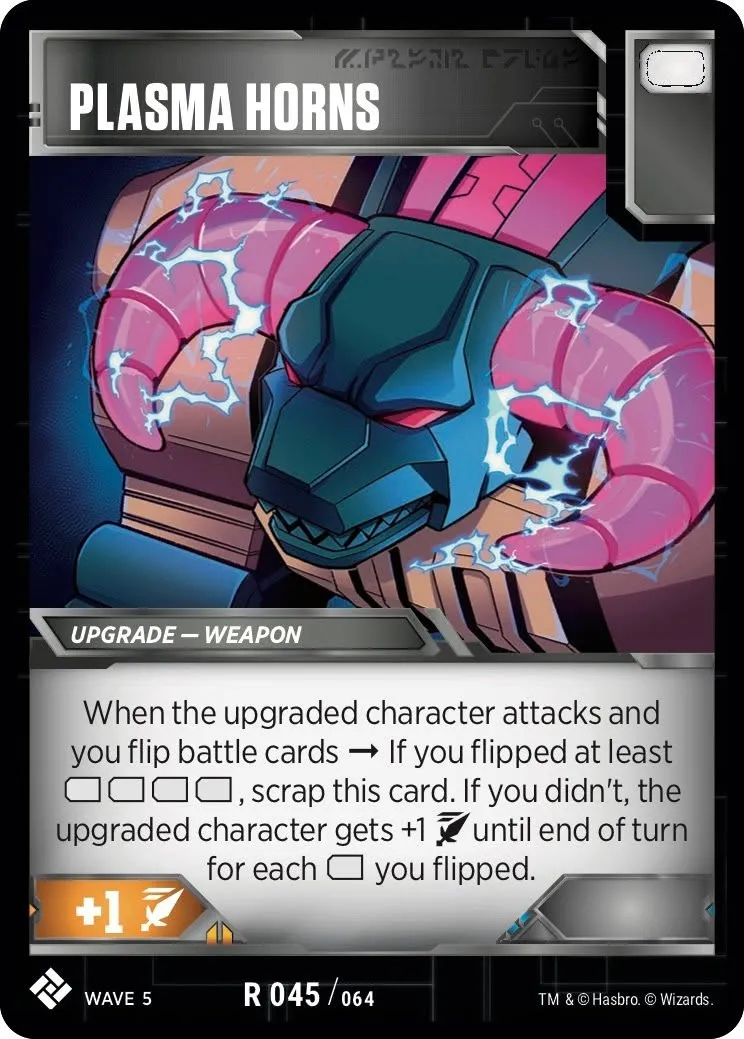
(I think the only difference was the original didn’t have the base +1 Attack, but playtesting showed that version to be just a bit weak. I’ve joked in the past that the perfectly balanced Upgrade – Weapon would have an attack bonus of +2.7. Of course, we can’t do that, so we nudge the cards in other ways. We have some rules of thumb. +2 weapons have some other bonuses or better battle icons (like Noble’s Blaster). +3 weapons have a minor hoop you have to jump through (like Energon Axe) or a small downside (like Erratic Lightning). +4 weapons have major downsides like blowing themselves up (I’m looking at you grenade launcher).
Plasma Horns can be a moderately safe +2 to +3 weapon if your deck is a little less than half white battle icons (or with some bold and even lower fraction of white cards). Or, if you’re feeling lucky/greedy, you can go more around three-quarters white and aim for a consistent +4. In theory, this could be the never-ending Grenade Launcher if you play your cards right, but one step too far and it’s sayonara. All I can say for sure is that my opponent will be hitting the sweet spot on this a heck of a lot more often than I will.
Staying Flexible
From the beginning of design, we found that the most fun battle decks were those that had a mix of orange and blue battle icons. We also found that there were strong incentives towards mono-color decks. The more Bold you had, the more you wanted to play only orange. The more Tough, the more you leaned towards blue. We always wanted those to be valid choices, but those decks have very predictable damage, and the game needs to have a countervailing pressure towards more overall power at the expense of consistency. We do some of that more subtly with counterdirectional cards like Power Sword, which when compared to a card like Flamethrower gives you more Bold, but at the cost of more blue in your deck.
We also push mixed decks more explicitly with pattern matching cards like Bluestreak
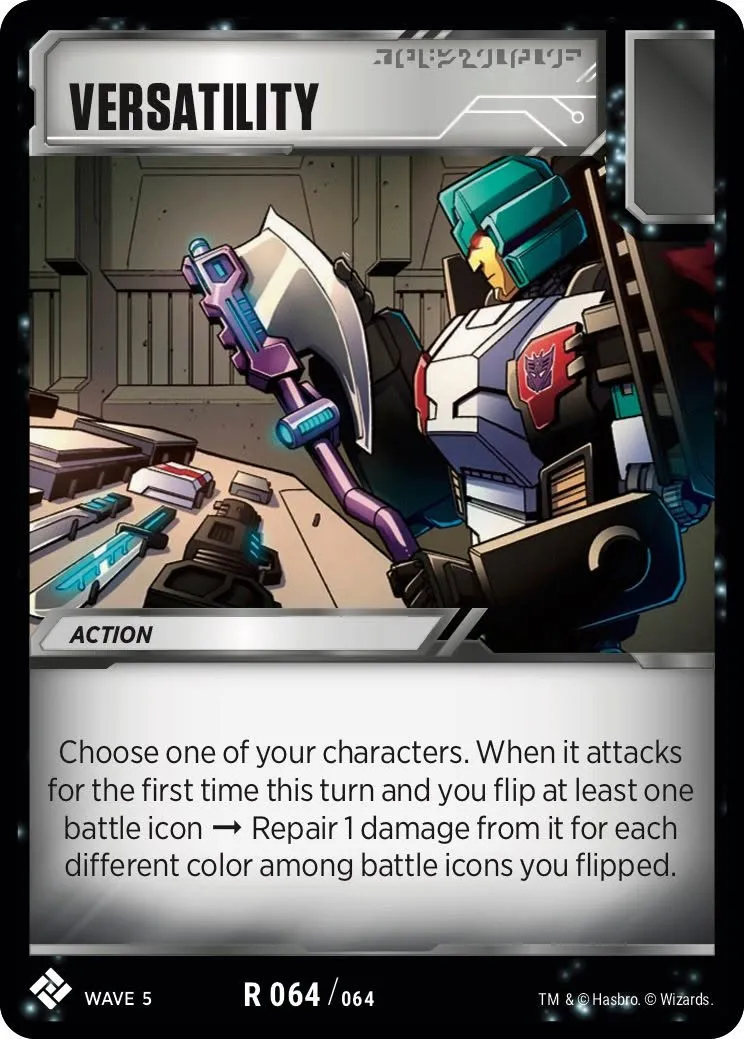
And icon counting cards like my second preview card.
We have chosen to be very careful with repair in the Transformers TCG. There is a real danger if we make it too good, then heavy blue defensive decks with strong repair could outpace the ability of their opponent to deal damage and games would never end. Versatility offers the dream of repairing as much as 5 damage from a single card, but unreliably and with a significant deck building cost.
Do you feel lucky, punk?
I talk a lot about how variance creates moments. We love the moment where something out of the blue and surprises you, but we also love the moments that are created by anticipation. You can see events coming to a head, and you know that all the threads will come together in a single card or ability and be resolved. This is the story of Odd Dodge, a little card that lets you put it all on the line.
One of the challenges we knew we were opting into with the design of the Transformers TCG game system is that there is a tendency towards snowballing. If one player gets ahead, say by KOing a character with a lucky shot earlier than they ought to have, it can be very hard for their opponent to come back from behind. The system has fewer built-in comeback mechanics than other game systems, so we look for opportunities to inject them back in with specific cards.
There will inevitably be game states where one player has their back against the wall, outnumbered 3-to-1, and we want them to have at least a dream of being able to come back. Perhaps more importantly, we want their opponent to not be sure that they have it in the bag. We want them to consider alternate, possibly suboptimal lines of play to avoid getting blown out by a curveball their opponent has queued up.
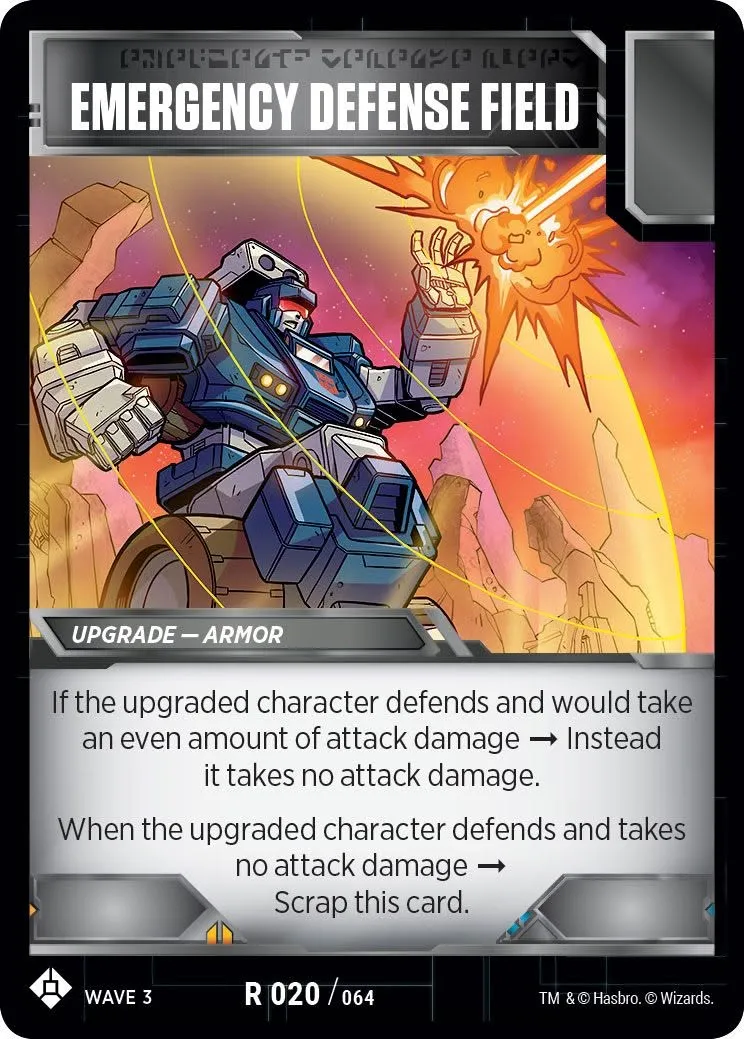
In wave 3, you saw Emergency Defense Field, which gave a 50/50 shot of surviving the most punishing attack, but it had the disadvantage of telegraphing the moment to your opponent and being susceptible to upgrade removal.
Now, you are quite lucky to have the opportunity to play Lucky Dodge, though it will always be Odd Dodge (its name during playtesting) to me.
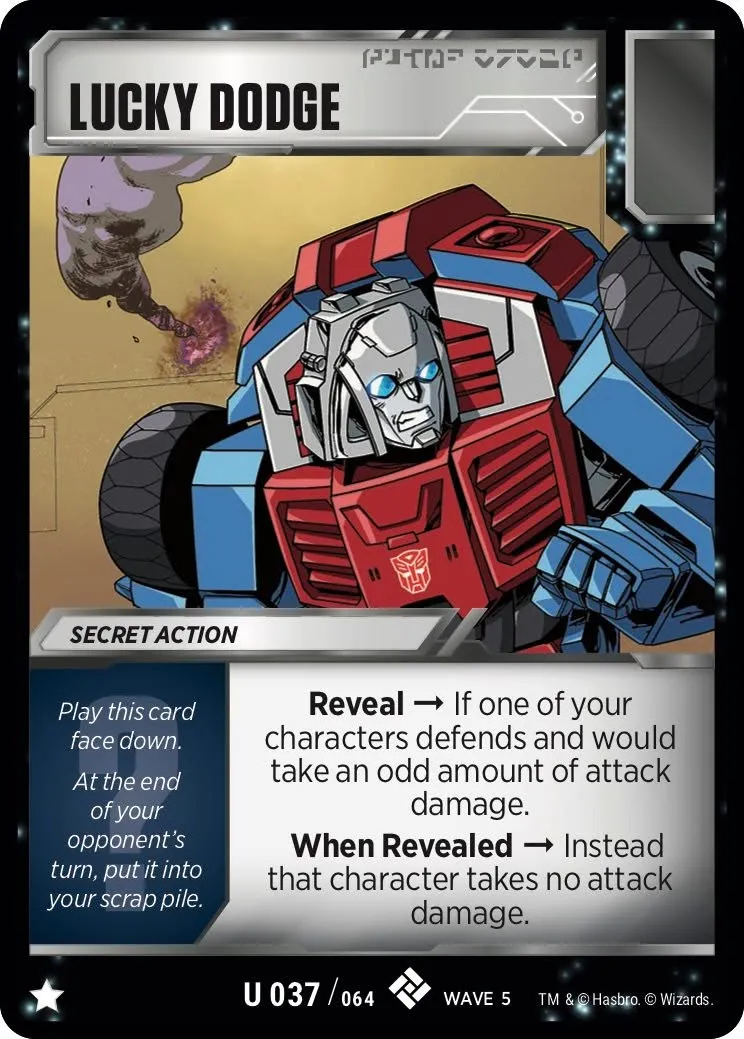
Cards like this are exciting and fun when they are rare, but cause major problems if they are too common or reliable. Over the course of design, this first lost all its battle icons and then gained a star, since blanking an attack even just half the time is an incredibly powerful play. I’m sure someone out there will make a 19 star team with three Lucky Dodges and three Emergency Defense Fields, but the best part about this card existing is that every time you sit down against a player with a 24 star team, you’re going to have to ask yourself about every secret action your opponent plays, and whether they are feeling lucky.
Until next time, may your flips be as varied as you need them to be.