


This was originally posted on the offline transformerstcg.com website.
As I enjoy my 121st day of the quarantine, I begin to realize that absent the grand events of life, there is much joy to be found in the tiniest of details: The love expressed by a partner quietly creating mental and emotional space for you; The warmth of a child snuggling up to get just a few (hundred) more kisses on their forehead; Finally fixing the towel bar that’s you realize has been hanging askew for, like, a year and a half; Reorganizing a pantry only to find a secret stash of sweets that the rest of the family has forgotten about; The ticking of a clock slowly but inevitably chronicling your inevitable descent into madn…
…Ahem…
Where was I?
Ah yes, tiny details.
I love sharing preview cards and I love grand design stories, but some of my favorite articles are the ones where I can delve into the tiny details and unexpected twists and turns they take you on through the design process.
When we started Wave 5, we knew that it was going to be a standalone set. It wasn’t connected to War for Cybertron, and instead wanted to be a throwback to a different hook. There were several possibilities, but Titan Masters quickly rose to the top of the heap. We did some exploratory testing to give us confidence that we could execute the mechanic well and then locked it in. Usually, when making a set, you settle on the pillars that define its identity fairly early, but it’s in solving problems and supporting your main themes that everything else gets fleshed out.
When designing a TCG set, every decision we make has cascading consequences downstream, so we are constantly exploring many parallel threads. Often, we’re not solving problems as much as we’re identifying potential problems and then making sure that “future us” has the tools to solve whatever may come up.
And that’s where this story begins.
Once we’d settled on Titan Masters, a few things were instantly apparent. The first was that we had to have separate cards for heads and bodies. Doing anything else would absolutely fail to meet player expectations (something we care deeply about), and would completely eliminate the mix-and-match component that is the most mechanically exciting part of these characters.
The second was that the set couldn’t be entirely heads and bodies. We needed to have cards that were just regular Transformers Characters. There are several reasons for that, one was that when you are exploring a new mechanic, it’s better to be conservative and save design space for possible future sets than to be aggressive and find yourself running out of design space and forcing bad or overly complicated designs onto cards. We also knew that as a combinatoric mechanic, doubling the numbers of heads and bodies would cost us four times the testing resources. The most important reason, however, is that in every set we want to have cards that are for people who aren’t into the set’s theme. If you’re not a fan of Titan Masters, or if you don’t “get” them, we don’t want you to just abandon the set completely. We want there to be lots of goodies in there that will appeal to all fans of the game. So, we decided that about half the set should be Titan Masters and half should be traditional Transformers Character cards. Note that sometimes in design, we need to be very mathematically precise. Other times, “Half” means “You know, like somewhere between 30 and 70 percent.”
Once that was settled, we asked ourselves what potential problems that could create in every step of our pipeline, from the start of design until a player opens a booster pack (Remember, cascading consequences). In this case, we asked ourselves how players would feel if they opened a pack that had a body but no head, or a head with no body. We have all different types of players and we need to make sure that they all have a positive experience (or as many of them as possible). Now, a player who buys a box or two really wouldn’t care (and might not even notice) if some of their packs had headless bots or disembodied heads, but many players just buy a pack or two looking for something new and different to add to one of their decks. To them, half of a Titan Master is an unplayable card, and that’s a negative experience we want to avoid, so we decided to do our best to make sure that every pack that has a body also has a head, and vice-versa.
That’s great, but now we have a new problem. Packs that don’t have a Titan Master now have an unfilled slot that needs a card. What can we put in there? (Note: This is getting into how packs are actually assembled. It’s a process that we call “collation” and we don’t talk too much about it, so I’m just going to hit the high points.) We considered “nothing” as an answer. You get six battle cards and then either large regular character card or a large Titan Master body and a small Titan Master head. We chose not to do that because we felt that that could be a letdown where people felt disappointed that they got fewer cards than another pack from the same set. It was also technically unfeasible to have two different bundles of battle cards (one of seven cards and one of six) and match them with the character cards so that each pack always had eight total cards. That meant that we had to have another card to fill that slot, and it had to be separate from the other battle cards.
We considered just having a loose random card from the set in that slot, and while it was feasible, we all thought that it just felt “weird” for battle cards to potentially be in two different places. We kept that as our safety option but were pretty sure we could do better.
This is the point where we started digging into our bag of “cool ideas we haven’t found a place for”. One of the ideas we had was what we called “limited format improvement cards”. The idea was that there are some staple effects (like Handheld Blaster, Plasma Burst, and Force Field) that make limited play more fun, but that we can’t always include in a set as a reprint or a variant. What if we included a slot in every booster that pulled from a curated list of these staple cards? They wouldn’t be a part of the set, just reprints to help out Turbo, Sealed, and Draft play.
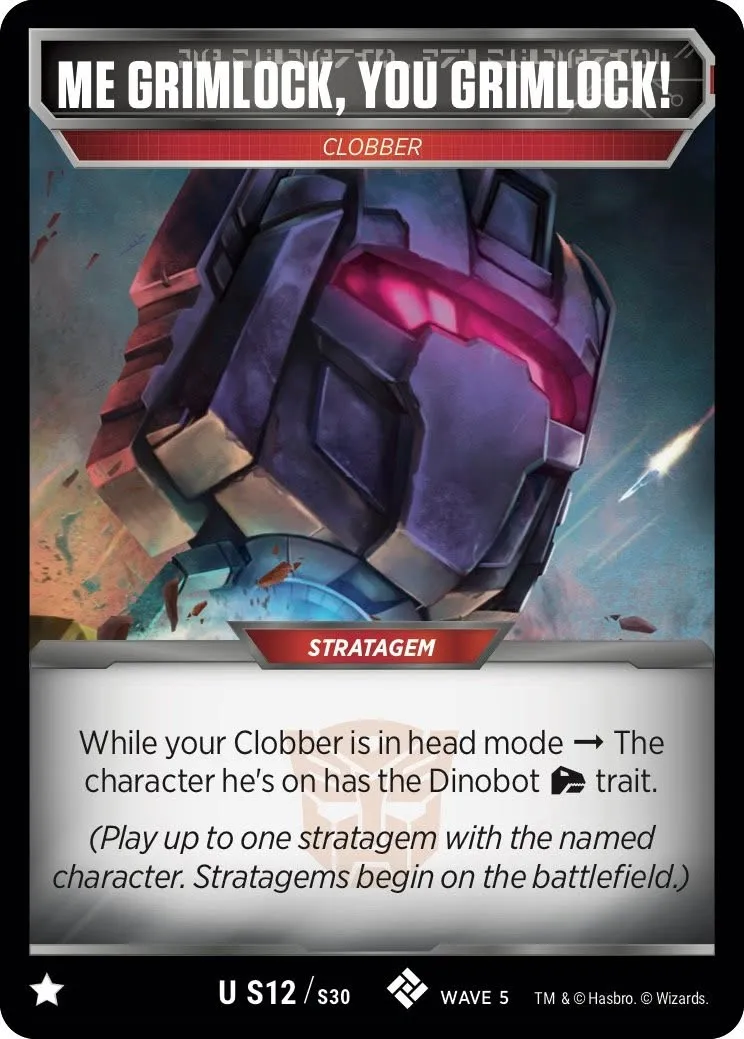
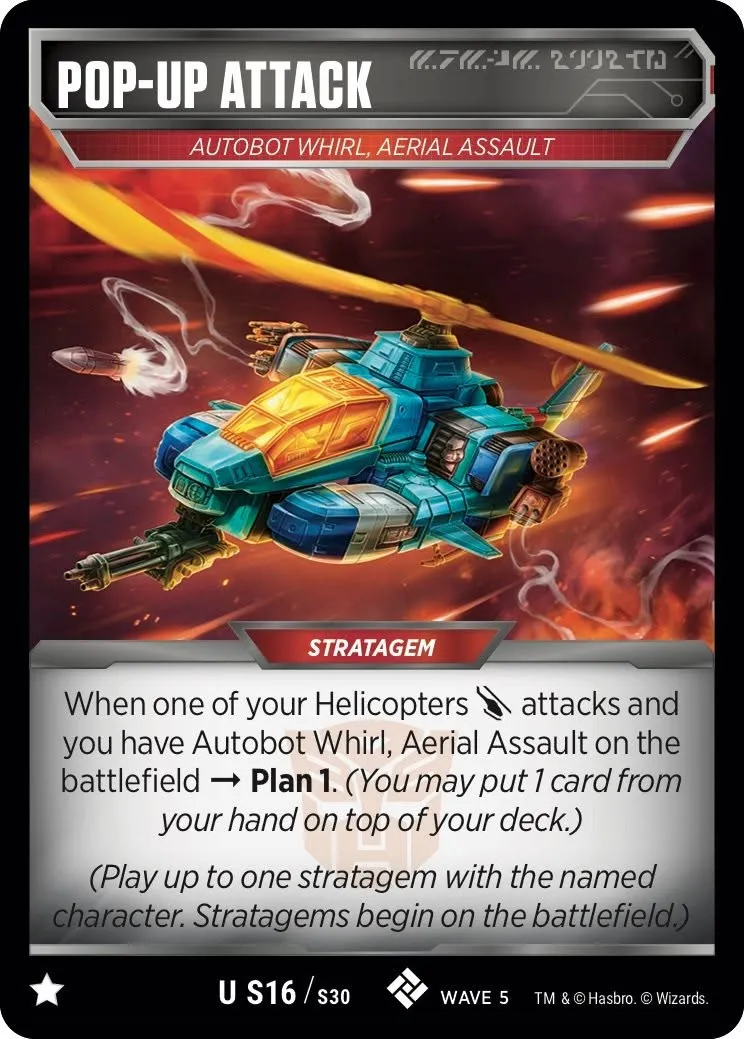
We were excited by this idea and pursued it for a little bit, but in the end, we found that being in only half the packs blunted the impact to the point that we felt we could do something better.
I wouldn’t be me if I didn’t tell you about our really crazy idea <REDACTED>. You see <THIS INFORMATION REMOVED TO PROTECT THE MINDS OF PUNY HUMANS> but we found <NOTHING TO SEE HERE, GO ABOUT YOUR ABYSMALLY DULL LIVES>*
We felt like whatever went in this slot should be different from normal battle cards to justify them being separated from the packet of battle cards. We also knew that they would show up at relatively low rates (less frequently than a rare battle card) and didn’t want it to be something that people wanted to collect multiples of. This led us to the idea of cards that start outside of your deck, so you only need one.
We considered locations as a concept and had what I sometimes call an “opposite problem”. Locations were too versatile and exciting of a concept space. There was too much going on in the set to properly execute on them (often, the hardest part of design is what you pull out of a file, not what you put in), so we tucked that idea safely away into our bag of “cool ideas we haven’t found a place for”. A gift to “future us”.
The next thing we pulled out of the hopper was something we’ve played within some of our other games, the idea of a “signature move”. This is a special ability tied to a single character. It’s a great fit for the Transformers TCG because we’re a character-based IP, and the concept is very cinematic. Originally all of the cards were single-use effects. They play well within the tempo of our game, and our costing system and starting team setup means that they were better outside of the deck. Large single-use effects are not the kind of thing you want to have in the deck since they are too swingy. We don’t want games to come down to “did I draw Optimus Prime’s Epic Punch?”. Instead, these cards act more like optional power-ups for characters and teams, which gave us lots of exciting options to work with both characters in the set and some from the past. Once we got deep into design, Signature Moves became Stratagems, a more versatile name that works with broader concepts, and we relaxed our restrictions to allow more variations in their form, but they remained true to their core idea.
If we hadn’t used them in Titan Masters Attack, Stratagems would have remained in the “bag of cool ideas we haven’t found a place for”. This isn’t a story about how a cool idea just barely made it into the game, it’s a story about how great ideas are like puzzle pieces. The most important part is finding the right fit.
I hope you are all staying safe out there and enjoying smashing metal at an appropriate social distance.
*Today’s guest editor: Starscream