

The End of Allied Crossplay
Part of: History of the Transformers TCG
During billmoo’s absence from active leadership, Team Bayformers continued operating within Allied Crossplay while Z-R0E assumed responsibility for the partnership’s wider direction. When billmoo returned to active leadership of Team Bayformers in the summer of 2023, he resumed substantial work in design, production, artwork, and promotion, and he argued that responsibility on that scale should carry meaningful influence over the decisions affecting it, while day-to-day leadership stayed with Z-R0E. Z-R0E told him that a majority of the project’s managers opposed giving him any formal decision-making role beyond his existing position, citing interpersonal tensions and criticism of the previous leadership period. The result was a mismatch between responsibility and authority: Team Bayformers remained one of the partnership’s major contributors while having little ability to influence the governance, development standards, or long-term stewardship surrounding its contributions.
That mismatch shaped everything that followed, as disagreements emerged over replacement cards, release development, public testing, and the long-term stewardship of the shared card pool, and Team Bayformers had no standing to resolve any of them.
The Wave 0 Dispute
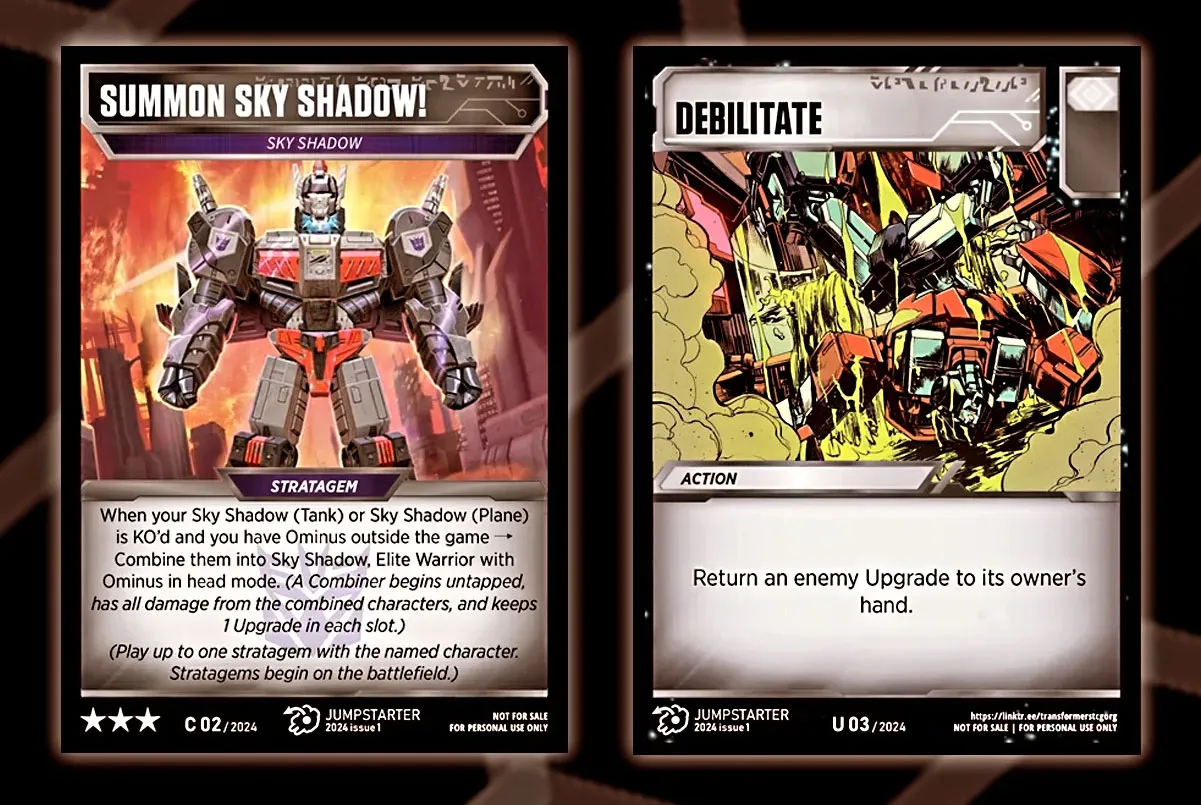
The first of those disagreements concerned replacement cards. Z-R0E had introduced “Wave 0” as a temporary holding space for replacements created outside the normal Wave cycle, with those cards eventually moving into permanent mainline releases. billmoo argued instead that replacement cards should stay together in a persistent, cumulatively updated product, giving returning players one stable place to bring an older collection up to date. The difference was between treating Wave 0 as part of the development pipeline and treating it as a permanent player-facing resource. Team Bayformers later implemented the persistent model as the Jumpstarter Update Booster.
The Wave 0 question was small in itself. It mattered because it showed that the two leaders already held different ideas of what long-term stewardship should look like, and a larger disagreement was developing around “Ark Exodus.”
“Ark Exodus” and Development Standards
“Ark Exodus” was The Ark’s rework of its first fan release, 2020’s “Ark Wave One,” into the balance and power levels of the Wave 4+ environment Allied Crossplay had followed for three years. By the time of the leadership transition it was already severely delayed. The Ark’s internal approval process repeatedly failed to move designs forward at a pace that let the wider Allied Crossplay team iterate, and further work often depended on those approvals, so inactivity inside one partner group could stall material intended for an active player base.
Long development was itself consistent with Allied Crossplay’s philosophy. World|Strike and Waste|Lands had both spent long periods in development while continuing through testing, revision, and active participation. “Ark Exodus” increasingly lacked that sustained movement.
By July 2023, Z-R0E was openly describing the development team as exhausted by “Ark Exodus” and eager to see completed work reach players. He argued that publishing finished portions sooner, while unresolved designs continued development elsewhere, could restore both community excitement and developer enthusiasm, and he described the prolonged lack of visible output as a major source of the team’s declining energy.
billmoo shared the view that large, self-contained Ark development cycles had become unsustainable. Before the leadership transition he had considered folding the smaller “Ark Exodus” release into another similarly sized release in development, “Hostile Airspace.” Later that summer, he supported spreading the remaining Ark material across future Waves and discussed the idea directly with Z-R0E. Both saw the same benefits: fewer production bottlenecks, greater ownership for active designers, better branding and marketing, and an end to Ark-only development repeatedly stalling the wider card pool.
The two therefore agreed that the Ark-only pipeline had to end. The disagreement was about the remedy, and the two remedies addressed different problems. The structural problem was that one subgroup held approval authority over shared material and could no longer exercise it at a sustainable pace, and nothing in the partnership allowed anyone else to take that material over. Publishing finished portions sooner answered the lack of visible output and the developers’ frustration. It left the approval structure that produced the delay untouched. billmoo regarded that structure as the primary cause of developer exhaustion and opposed answering it by compressing the testing and release discipline applied to the resulting cards, the lengthy cycles and Wave 4+ balance standard that had guided Allied Crossplay since its founding.
Public Beta was where the difference in development philosophy became clearest. Under the earlier Allied Crossplay model, Public Beta remained part of active development. Individual cards could still undergo substantial revision, return to internal testing, or be delayed while other parts of the release continued moving forward. The process was deliberately asymmetrical: a serious problem with one design did not require the entire Wave to stop progressing. Public testing therefore remained capable of identifying problems serious enough to change the design itself, and the wider player base was treated as a meaningful source of design insight.
By the time of “Ark Exodus,” leadership was describing Public Beta more narrowly. The release entered Public Beta at the start of September 2023 and released on October 26, less than eight weeks later. Announcing the Beta on September 1, Z-R0E wrote publicly on transformers.cards that the team felt “very confident in its development” and that:
Beta means we’re done making any big changes to these cards, and the most we’ll likely do is a +-1 here and there.
The same announcement invited feedback through a form and opened signups for a tournament meant to help test the release. Players were being asked to test cards whose major design decisions leadership had already described as settled.
The difference concerned more than the length of the testing window. It changed what kinds of findings the process was prepared to act on. Earlier Public Betas remained capable of sending individual designs back into substantial development; under the “Ark Exodus” model, major design decisions were treated as largely complete before public testing began. This narrower conception of Public Beta developed alongside changes inside Allied Crossplay’s private design spaces, where candid criticism was becoming more restricted and decision-making more concentrated among a smaller group of designers.
Duration reinforced that difference. World|Strike had remained in Public Beta for roughly three months, and Waste|Lands for roughly twelve after about six months of Pre-Alpha and Alpha development. The next transformers.cards release later spent substantially longer in Public Beta than “Ark Exodus,” from November 1, 2024, to March 25, 2025, or 144 days: roughly the three to four months World|Strike had, and far shorter than Waste|Lands. The more consequential change was the scope of revision Public Beta was expected to permit.
For billmoo, the central concern was therefore the role assigned to Public Beta itself. Earlier testing had been able to send individual designs back into development. “Ark Exodus” entered public testing as a stage for confirmation and numerical tuning of material that internal design circles had already signed off on as complete.
The Beast Wars Flashpoint
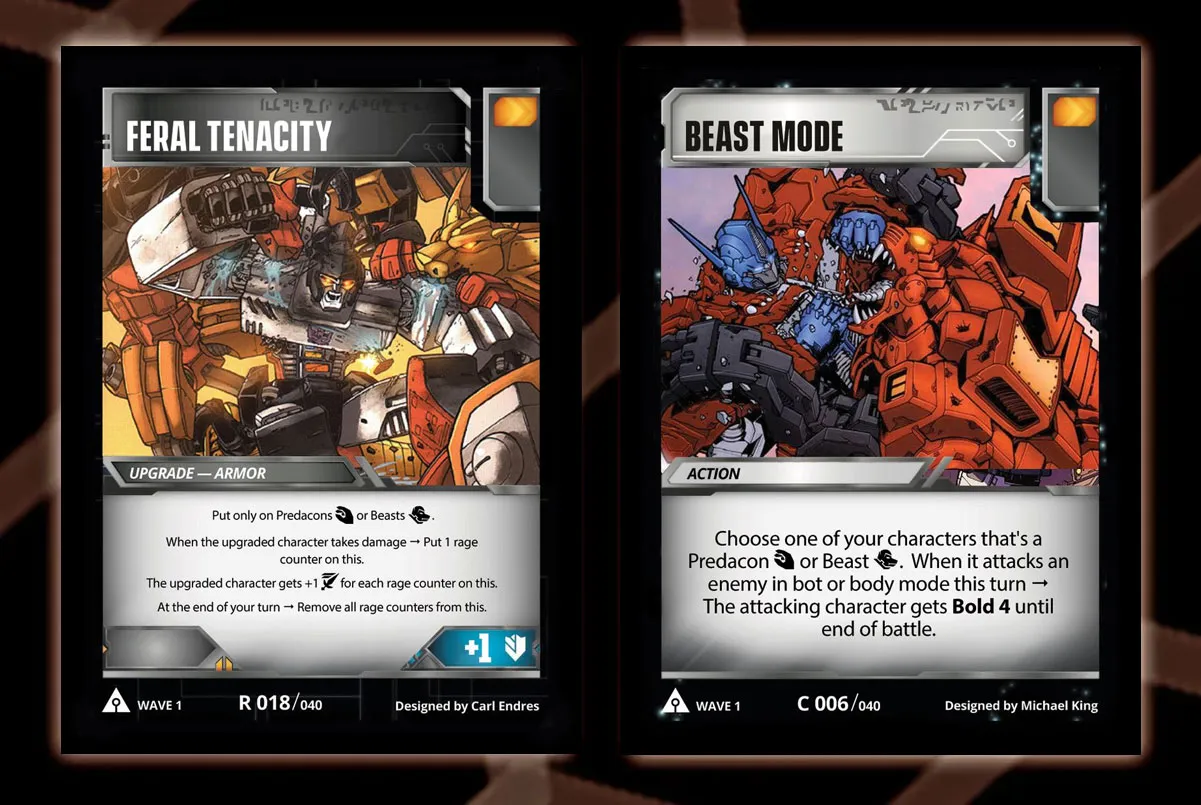
Within that already strained “Ark Exodus” development cycle, two Beast support cards brought the broader disagreement into focus. The rework produced “Beast Mode” and “Feral Tenacity,” two particularly powerful Beast cards, at a time when plans already existed for a future Beast Wars-centered Wave built substantially around the Beast trait.
Several designers, including billmoo, argued that both cards were already approaching the practical power ceiling for Beast support. If some of the strongest available Beast designs were released more than a year before the dedicated Beast Wars Wave, considerably less design space would remain when that release entered development. Many Allied Crossplay designers did not share the same level of concern and prioritized completing the release in front of them. The disagreement therefore extended beyond the power level of two cards to the time horizon designers were expected to protect: Team Bayformers treated future design space as a present development constraint, while others weighed the cards against the current release alone.
That distinction became consequential almost immediately. billmoo raised the concern during Public Beta, his first opportunity to do so: he had stepped down before the closed Alpha ended and had not been part of active discussions that considered the two cards ported from “Ark Wave One”. His objection concerned the cards’ power level and the timing of releasing strong Beast support long before a Beast Wars Wave, and his proposal was to move both cards into that future Wave, where they would give the release focus rather than consume its design space in advance. That is exactly the kind of substantial reconsideration the earlier Public Beta model had allowed, and a different category of change from a +1 or -1. By the model Z-R0E had described publicly, however, that kind of feedback was arriving in a phase where major changes were already considered finished. By billmoo’s account, Z-R0E and several designers received the objection as an obstruction to a release already in motion, and as evidence that he had not handed over leadership gracefully, rather than as design feedback from a long-tenured peer. billmoo later received private messages from other testers describing similar experiences: they had held back feedback on beta cards because the design team appeared to have made up its mind and wanted to move on.
For billmoo and Team Bayformers, the dispute crystallized the question that had been building throughout 2023: how much future design space should be protected when evaluating cards intended for the current environment? Preserving that space and maintaining long-term balance had been central to the Wave 4+ philosophy, and they believed immediate release pressure was beginning to outweigh the sustainability of releases still years away. The continuing game, in their view, required designers to weigh a card’s consequences well beyond the release in which it first appeared.
The Wave BFC Restart and the Split
The Beast Wars dispute became one of the catalysts for Team Bayformers restarting a shelved prospective release, internally known as Wave BFC, as an independent project outside the shared Allied Crossplay development process. With Team Bayformers again producing substantial development work but holding no authority over Allied Crossplay’s direction, a separate project was the only place it could apply the testing, balance, and long-term design standards it wanted to preserve without needing approval from a structure that had declined to give it a formal voice. Team Bayformers announced the restart on November 23, 2023, having already established a separate private Discord for Wave BFC development.
The move prompted a secret vote among Allied Crossplay designers and Z-R0E over how to respond. Neither billmoo nor anyone else on Team Bayformers knew the vote was taking place. Following it, billmoo was removed from the Transformers TCG Community Discord; he discovered the removal one morning when he could no longer reach the server, with no message from anyone explaining what had happened. He then withdrew Team Bayformers from the Allied Crossplay partnership and moved its remaining operations into the newer Discord. With one of its two founding organizations gone, Allied Crossplay ceased operating in December 2023.
Structural Failures
The collapse of Allied Crossplay reflected more than the disputes of late 2023. The partnership’s original structure carried failures of its own, including choices made during billmoo’s leadership, and it depended on active central leadership to compensate for rules and responsibilities that had never been formalized. When participation declined and leadership changed abruptly, the informal mechanisms that had kept the partnership working stopped being enough.
Partnership durability. The partnership between Team Bayformers and The Ark had been formed without clear requirements for continued participation, approval turnaround, transfer of responsibility, or stewardship of a partner’s cards if that partner could no longer maintain them. The arrangement worked while both groups were active. As prominent Ark members gradually left the game, approvals slowed dramatically, and Allied Crossplay had no mechanism for taking over stalled material or keeping one subgroup’s inactivity from delaying the wider pipeline.
Leadership succession. billmoo had told Allied Crossplay’s inner circle as early as the fall of 2022 that he intended to step back from leadership eventually, and had begun preparing others within that circle for greater responsibility. Sudden personal circumstances in February 2023 forced that transition far faster than planned, handing Z-R0E an increasingly complicated organization in the middle of a difficult development period, before the preparation was complete. The transition’s fragility came from circumstance accelerating a succession that was still incomplete, and from that succession not having been planned with more urgency in the first place.
Broad design access. Allied Crossplay’s development chambers were unusually open. Members aligned with its partner groups could gain Pre-Alpha and Alpha access despite wide differences in experience, contribution, balance philosophy, design philosophy, and familiarity with the shared card pool. That breadth increased collaboration, and it placed heavy demands on central leadership to maintain consistency, resolve disagreements, control power level, and keep projects moving. In retrospect, a smaller structure built around active contributors, clearer responsibilities, and more carefully limited access would likely have reduced many of the conflicts that later became difficult to manage.
Feedback culture and internal consolidation. Under billmoo’s leadership, Allied Crossplay’s design rooms had placed unusual emphasis on candid internal discussion. The #swerves-bar channel became the center of that culture: a space where designers could criticize active work frankly, discuss difficult community behavior, and occasionally vent frustrations from a fragmented and often factional fan scene. That openness had weaknesses of its own. The rooms were still broad, participants had very different levels of design experience, collaborative discipline, and comfort with direct criticism, and some discussions became more personal than intended in a room meant for experienced peers working through hard design problems. Toward the end of his leadership, billmoo had begun introducing participation ranks that would gradually reduce the number of people with access to spaces such as #swerves-bar, keeping candid iteration while placing it among contributors with more experience and responsibility. That transition was still incomplete when leadership passed to Z-R0E.
By the time billmoo returned, the internal culture had changed considerably. #swerves-bar was being phased out and renamed to the less thematic #design-table, and placed under rules that more strongly restricted negative discussion, including criticism of active card work. A smaller inner design circle had formed around Z-R0E and the designers most closely involved with current releases. The move toward a smaller design group therefore continued a direction that had begun under billmoo; what changed were the norms inside it. billmoo came to believe that the greater emphasis on positivity and the concentration of design discussion within a smaller circle made candid criticism harder to surface, at the same time that Public Beta was becoming more constrained as a venue for major revision.
Rotating ownership. Successive Waves were centered on different subgroups: The Ark led “Ark Exodus,” and another subgroup was expected to lead the Wave after it. Designers sympathetic to the earlier approach later told billmoo that this rotation had shaped how the late-2023 disputes played out. According to those accounts, completing one Wave meant the next subgroup could take its turn in the spotlight, which created pressure to move on rather than keep refining another group’s release. They also described a structure in which the reputational cost of unresolved problems would fall most heavily on the subgroup identified with the release, while the next group could distinguish itself through stronger execution. billmoo came to view this as evidence that subgroup incentives were beginning to compete with the earlier communal emphasis on the success of the shared card pool.
No single flaw ended Allied Crossplay. Together, these failures left the partnership poorly equipped to absorb declining participation, an incomplete leadership succession, release bottlenecks, differing design philosophies, a feedback culture that had grown less receptive to candid criticism, incentives that had drifted from the shared pool toward individual subgroups, and disagreement about the future of the shared game.
Avoiding a repeat of those failures, including mistakes billmoo made during his own leadership of Allied Crossplay, became a founding goal of transformerstcg.org, and each failure above has a rule that answers it:
- Partnerships gain shared access gradually, as a partner demonstrates sustained activity and durability over time, rather than receiving it on formation.
- Private development access is limited to an architect-and-apprenticeship model in place of open development chambers, with serious internal critique expected as part of the work.
- Privileges and responsibilities, including leadership and game-direction roles, expand in proportion to what a contributor has already demonstrated for the community; nobody moves directly into them.
- Privileged design and event access is separated from competitive advancement by the competitive lockouts set out in the Guidance on Ideal 1.
What the Breakdown Exposed
Allied Crossplay did not end over a single card, release, vote, or personality conflict. By late 2023 several unresolved structural problems had converged. A partner group retained approval authority over shared material with no requirement of active stewardship. A major contributor carried substantial responsibility with no corresponding authority. Development access was broad while accountability for it was uneven. Leadership succession rested on informal relationships inside one circle. And disagreements over testing standards and long-term stewardship had no agreed way to be resolved; when one arrived, the response was a vote held in secret from the partner it concerned.
The dispute over “Beast Mode” and “Feral Tenacity” made the differences visible. The Wave BFC restart forced the governance question. The vote and billmoo’s removal ended the remaining basis for Team Bayformers to operate inside the partnership.
What Came Next
transformerstcg.org formed from the Team Bayformers lineage in December 2023.
The independently restarted Wave BFC continued development outside Allied Crossplay and became Org Wave 9: War|Void, which entered Public Beta on December 23, 2024.
The private Team Bayformers Discord created for that development became the new organization’s operational center. On July 1, 2024, it opened to the public as the transformerstcg.org Discord.
What began as responses to the Allied Crossplay split became the foundations of the organization that followed. See History of the Transformers TCG for the wider chronology before and after the end of Allied Crossplay.