

How to Play Secret Actions
Part of: How to Play the Transformers TCG
A Secret Action is a type of Action card you play face down. Your opponent can see that you played something and cannot see what. It stays face down until its own text tells you that you may reveal it, and that moment is usually during your opponent’s turn.
That is what the card type is for. Secret Actions are one of the game’s main ways to set up a defense that fires on your opponent’s turn, once you can see what the attack actually is.
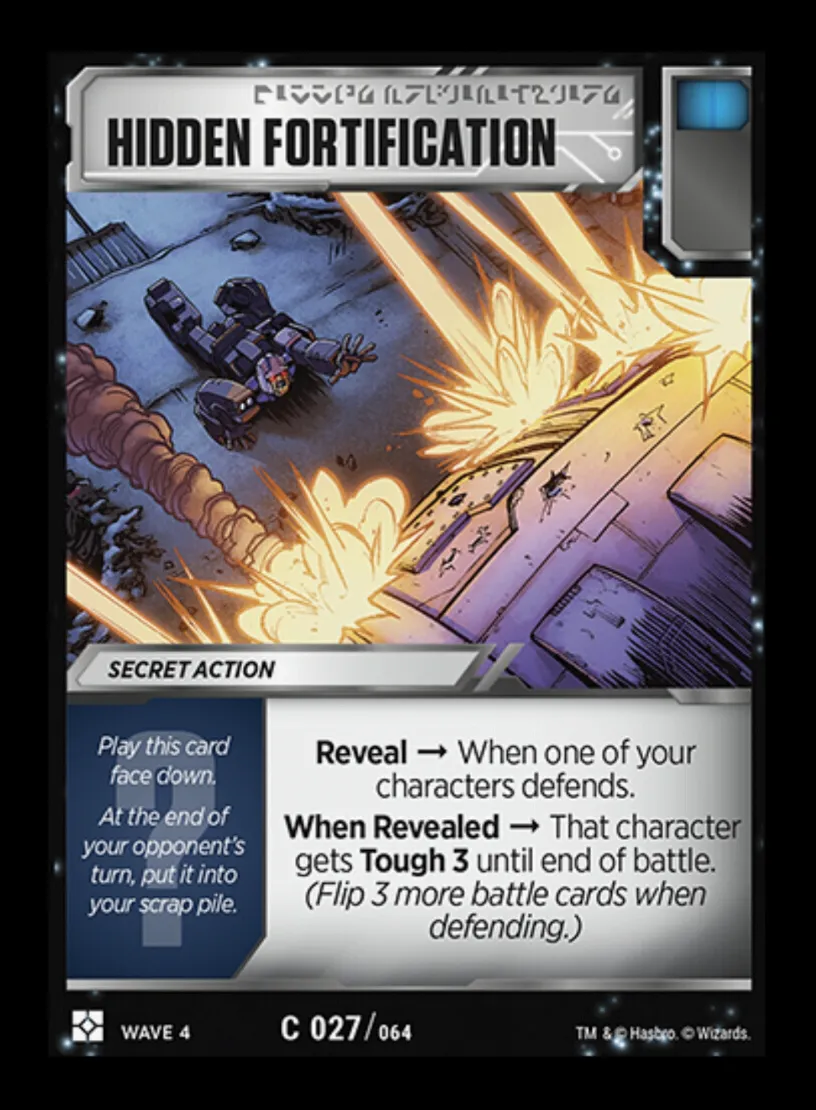
Hidden Fortification is the card most players picture. You spend an Action on a quiet turn to put it face down, it sits there looking like nothing, and when your opponent commits to an attack the defender gets Tough 3 and flips three extra battle cards they had no way to plan around. It is a Wave 4 common, reprinted in the 2024 Goodies Starter Deck, so it is often the first one a new player owns.
The effects reach past defense from there. Dampening Field caps how many battle cards your opponent may flip in a battle, Overheat stops their ⬛️ icons giving Pierce and their 🟧 icons adding Attack, and Backfire does damage straight back to the attacker.
This page collects everything a Secret Action does, in the order you will meet it in a game. For the full turn sequence around it, see our complete rules.
Playing a Secret Action
Play a Secret Action during your turn, face down, into your played area: the space in front of you where played Actions and flipped battle cards sit until they are scrapped. Face down is the only way a Secret Action is ever played, whatever put it there.
Three things follow from playing it face down.
- It uses your Action for the turn. A Secret Action is an Action, and you play one Action per turn. Putting one face down means you are not also playing a face-up Action this turn.
- It counts as playing a card with no icons. Nothing can read the battle icons printed on a face-down card, so an effect that cares about the icons on the Action you just played sees none of them.
- The opening restrictions still apply. The player going first plays no cards at all on the first turn of the game, and the other player plays either an Action or an Upgrade on the second turn. A face-down Action is still a card played.
Revealing a Secret Action
Every Secret Action carries a Reveal line, and that line is the only thing that turns the card face up. Most of them wait on something your opponent does: an attack against you, or an Action they play.
Revealing is optional, and the window closes. Our tournament rules carry the rule: “Revealing Secret Actions while they are in play is optional. If additional game actions occur after the event that would have revealed the Secret Action, the player whose Secret Action it is will be considered to have elected not to reveal it.” Once play has moved past the trigger you have declined, and the card stays face down for a later one. The same section asks for the matching courtesy: a player with a Secret Action in play “should be given a reasonable amount of time to reveal it.” Wizards of the Coast arrived at this in a June 2019 roundup, reversing an earlier answer that had made revealing mandatory.
Revealing is not playing a card. You played the card when you put it face down, so the reveal costs you nothing and does not use an Action. A character whose ability triggers when you play an Action triggers at that moment and not again on the reveal. The Wave 4 FAQ puts it plainly: “if they end up revealing a Secret Action during their turn, that’s not playing a card.”
The counter cards interrupt the Action rather than follow it. Infiltrate, Jam Signals, Overrule and Speed Trap were printed as “Reveal -> When your opponent plays an Action,” which left it unclear how the inactive player could get ahead of the active player’s play. All four are errata’d to “Reveal -> As your opponent plays an Action.” The errata list carries the full wording.
The effect happens when the card is revealed, and does not depend on the card staying where it is. The Aequitas committee answered this one in September 2020, with Intrusion Countermeasures Software against Counterespionage: the Secret Action resolves on reveal, “and does not depend on whether the card remains in play or not.”
Attacker effects resolve before defender effects. If your revealed Secret Action and your attacker’s own cards both want to act at the same moment, the attacking player’s effects go first. A Sabotaged Armaments revealed against a Sturdy Javelin does not get to scrap the Javelin before its owner uses it, as a November 2019 roundup settled.
When It Reaches Your Scrap Pile
A Secret Action does not go to your scrap pile at the end of the turn you played it. It stays in your played area through your opponent’s turn, which is what gives it something to react to, and it is scrapped at the end of that turn. If it was never revealed, it goes to the scrap pile face up and has no effect.
Revealing it does not change that timing. Asked whether a Secret Action triggered on the opponent’s turn goes straight to the scrap pile, Wizards of the Coast answered that it stays in the played area and scraps at the end of that turn like everything else.
At the end of the game, both players reveal any Secret Actions still face down.
Playing More Than One
You get one Action per turn, so one Secret Action per turn, unless a card gives you another play. Special Ops Mission and characters that grant extra Action plays both qualify, and Wizards of the Coast confirmed that an extra play may be spent on a Secret Action.
Two face-down copies of the same card are two separate cards, and you choose how many to reveal. With two copies of Infiltrate face down, revealing one and leaving the other for later is legal, and usually better than revealing both.
Cards That Care About Secret Actions
Some cards keep a Secret Action waiting longer than the timing above allows, because one you never got to reveal is an Action you spent for nothing.
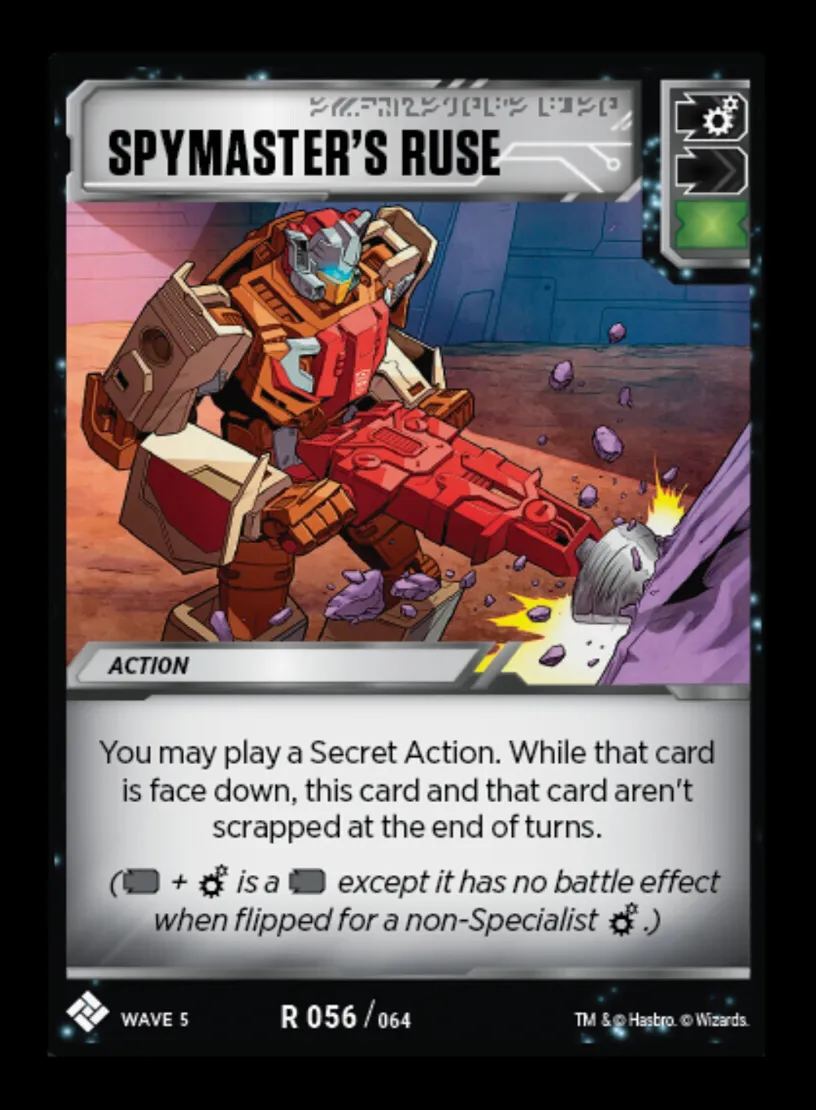
- Spymaster’s Ruse, an Action from Wave 5: Titan Masters Attack, plays a Secret Action for you. While that card is face down, neither it nor the Ruse is scrapped at the end of turns, so the trap can sit there as long as you need.
- Sitrep Update, a Utility from Wave 8: Waste|Lands, scraps itself in place of a face-down Secret Action that was about to be scrapped. The Secret Action stays where it is, still hidden.
- Extended Duration Mission, a Rolling Action from the same wave, works on one you did reveal. Scrap it when a Secret Action is revealed while you defend, and at end of battle that Secret Action is scrapped and played again, face down as always.
Other cards point the other way, and this is the cost of playing face down that is easy to miss. Your opponent cannot see what the card is, but they can see that it is there.
- Decipher, an Action from Wave 4, does 1 damage to each enemy for each enemy Secret Action in the played area, face up or face down.
- Counterespionage, an Action from Wave 5, names an Action, looks at your hand and at each of your face-down Secret Actions, and scraps every copy of the named card it finds. A Secret Action taken that way never reveals and never does anything. It is also the card the Intrusion Countermeasures Software ruling above was answering.
- The Dweller Awakens, a Secret Action from Wave 6: World|Strike, answers that in kind. It reveals “when your opponent plays an Action that reveals or triggers a Secret Action,” and then does 1 damage to each enemy or 2 damage to one.
Where to Find Them
Secret Actions arrived with Wave 3: War for Cybertron: Siege in 2019, which printed eight of them: Battlefield Report, Bolster, Dampening Field, Defensive Formation, Hiding Spot, Infiltrate, Scavenge the Battlefield and Take Cover. Wave 4 printed twelve more, Jam Signals and Sabotaged Armaments among them.
Every release since has carried the type: Wave 5: Titan Masters Attack, Wave 6: World|Strike, Org Wave 7: Monster Menagerie, Wave 8: Waste|Lands, Org Wave 9: War|Void and Org Wave 9V: Marvelous Heroes VS Rising Villains. Org Wave 9 alone carries twenty-one Secret Actions across its eighty-one battle cards, more than Waves 3 and 4 together, among them Opportune Shadow for Mercenary teams, The Darkest Hour for Herald teams, and Die Another Day, built as a homage to the fan card Despite Any Difficulty.