


This was originally posted on the transformerstcg.org Medium page.
November 24th, 2024 update: Since this article was published, the transformerstcg.org Team (the community successor to Team Bayformers) no longer recognizes either transformers.cards or its associated Discord, “Transformers TCG Community,” as community authorities to overall Transformers TCG balance due to their policies of exclusion and censorship. The decisions that transformers.cards makes are applicable to the .cards environment and that environment alone. Additionally, any edits transformers.cards independently makes to transformerstcg.org content such as Wave 6: World|Strike and Wave 8: Waste|Lands are made without our authorization, license, or participation, and may differ from content distributed in its intended and supported state by transformerstcg.org. The transformerstcg.org Team is currently working on constructing a balance council that includes tenured players from across the community, regardless of favored play style, guild, or in-group.
TL:DR; summary: A number of nerfs to Wave 6 and Wave 8 cards in the Transformers TCG have been proposed by transformers.cards. Here’s what Team Bayformers thinks about those proposals.
In 1985, a tragedy occurred. During our elementary school’s winter break, my friend — an F-1 race car fan — handed me a pristine G1 Mirage. It was box-fresh from his family’s Christmas openings. He shook with excitement, consumed by the simple fun of the transforming F-1 racer. He handed it to me, asking me to transform it into a robot. I had never played with the Autobot spy, and I dove in with glee.
Yet, after a couple of innocent and adventurous spins — SNAP! His Mirage broke in two in my hands. My friend ran out of the room in tears.
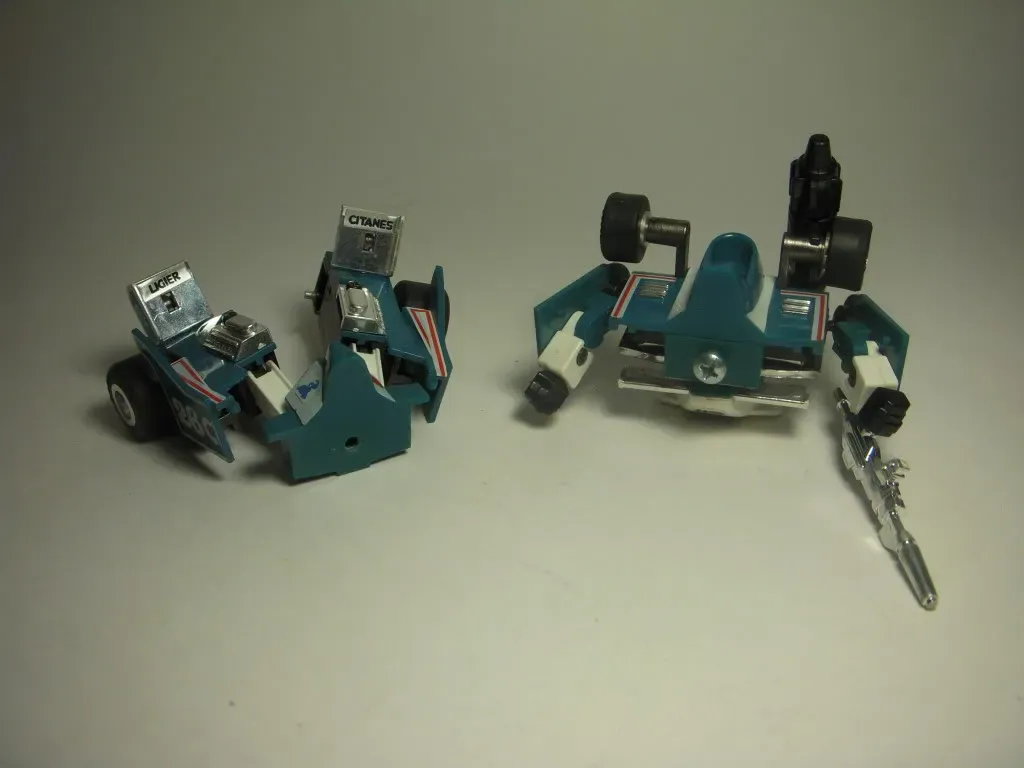
Years later, I discovered that the Mirage breakage is one of the most common of the G1 toy line. The original designers intended a specific step in the transformation before that critical waist twist — without it, snap! The younger me would have done better with instructions in hand.
However, it’s a valid argument that Mirage’s toy makers should have designed against the potential breakage. Clumsy children like my friend and I might have appreciated the additional design diligence. Regardless, the designer’s transformation intent was a critical factor in enjoying the Mirage experience. Enjoying Mirage, without… well, having your fun shattered.
This month, the Big Beta Bash event occurred. Along with the bot-flipping action came several proposed nerfs and adjustments to existing community cards. My trauma surrounding G1 Mirage surfaced while reading the proposed edits. The memory reminded me of how important designer intent is when adjusting a community game for balance.
Update 2024/3/4: References to “community design team” have been changed to “transformers.cards”.
Update 2024/4/3: Added details to Impetuous Stand and its creator Matafer’s obstructionism towards its nerfs and bans.
Update 2024/11/24: Added a notice at the top of the article describing transformers.cards and the “Transformers TCG Community” Discord losing its place of legitimacy in the Transformers TCG community.
Quick introductions
For fresh faces — hello! I’m [BF] billmoo, developer lead of Team Bayformers. We’re a team of Californian #transformerstcg players that have been with the game since Wave 1 in 2018. During the Hasbro/ WotC era of the game, Team players ranked in national events and tournaments.
In mid-2020, Hasbro/ WotC made the official decision to discontinue the Transformers TCG. Following this, Team Bayformers played a pivotal role in uniting like-minded creators to support the game through community-oriented initiatives. Those initiatives have resulted in over 350 cards to sustain the game. One community release, the Team’s Wave 8: Waste|Lands, is the largest Transformers TCG content release in history.
In 2024, the Team is planning its third release, code-named Wave BFC. BFC will continue the tradition of new gameplay features that began with Wave 6: World|Strike. We expect BFC will match or exceed the size of Wave 8 upon release.
Over four years, a balanced meta has emerged in a dynamic Transformers TCG gameplay scene. We’re delighted that our content is at the heart of that. It’s a far cry from gameplay after the debut of Wave 5: Titan Masters Attack. Many players perceived Wave 5 as rushed to release. In the Wave 5 meta, Sky Shadow, Horri-Bull, and Fangry decks powered out most legacy decks in the TCG. Promoting gameplay balance and diversity through design is a top priority for us. This remains true even as we develop fresh cards for the game.
We continue to be involved in physical and digital Transformers TCG events. If you’re an attendee of TFcon and enjoy playing the TCG, look for us!
The intended audience for this article
Fair warning — this is a mammoth article, and not one all players will enjoy or find useful. Read on if you’re one of these:
- You’re invested in a healthy community gameplay scene and want to see how proposed nerfs and edits to existing community cards may affect it.
- You enjoy getting a view of the minutiae of Transformers TCG game design in the current era of community gameplay.
- You’re a member of .cards.
If this doesn’t match your tastes — don’t worry! More content for players is coming soon that is more tailored to them. See the end of the article for previews and links.
The Team’s philosophy on nerfs
Before diving in, let’s define “nerf” and how it applies to the post-cancellation Transformers TCG. The Collins Dictionary has the definition we like the most:
to reduce the effectiveness of (a character, weapon, skill, etc) in order to achieve a greater competitive balance
During the game’s official lifespan, Hasbro/ WotC enjoyed, in a sense, a set of limitations on how they could respond to the power level of a released card. Since the pre-COVID-19 game was purely physical cards, there were fewer options to issue changes to gameplay. The design team used two responses to abusive cards:
- Ban abusive cards from Constructed play
- Create cards in future sets to combat abusive cards and strategies
Each approach had its pros and cons. Banning cards removed negative player experiences (NPEs) related to the banned cards from most types of play — but it also removed the distinct experience of playing that card. For counter cards, it gave opponents options against abusive cards and strategies — but counter cards weren’t always effective. Despite its apparent design intent as a silver bullet against Daring Escape decks, Private Turbo Board, Air Command • Evac did not defend against the most abusive competitive decks. Strong showings of Daring Escape decks in the 2019 competitive circuit (including the Energon Invitational) eventually led to Daring Escape’s ban by the community.
Post-cancellation, with the rise of community groups overseeing gameplay events, the options for nerfs have increased. The Transformers TCG has since grown into a digital and physical game. Digital platforms like OCTGN and Tabletop Simulator are now central for hundreds of games a month. With this wider distribution and a greater focus towards digital gameplay, the options for nerfs have also widened.
- Ban abusive cards from events
- Create cards in future sets to combat abusive cards and strategies
- Issue new versions of abusive cards, rendering the older versions obsolete and invalid for play in events
Team Bayformers uses and used each of these methods as a card creator, event organizer, and community lead.
- Besides continuing to use the original Hasbro/ WotC ban list, we added many abusive and overpowered cards from the original game to ban lists for events. Hasbro/ WotC cards like Sergeant Springer, Fusion Borer, and Mission Briefing are among a handful of official, banned cards. We were also not above banning community cards: Impetuous Stand remains the sole perennial community card in event ban lists.
- New cards in community sets act to counter abusive and overplayed strategies from the official waves. Cards like What Lies Beyond and Give Me Your Face counter Peace Through Tyranny and Titan Masters, as an example.
- New versions of community sets are primarily driven to further refine cards and issue nerfs. Cards like Turnabout Snare and Orbital Command received nerfs and edits in the latest version of World|Strike.
With these historical adjustments, it’s safe to say that the Team is pro-nerf — though not without standards in mind. Any proposed nerfs should lean upon the following ideals and standards:
- When a potentially abusive card or strategy appears, do not rush to ban or fix a card. First, gather opinions from players, testers, and other creators. Observe the card or strategy in question with collaboration and objectivity. Last, give players a fair chance to respond to that card or strategy in gameplay — their cleverness may inform steps forward.
- It’s informative to poll the original creator or originator as to the design intent of the card.
- Game balance should not belong to a single creator — rather, it should be collaborative, with equal voices chiming in to manifest the final nerf.
- A creator group bias is counterproductive to game design with an objective point of view. Look equally at all cards when looking to optimize — not just those you didn’t make.
- A process should be in place for feedback and proposals. This can help reduce noise, prioritize information, and increase proposal rigor. A Discord channel message or thread should never be the definitive form of a proposal to edit a community card. Something more structured is required.
Per that process, we have an article coming soon on a loose process the Team used while overseeing community play during Wave 6 through Wave 8. The process helped eliminate negative, design-adverse factors like bias, favoritism, tribalism, and snap judgments. Even in the best of times, those factors will be present in degrees in a community-driven, collaborative project — especially one that includes amateur creators without formal design rigor.
Rating the Big Beta Bash nerfs
We’ll be using an algorithmic, scientific method for rating the nerfs, driven by over 100,000 separate data points and a million trained hamsters — just kidding! It’s a tier system. Look for an averaged rating for the complete set of nerfs at the end of this article.
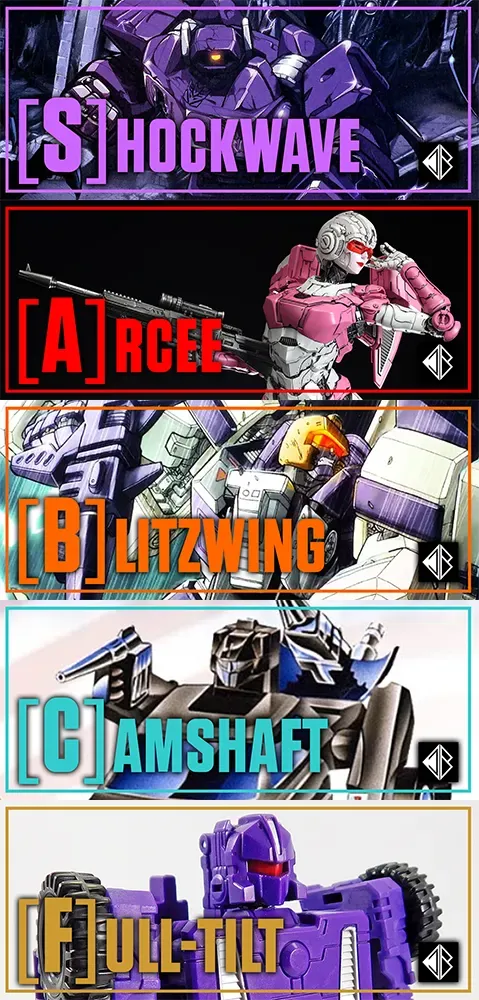
- S-tier: 4 points — A winning and thoroughly considered nerf; an ideal to follow for future proposals
- A-tier: 3 points — An otherwise ideal nerf that might have missed slightly
- B-tier: 2 points — A nerf with gaps or something not considered
- C-tier: 1 point — A good-natured nerf with serious problems
- F-tier: 0 points — Something foul; a nerf that is misguided, short-sighted, or has disregard for ideals, standards, or existing precedent
Summon Sky Shadow!
Summary of proposal
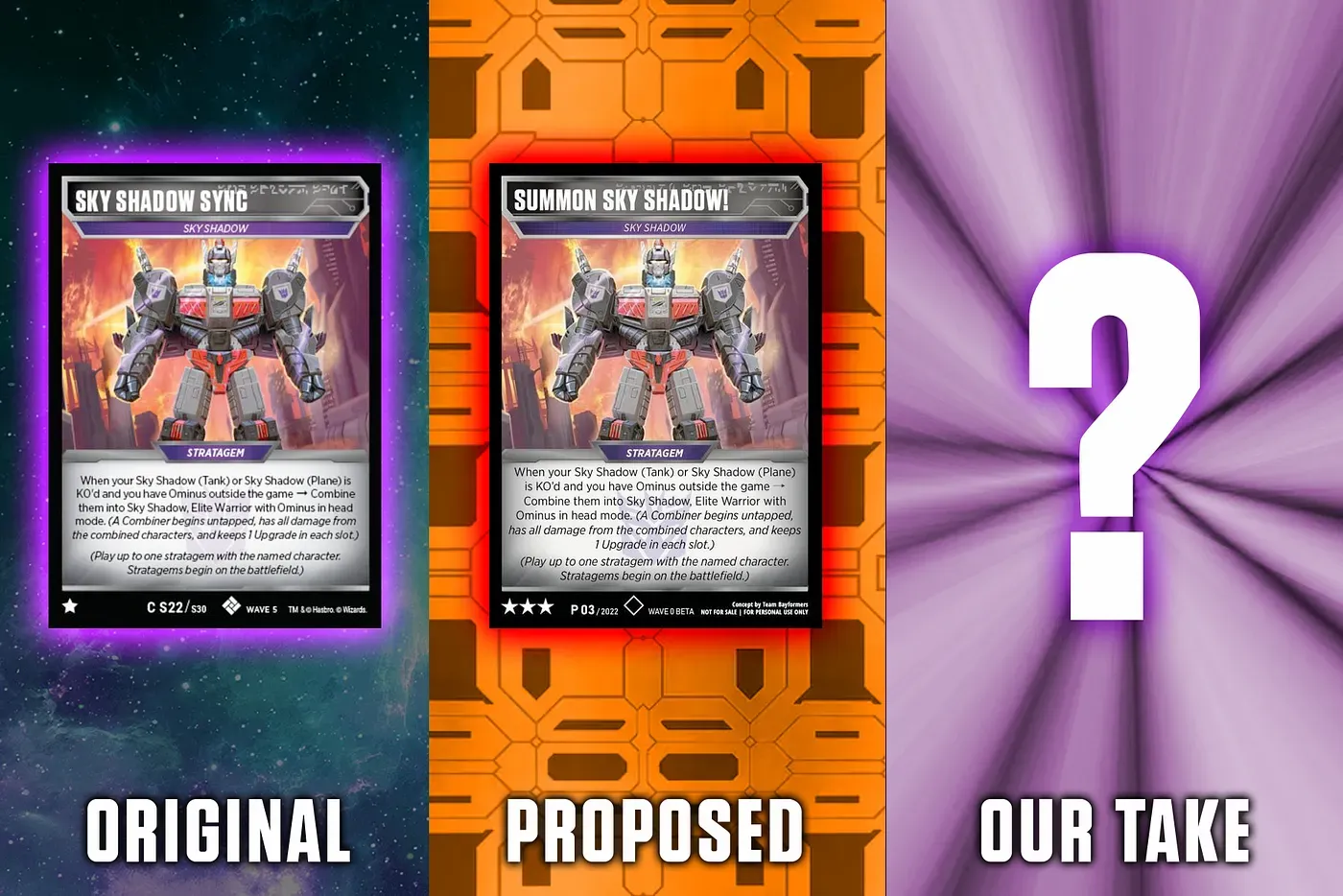
The proposed Summon Sky Shadow! is a replica of the banned Sky Shadow Sync — save an increased star count from 1 to 3.
History
When Wave 5: Titan Masters Attack released, players quickly paid attention to Sky Shadow, Elite Warrior, and they found its multiple health bars to be massively useful on the battlefield.
- Reducing either Sky Shadow (Plane) or Sky Shadow (Tank) to 0 health was the first hill an opponent had to climb.
- Next, the combined Sky Shadow applied its base Attack value of 8 and a powerful anti-Autobot combine trigger against the opponent’s team.
- Finally, if the combined Sky Shadow was KO’d, Ominus provided a final health bar and a base 2 of nearly guaranteed Pierce damage on attack.
All of this led to Sky Shadow becoming the foundation of a majority of decks in the Wave 5 meta. Ask any Wave 5 player their impressions of decks named SkyCeptor and SkyBull — their replies may include:
“That deck beat my poor Wave 4 deck.”
And, perhaps, worse:
“I played that deck! I also played against it a lot.”
Truly, the game came closer to becoming solved than ever before. Thus, as the game settled into community organized play, one of the first cards to be banned from events was the massively overplayed Sky Shadow Sync. Though the banning of SSS had an immediate effect on gameplay diversity in the community, losing a character is never ideal.
Design intent
First, the description for Oppress, a keyword which made its debut in Wave 8: Waste|Lands:
Oppress X (While this is battling, reduce ALL characters’ Bold and Tough totals by X this battle.)
With mechanics such as Oppress debuting in community waves, creators started a discussion: what would it take to bring Sky Shadow back into event play? An answer we sought to test: an exact replacement for Sky Shadow Sync — save its star count. An increased star count would not only better match Sky Shadow’s effective health and abilities, but it would also remove other powerful Titan Master body characters for selection from a Sky Shadow team. Combined with bans of health heads and Horri-Bull, decks such as SkyCeptor and SkyBull would be impossibilities in event play with a released Summon Sky Shadow!.
Our take
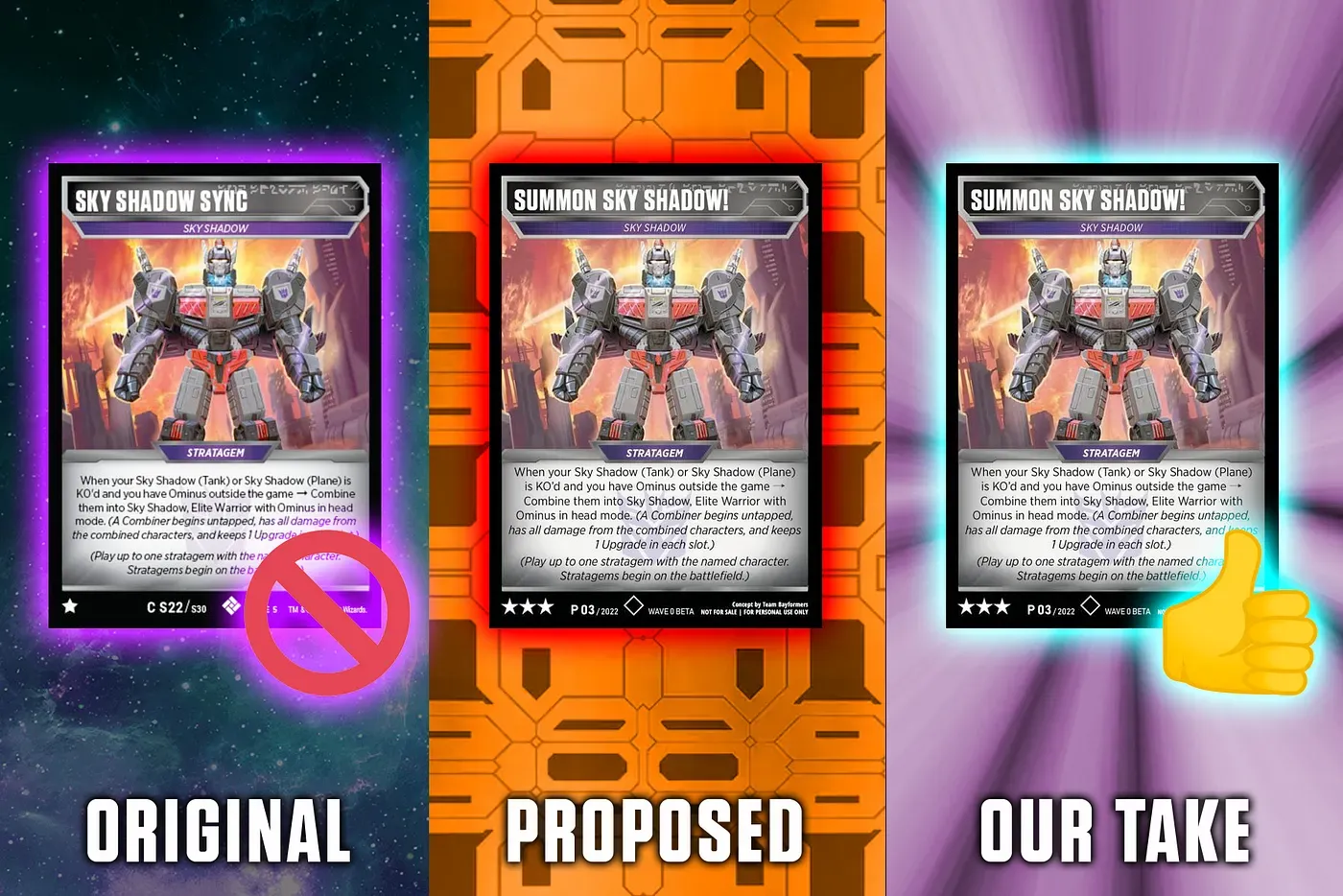
We’re excited about Summon Sky Shadow! This nerf is easy to rate, since it was our original proposal to fix the banned Sky Shadow Sync and bring Sky Shadow, Elite Warrior back into play. Assuming the new SSS passes tests, we look forward to being afraid of Sky Shadow decks again in a whole new, more balanced context.
In conclusion
The Team rates Summon Sky Shadow! in replacing the currently banned Sky Shadow Sync an S.
Allicon Eyuk, Bog Scavenger
Summary of proposal
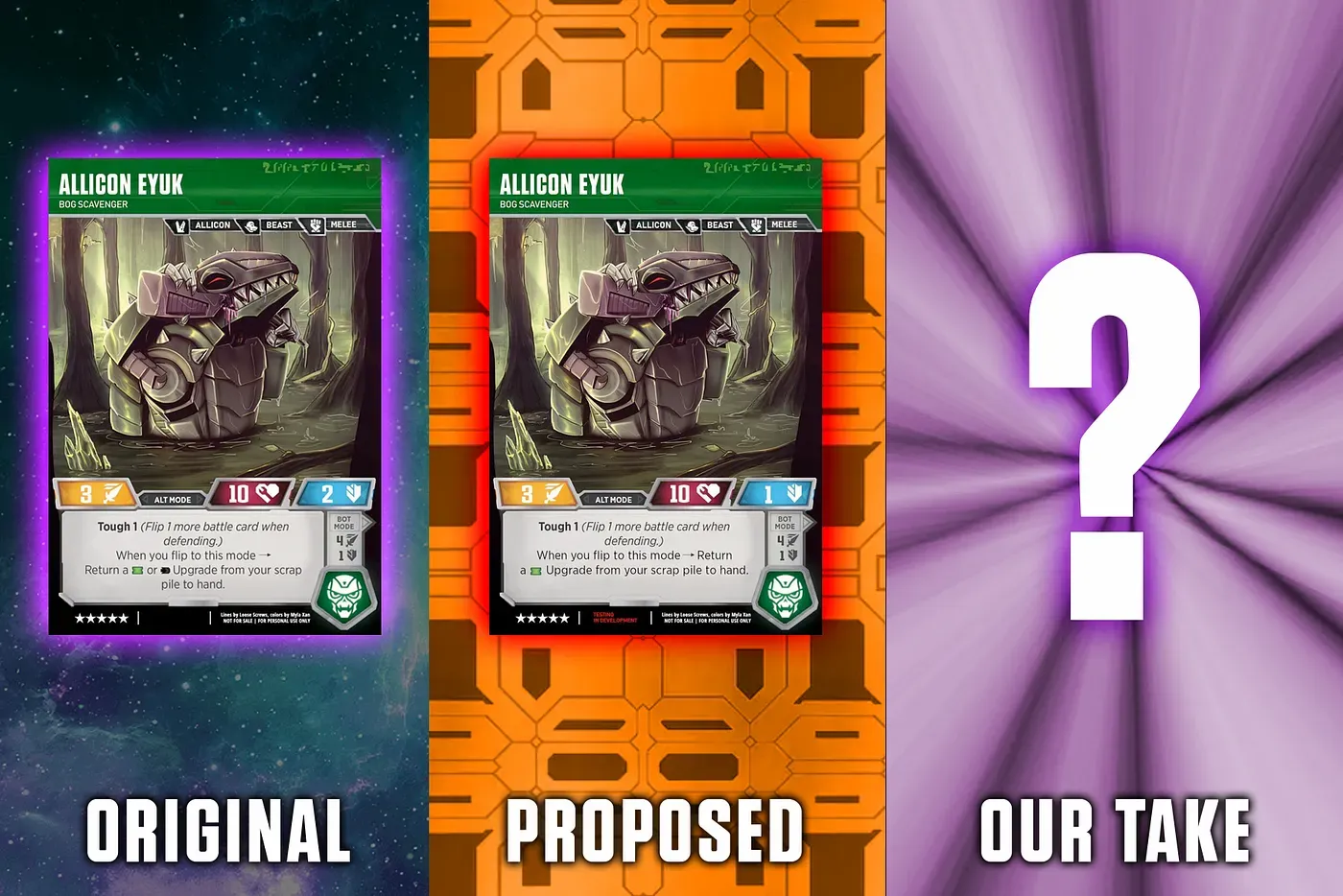
transformers.cards has proposed to reduce Allicon Eyuk, Bog Scavenger’s alt mode’s Defense from 2 to 1. They also propose to limit Eyuk’s Upgrade recursion ability to green Upgrades only, as opposed to black and green Upgrades from the original Eyuk’s abilities.
History
Allicon Eyuk, Bog Scavenger in its current form would not exist were it not for the debut of Wreck-Gar, Junkion Leader in the fan group Ark’s fan set “Wave One”.
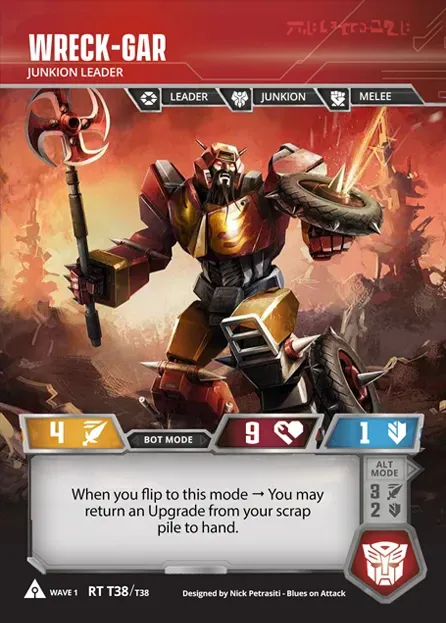
At the time of its reveal in late 2020, players were eager to play Wreck-Gar, Junkion Leader — though it was quickly noted how much power he was bringing to the battlefield at an extremely low star count of 5. Card creators in that time were brainstorming ways to provide a unified, multi-creator gameplay environment for players and they often cited Wreck-Gar as a problem for that unity. The central issue: if individual card creators could make cards as overpowered as Wreck-Gar, how could they make a shared, balanced gameplay environment without igniting a creator-sparked arms race for relevancy?
Eventually, a unified gameplay community began — at the time called Allied Crossplay. Allied creators made the collective decision that the cards of Ark’s “Wave One” weren’t yet appropriate for play in that environment. That release’s power level and balance discrepancies needed to be resolved first. Many of those cards would eventually make their debut in the .cards fan set “Exodus” — though a balanced version of Wreck-Gar was not part of that release.
Allicon Eyuk, Bog Scavenger has since enjoyed success in competitive play. A Galaxy Prime deck that includes Eyuk won the .cards season-ending tournament in 2022.
Design intent
In the light of Ark’s “Wave One” Wreck-Gar’s debut in 2020, Allicon Eyuk was born as a counter-example in the 5-star space. It stated simply this:
A card doesn’t need an all-inclusive Upgrade recursion ability in order to be good.
The abilities for Eyuk were much more measured. Rather than Wreck-Gar’s single flip to recur an Upgrade, Eyuk required two. Rather than Wreck-Gar being able to recur any Upgrade at all, Eyuk could only do this for black and green Upgrades.
Our take
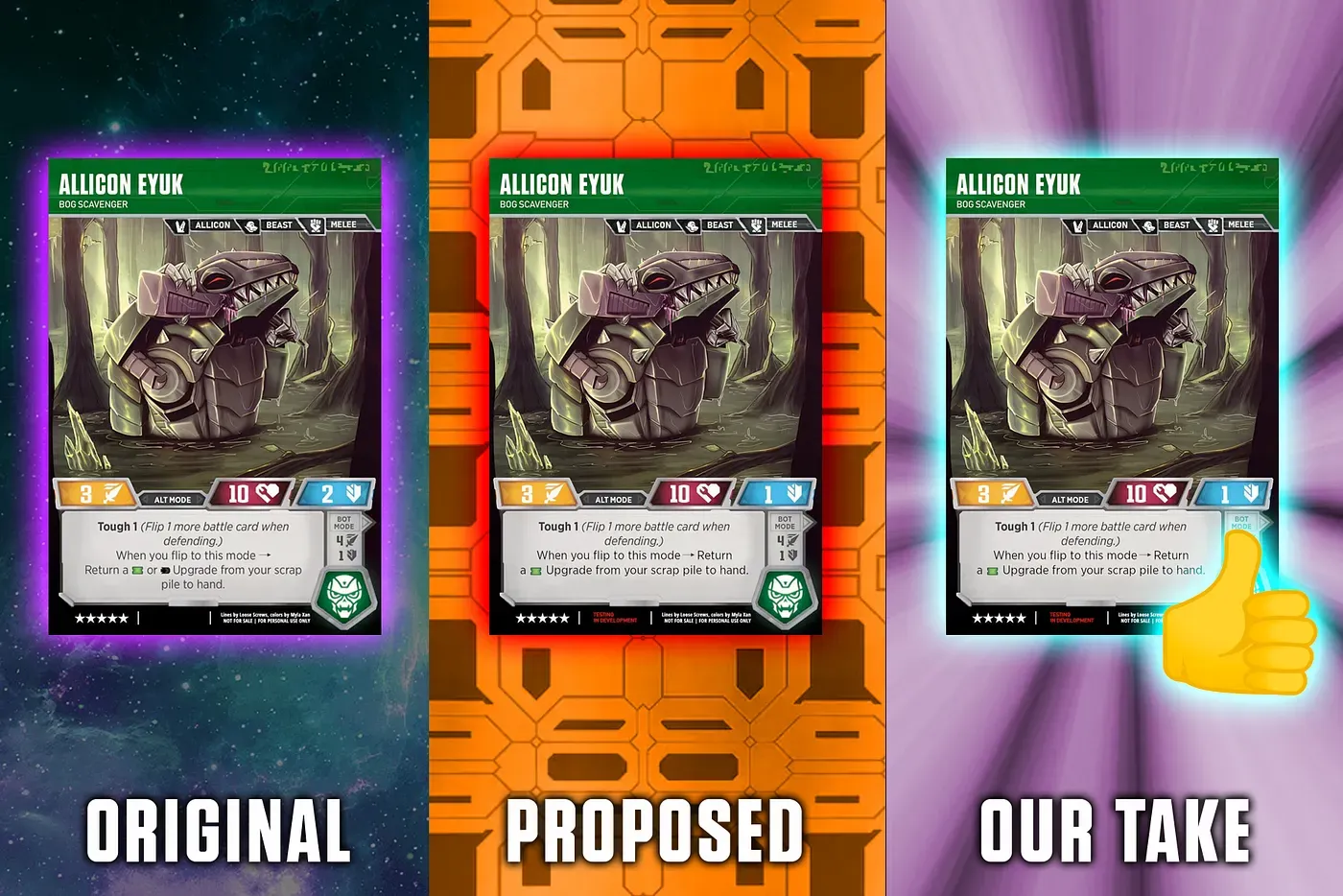
We’re in favor of this nerf.
In retrospect with the current meta in mind, the 2 base Defense in alt mode combined with Tough 1 is a lot of value at 5 stars. Reducing this to 1 base Defense seems reasonable.
In the current era of gameplay, Upgrade recursion is an extremely powerful ability. Those powerful abilities led to a soft ban on new Upgrade recursion abilities by the Team for future cards — one the Team favors for wider community adoption. We favor limiting Eyuk’s recursion to green Upgrades only.
We hope that creators across the community will look negatively at Upgrade recursion as a design option for future cards.
In conclusion
The Team rates the proposed nerf to Allicon Eyuk, Bog Scavenger an S.
Stuck on You
Summary of proposal
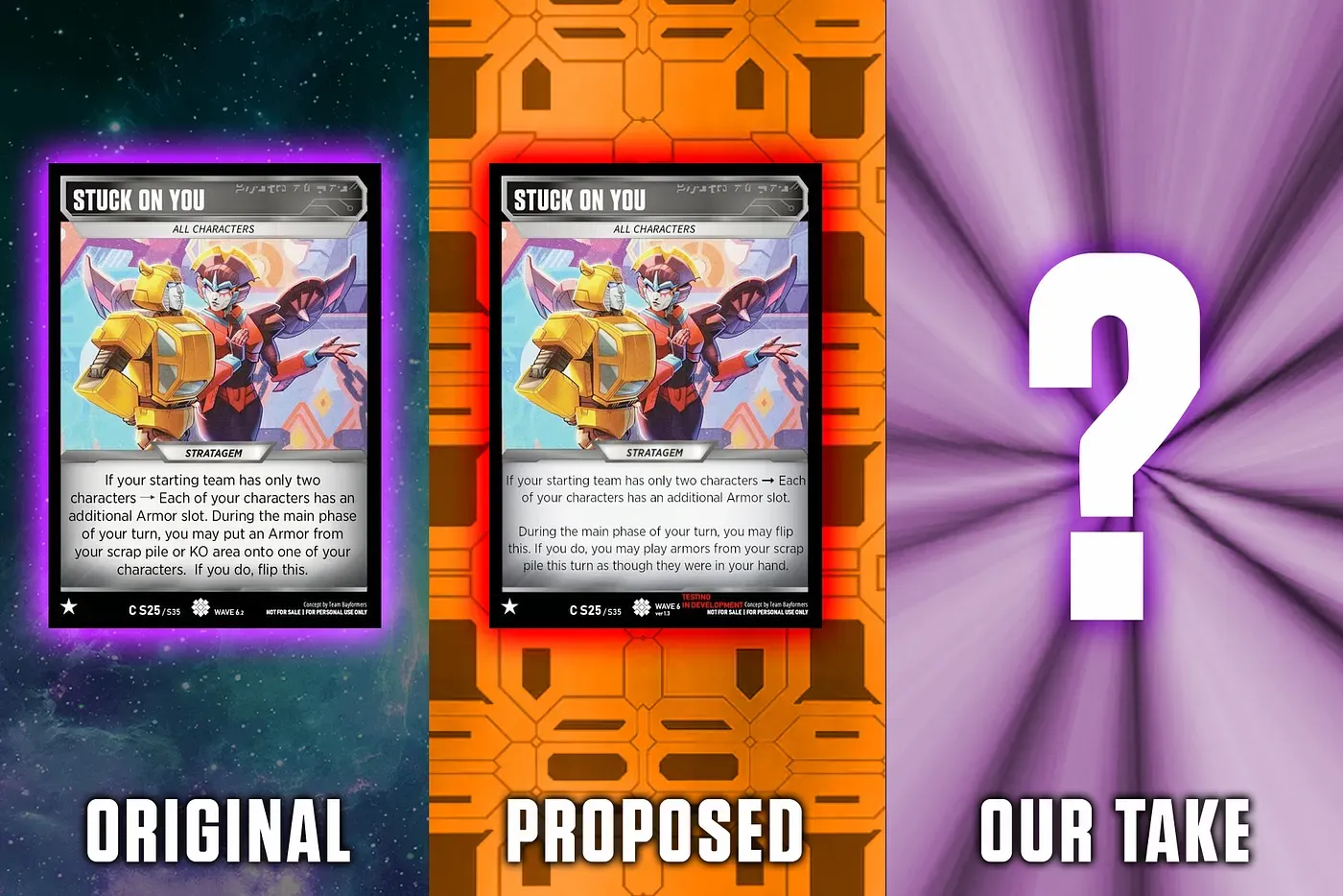
The proposal changes the verbiage of “playing” Armors in the scrap pile from “put” to “play”. However, the proposed verbiage from .cards has dropped putting Armors from the KO area. It is unknown if dropping support for Armors in the KO area is intentional.
History
The two-wide team space is one Team Bayformers has long been interested in. In the months immediately following Wave 5’s release, two-wide teams were nearly unheard of in the ever-widening meta. The occasional appearance of UltraJet decks on tables reminded us of its potential — provided it received a little help.
Design intent
In an ever-widening meta, the focus for Stuck on You’s design was on giving two-wide teams more durability via additional Armor slots. During its design process, numbers for Battle Master and Weaponizer gameplay were low, so further enabling those with Armor modes was a goal.
The method for playing that once-in-a-game Armor from the scrap pile or KO area is not a sticking point in its design, only that it is an option on flip.
Our take
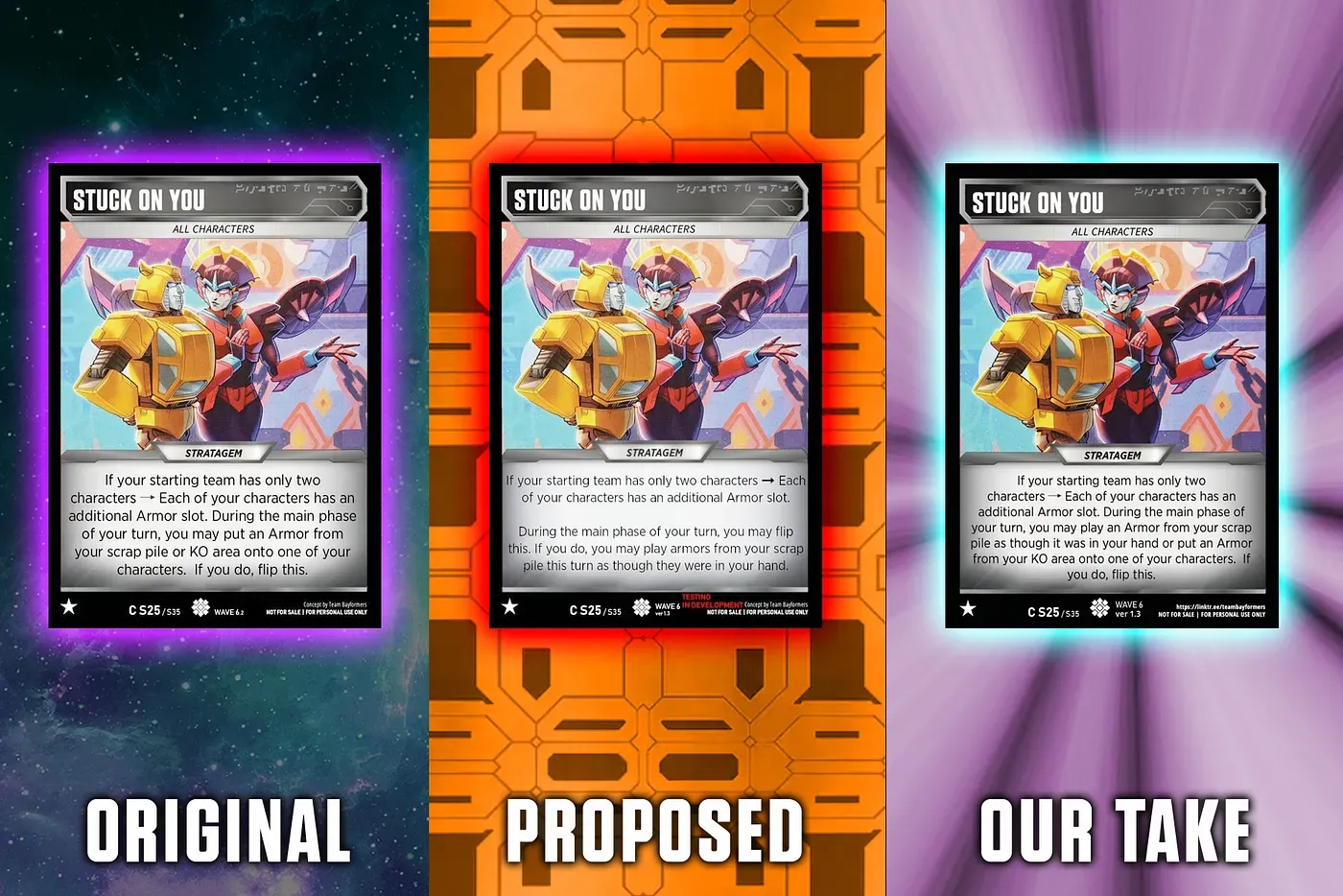
We’re mostly on board with the Stuck on You nerf, but we hope that support for KO’d Armors returns. The underutilized Battle Master/ Weaponizer space received a minor boost with Stuck on You, and we would hate to see that go away.
In conclusion
The Team rates the proposed nerf to Stuck on You a B. Restoring Battle Master/ Weaponizer Armor inclusion (pending testing) would immediately raise this to S.
Impetuous Stand
Summary of proposal
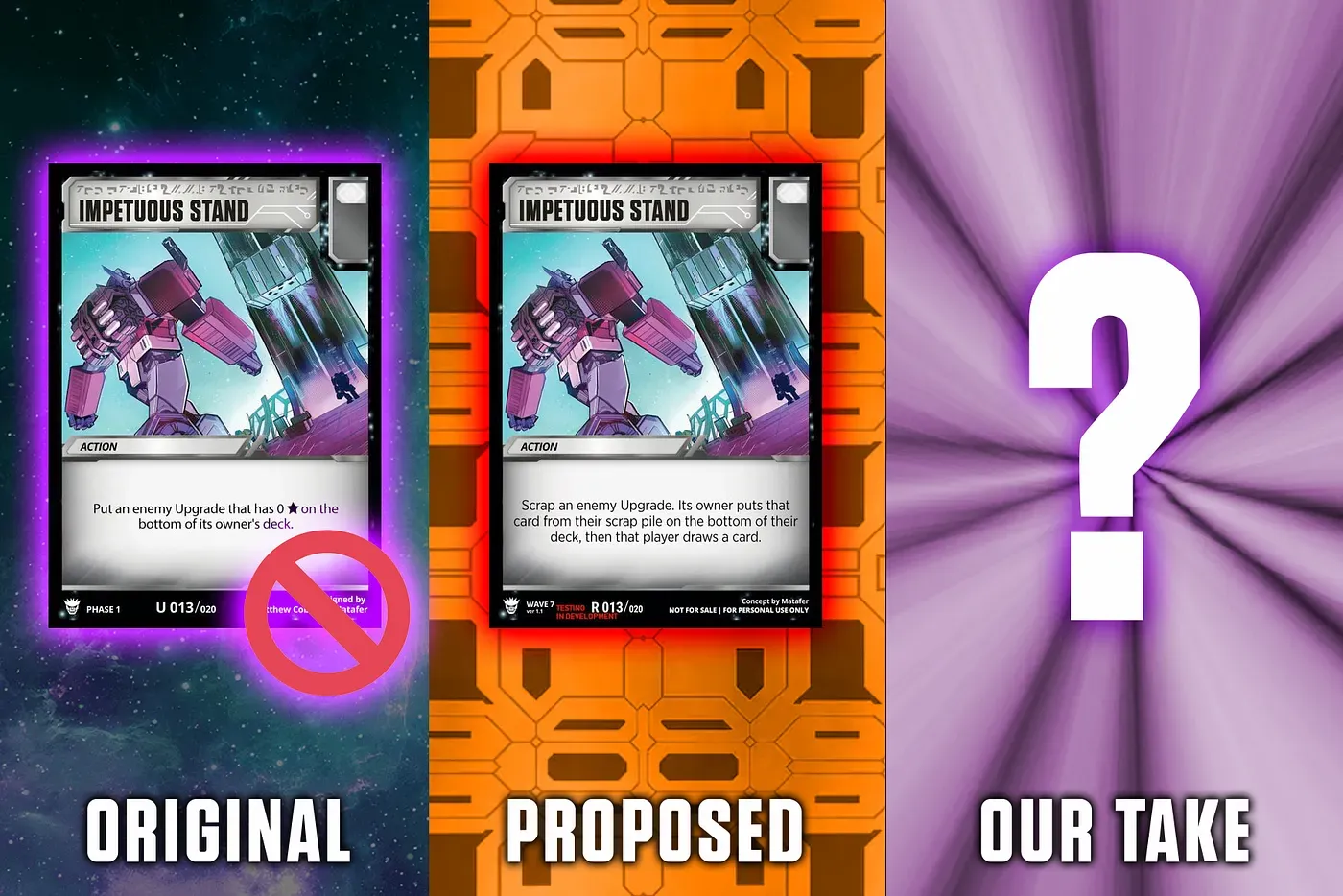
transformers.cards proposes to rework the currently banned Impetuous Stand to make it legal for play. First, .cards plans to remove the previous star count limitation. Next, the affected Upgrade is scrapped first before being placed at the bottom of its owner’s deck, in order to allow for anti-scrap options to activate. Last, the owner of the Upgrade draws a card.
History
Impetuous Stand has long had a troubled history in community play — one that began even as its origin wave, Turbo Revving Old Punks’ Phase One, was first released.
As TROP kicked off a limited, weeks-long beta period for Phase One, discussions ramped up between creators on fulfilling a goal for a unified gameplay environment, centered on World|Strike and Phase One. In that beta, Phase One had 19 battle cards — and those were the cards creators analyzed to include in that unified scene. Nowhere in those 19 battle cards was the original version of Impetuous Stand — which suddenly appeared in Phase One roughly a week before its release as the 20th battle card. In the desire to bring Phase One into gameplay with World|Strike, creators adopted a “wait and see” approach to Impetuous Stand. Anxiety, however, was present as Impetuous Stand was only in beta for a week and was already presenting itself as an extremely powerful card.
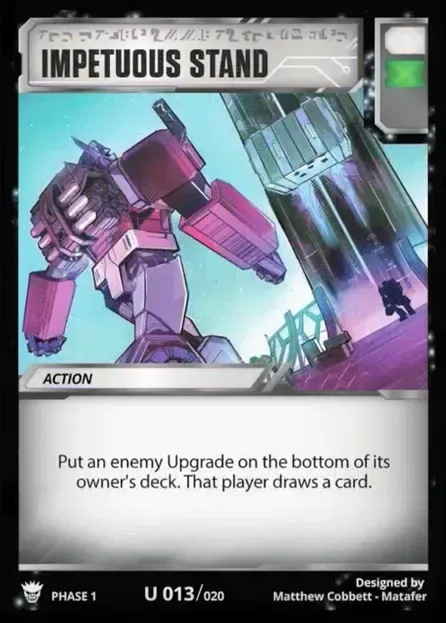
Not long after Phase One’s adoption, its green battle icon and ability to bypass anti-scrap mechanics via its “bottom of the deck” clause launched Impetuous Stand into supremacy among Upgrade removal cards. Decks that depended upon singular, powerful star Upgrades like Major Ultra Magnus and Quintessons withered in the face of IS. Cards like Ramming Speed and Reprocess, once staples in removal, were suddenly nowhere to be found. Thus, calls began to nerf Impetuous Stand.
The efforts to nerf Impetuous Stand — which became something of a debacle — were also one of the very first tests of the unified environment that eventually became known as Allied Crossplay. The element within TROP responsible for Impetuous Stand’s creation (and bungled beta period)— Matafer — took an obstructionist posture towards changing Impetuous Stand. Matafer dismissed any and all valid balance arguments from event organizers and other community designers, favoring only his own preferences and bias towards a card he created. Hence, a heated debate on what exactly to do with Impetuous Stand kicked off, and it dragged on for weeks in creator channels. With no immediate solution in hand, event organizers, after observing a few tournaments with a legal IS, its toxic results, and Matafer’s obstructionism, took the initiative and placed it on the ban list — the first community card to be banned. This ban occurred with the support of the grand majority of community creators and players. Matafer had none of it, feeling any constructive feedback or actions against Impetuous Stand were purely personal attacks, despite the quorum against the card.
Eventually, perhaps driven by a desire to get Impetuous Stand back on event tables, Matafer relented and enabled discussions for a nerf to proceed. Those discussions manifested in a second version of Impetuous Stand being issued, and IS came off the ban list.
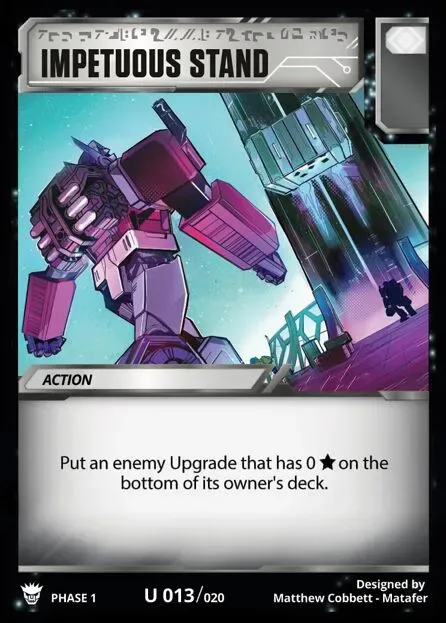
However, the problems with Impetuous Stand did not end, as the new version was just as rushed to release as the original. Unresolved with the new version was its enduring ability to bypass anti-scrap protections via its “bottom of the deck” clause. The Team started witnessing an ability escalation in new card designs to accommodate the existence of Impetuous Stand in the meta. No longer were designers building anti-scrap abilities like:
When one of your Upgrades is scrapped by the opponent’s cards…
Now they were building abilities like:
When one of your Upgrades leaves the battlefield by the opponent’s cards…
This was a clear sign of an arms race: where designers are effectively competing against each other, leading to rapidly escalating power creep and ability sprawl. The collateral damage to an arms race started by Impetuous Stand was clear: cards like Disarm and Debilitating Crystal would be immediately impacted by “Upgrade leaves the battlefield” effects. After a few more events where Impetuous Stand’s play rate remained first among other Upgrade removal options, the ban list welcomed it back — where it has remained.
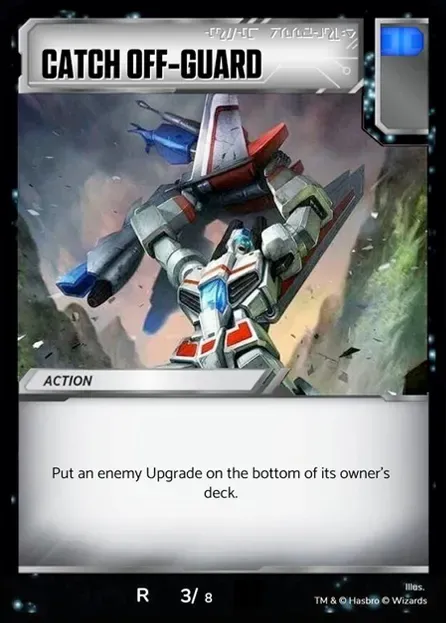
In a story of parallel development, ATP separately developed an Upgrade removal card similar in fashion to Impetuous Stand: Catch Off-Guard. According to data on .cards, Catch Off-Guard also enjoyed an outsized rate of play in their environment, outperforming other long-storied cards in its space like Vaporize.
Design intent
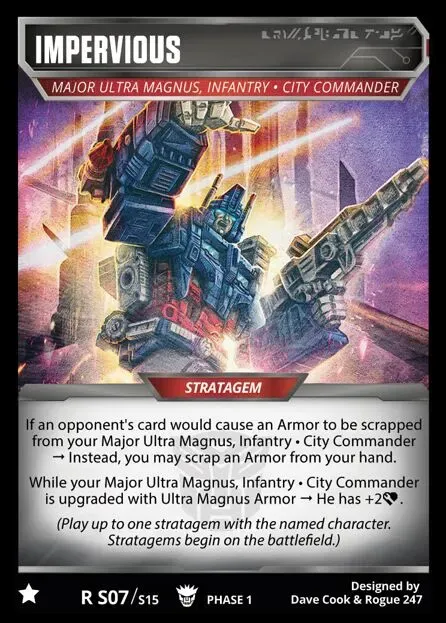
Eventually, a couple of creators involved with TROP (their identities protected here) relayed answers about Impetuous Stand’s sudden appearance at the end of the Phase One beta. Apparently, Matafer’s Impetuous Stand design erupted from a fear of the Phase One stratagem Impervious — a stratagem designed by a separate TROP creator, Dave “TheEnergonHustler” Cook. This troubled the Team, as it appeared Matafer was actively competing with other designers on the TROP team — a toxic design pattern known to contribute to power creep. This toxic design pattern was also reported by designers associated with the Ark, in private conversations with other creators.
Our take
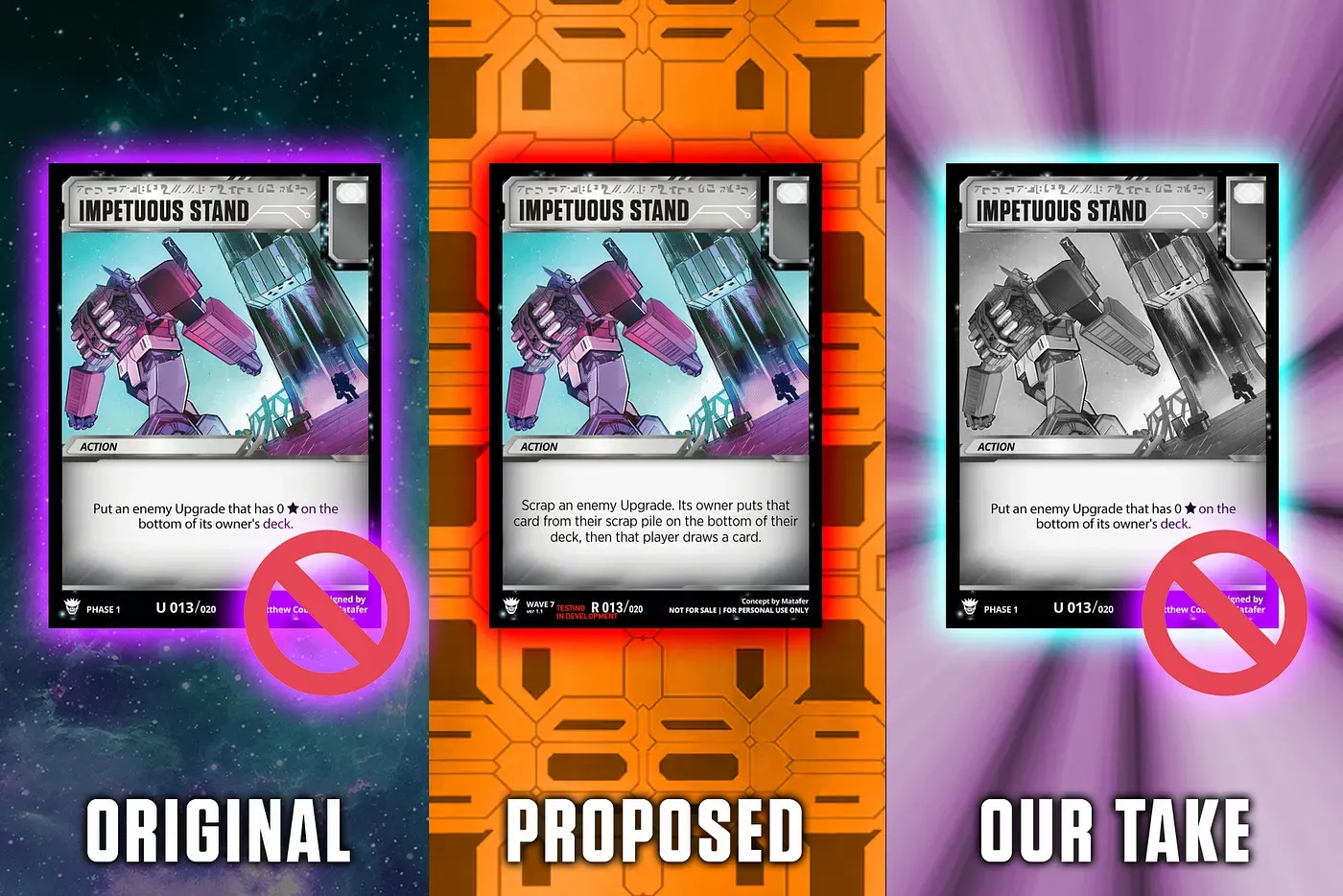
Keep Impetuous Stand banned and untouched.
It’s safe to say we continue to have concerns about making a version of Impetuous Stand legal for play again. Our primary concerns about every version of Impetuous Stand center on its “bottom of the deck” clause, for all the reasons detailed above under the “History” heading. Even with some accommodations for anti-scrap protections, the problems remain in ability escalation. A meta that includes an Impetuous Stand with a “bottom of the deck” clause will never see decks that include star card Upgrades thrive — a double tragedy, considering an entire community faction, the Quintessons, has factional star card Upgrades at the center of its design.
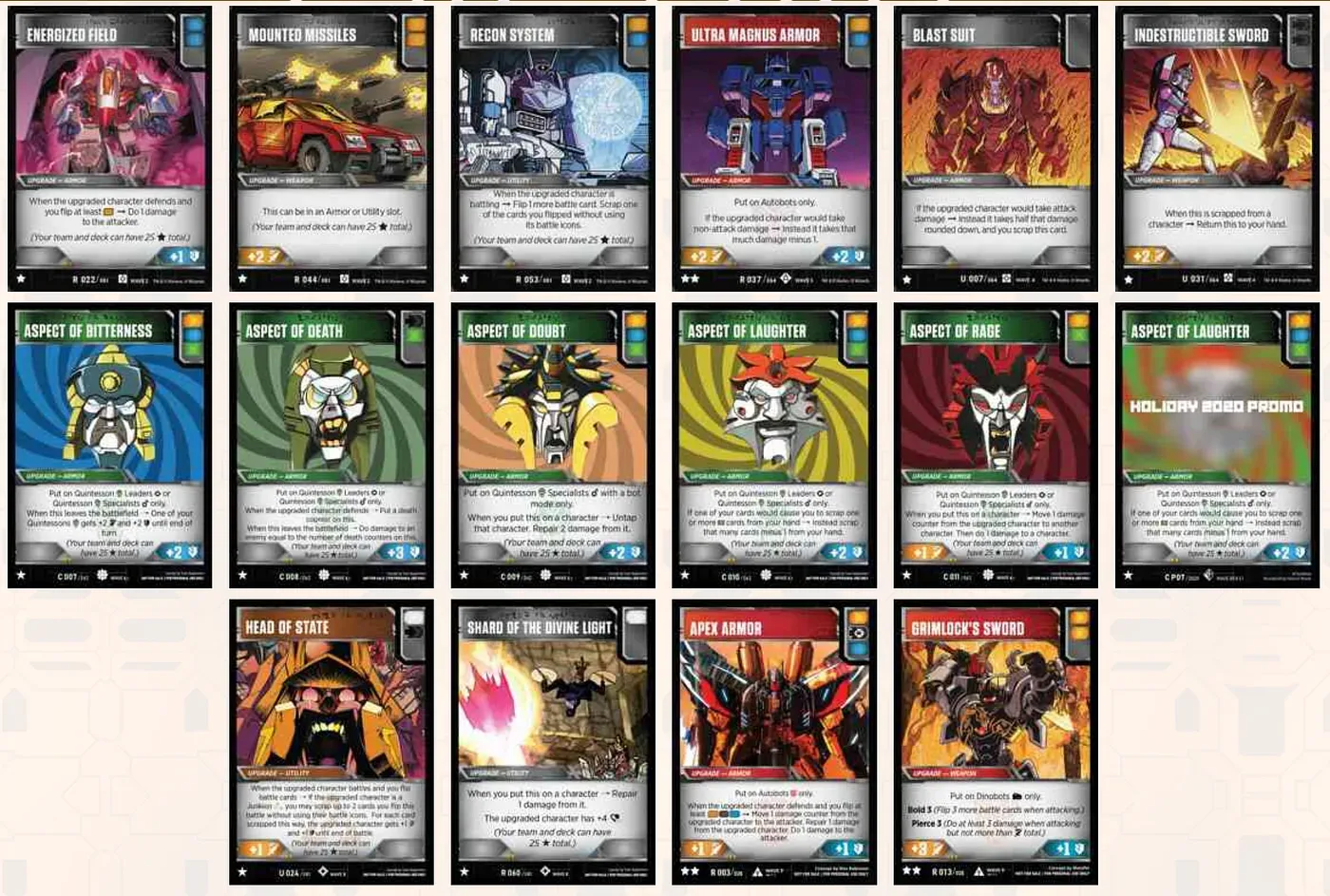
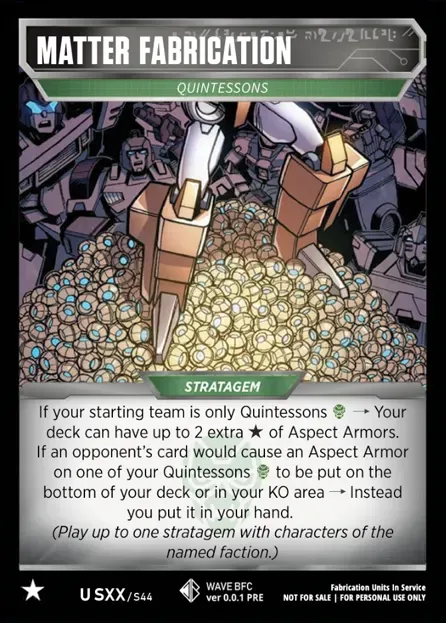
Speaking of the Quintessons, we’d like to preview the first card from Wave BFC! First, a disclaimer: this BFC card will only happen if a legal version of Impetuous Stand that includes a “bottom of the deck” clause emerges in community gameplay. In addition, we openly admit this is an artifact of an arms race kicked off by a legal IS — but it’s necessary to protect the Quintesson design space, one that existed long before IS did. Presenting Matter Fabrication!
During discussions about the potential return of Impetuous Stand, the topic of a perceived need for a white battle icon Upgrade removal Action surfaced. To which we respond: a fantastic one already exists, thanks to the Ark’s fan set “Exodus”!
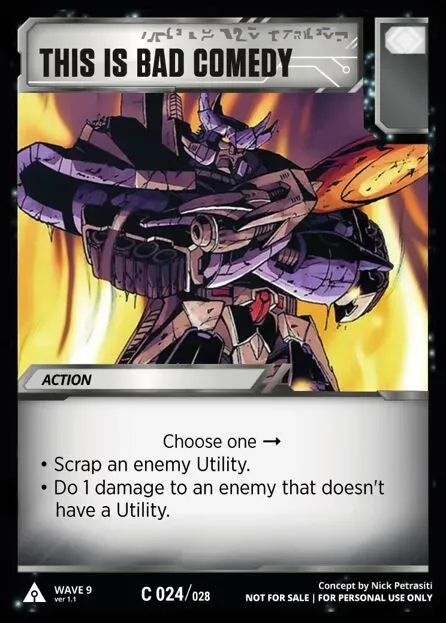
This is Bad Comedy may focus only on Utilities, but Utilities are some of the strongest Upgrades in the game — fueling winning cards like General Optimus Prime, Galactic Commander to world championship victories. It also doubles as a direct damage card — a winning combo against the wide, orange meta.
But, perhaps .cards organizers desire a white Upgrade removal Action that can hit every kind of Upgrade? No problem!
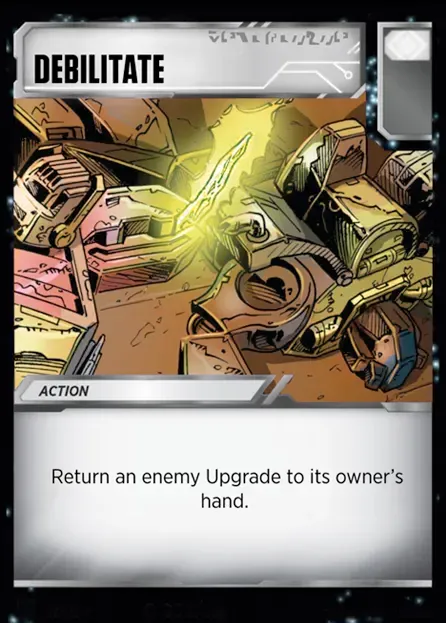
Rooted in the ability of this proposed Debilitate card is the ability of a well-proven card: that of Wave 1’s Debilitating Crystal. Debilitate also fulfills the original design intent of Impetuous Stand far better than the current version of IS does — to combat Impervious. Last, Debilitate also conforms to the white battle icon design pattern established by cards like Head-On Collision versus Leap Into Battle. This Debilitate is a lesser version of Disarm, because it has a white battle icon instead of a blue one. Do we need to mention Debilitate’s simplicity as well?
In conclusion
The Team rates the proposed edit to the currently banned Impetuous Stand (thus, making a form of Impetuous Stand that includes a “bottom of the deck” clause legal for play once again) an F. A rework that doesn’t include a “bottom of the deck” clause — or giving up Impetuous Stand altogether in favor of a new white upgrade removal card — is bound to score higher.
Severed Combiner Hand
Summary of proposal
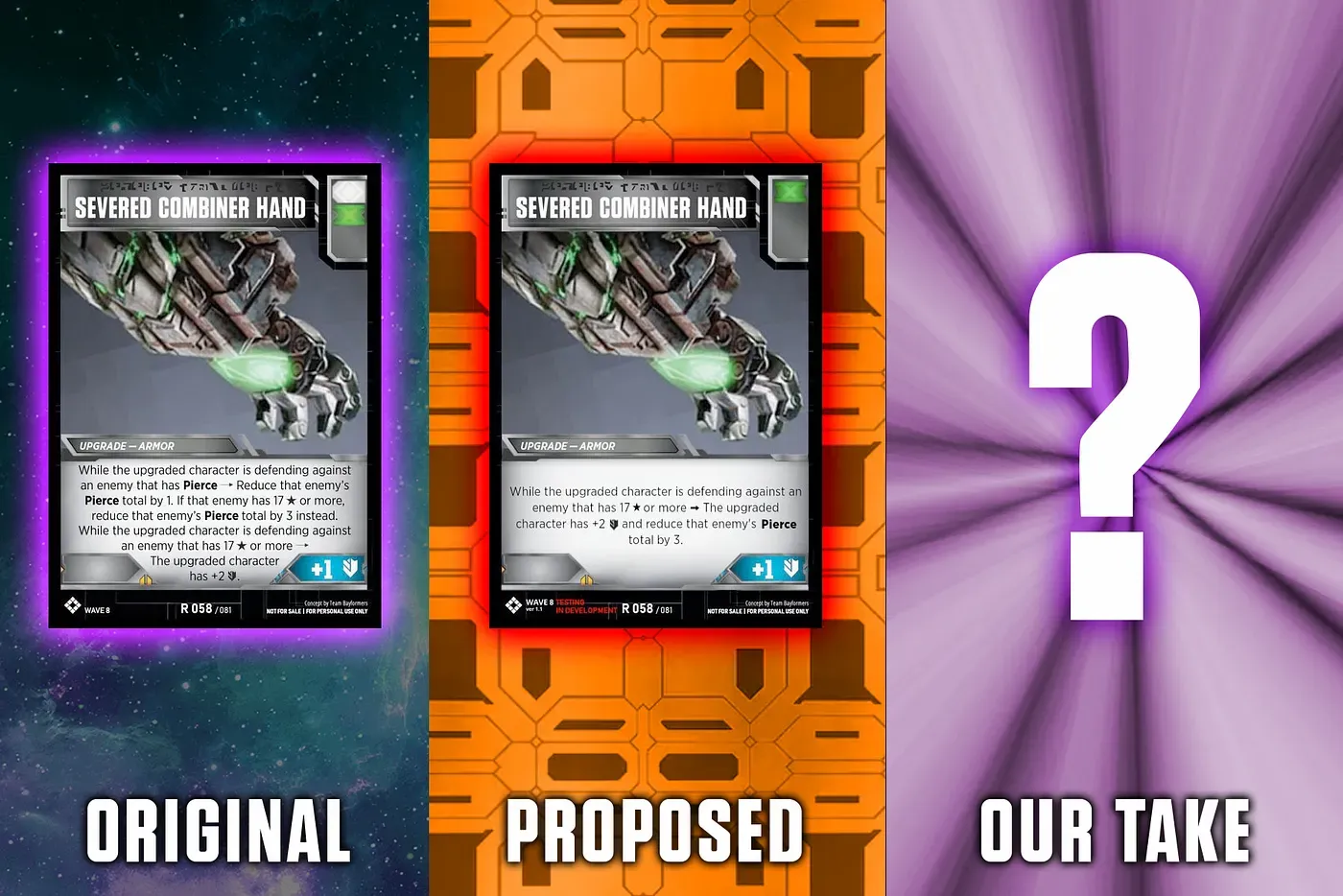
The proposed nerf to Severed Combiner Hand removes its white battle icon. The proposal also removes the base reduction to Pierce, so that the effective benefits of SCH are as such:
- Against characters with 16 stars or fewer: +1 Defense
- Against characters with 17 stars or more: +3 Defense, Pierce reduction of 3
History
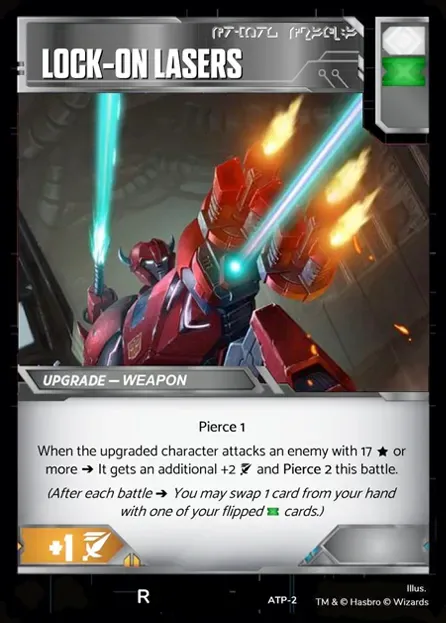
Severed Combiner Hand made its debut in the Wave 8: Waste|Lands release. Some of its original design inspiration came from a card in the extended Transformers TCG fandom: the ATP card Lock-On Lasers.
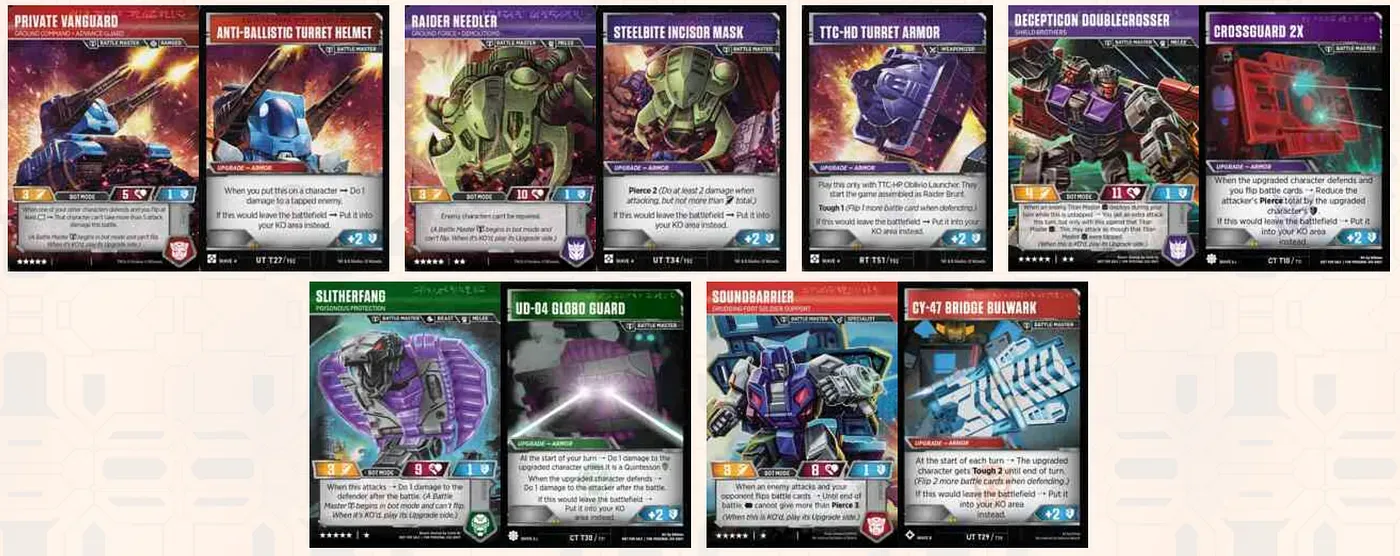
Since its debut, SCH has slowly approached common usage. Players have reported some negative interactions between SCH and Stuck on You, along with characters with multiple Armor slots. Those reports have prompted a proposal for nerfing.
Design intent
Despite what the name of Severed Combiner Hand may suggest, the primary design intent for SCH was not to provide an Armor answer against characters with 17 stars or more, with a secondary added general purpose Armor bonus. Rather, it was the opposite: first provide a green low-powered anti-Pierce Armor that has a secondary added benefit against characters with 17 stars or more. SCH’s priority was always general purpose, low-powered anti-Pierce — not anti-big bot. The ability against 17+ star characters was always a secondary feature.
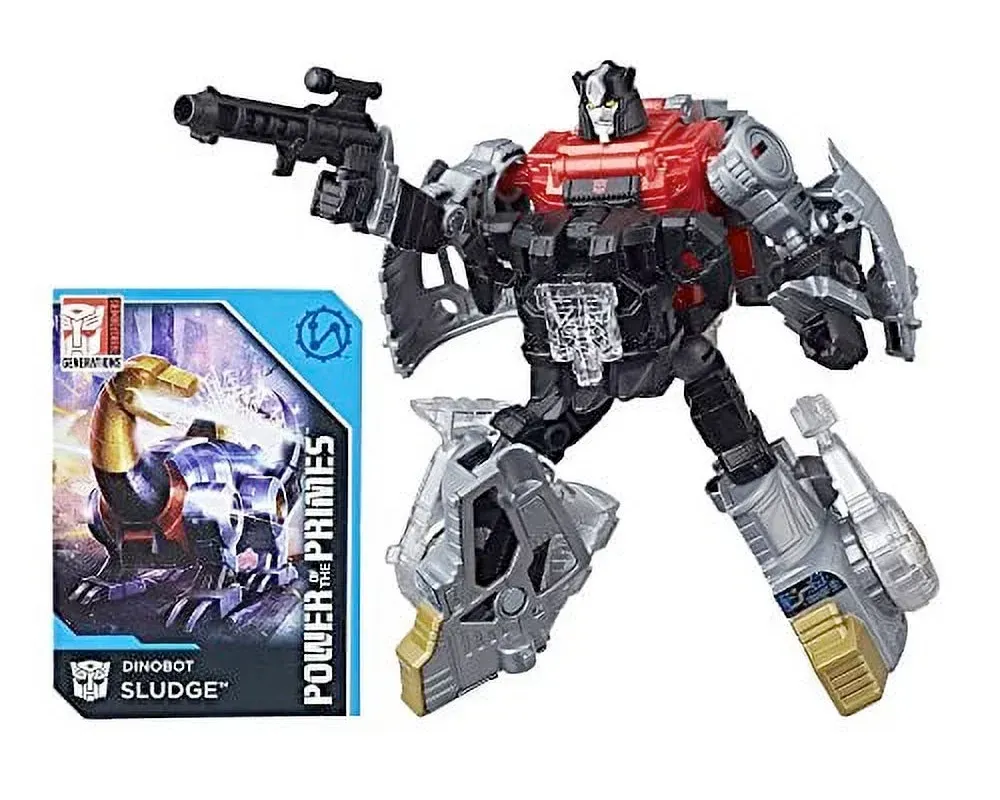
An aside: we’re often asked where the design inspiration for Severed Combiner Hand comes from. One of the sillier features of the Power of the Primes toy line was the ability to attach unused combiner hands as “Prime Armor” for the individual component robots. Our thinking was that the lopped-off hand of a Combiner would be an effective psychological Armor against said Combiners.
Our take
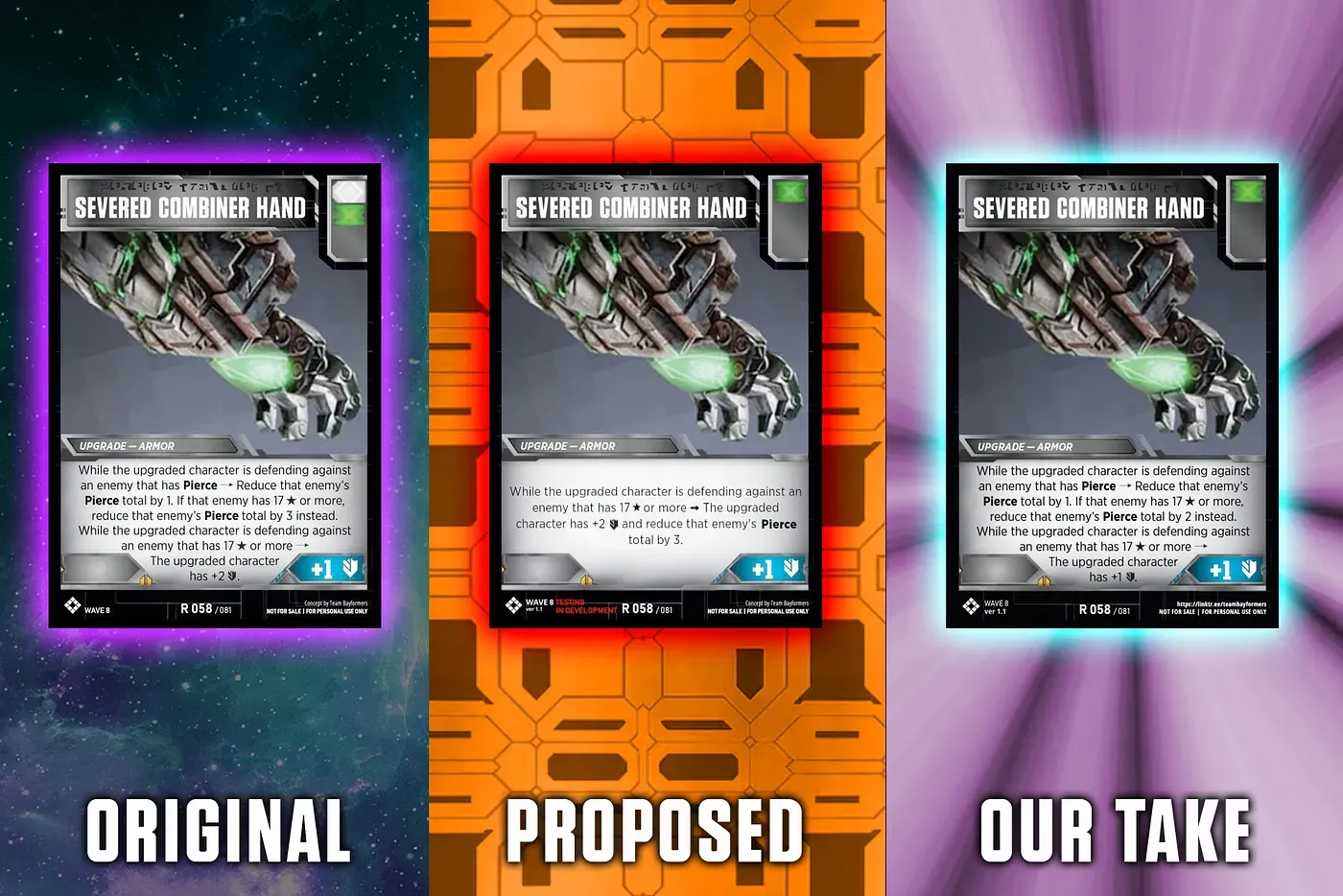
Our version drops the white battle icon of the original. This edit is also in the .cards proposal and it’s a move that the Team favors. In addition, our version reduces from the original SCH both the Pierce reduction and Defense against characters with 17 stars or more by 1. This would effectively make SCH abilities as such:
- Against characters with 16 stars or fewer: +1 Defense, Pierce reduction of 1
- Against characters with 17 stars or more: +2 Defense, Pierce reduction of 2
During the writing of this article, a member of the community let us know their opinion about the .cards proposal for SCH.
“It feels like they’re just guessing wildly with that one. It kind of misses the point.”
In the Team’s opinion, the current proposal to dedicate SCH’s utility to solely being an answer against characters with 17 stars or more is an effective nerf into irrelevancy — especially given the current wide meta. We fear we will not see SCH on community tables again if the current proposal goes through without edits.
In conclusion
The Team rates the proposed nerf to Severed Combiner Hand a C. Pivoting an SCH edit back towards accessible, general utility anti-Pierce would improve its rating.
(Bash)ing it all together
You’ve done it! We’ve arrived at the end. Pat yourself on the back — few players will make it this far! All that’s needed now is to average out the ratings for a comprehensive score.
Overall, most of the proposed nerfs are close to their targets. Little work is required for most to get them into an optimized state that also honors their design intent. Outside of the attempt to make legal a version of Impetuous Stand that keeps a form of its bottom-of-the-deck ability, most of these proposals are close to workable, fixed cards. We will update this article to include a final rating when the finished nerfs hit the gameplay tables.
In conclusion, Team Bayformers rates the Big Beta Bash proposed nerfs a B.
This won’t be the last article that Team Bayformers writes for the community! We strive to cover common gameplay topics, as well as provide insight into a designer’s point of view. You may even see a few guest articles — written by players for players. Here are a few bullets from our 2024 topic list:
- Previews of Wave BFC features and cards
- Demystifying Station gameplay
- Beginner’s guide to integrating community cards into your existing decks
- How feedback and process has made better Transformers TCG cards
Have comments? Ideas? Would you like to contribute to upcoming releases? Follow us and transform your gameplay!