


This was originally posted on the offline transformerstcg.com website.
Greetings, fellow humans! I’m Ken Nagle, design lead for the Transformers TCG. Our next release is Titan Masters Attack, which is Wave 5 of our releases.
Today I have three battle cards to preview that should help in battles to come. Each performs a specific duty against frustrating gameplay you the players have identified to us.
Big and Small
The Transformers TCG has a natural archetype inclination for small and large characters:
- The smaller a character is in stars, the more likely it is to be KO’d in one attack, so it’s better to go pure offense while it can.
- The larger a character is, the more stars of your team it consumes, and the more likely it is for the enemy team to simply outnumber yours. In this case, the large character’s attack number will be used once each round, but its defense number will be used more than once, so adding defense multiplies the outcome more than adding offense.
There are nuances, but “wide offense” and “tall defense” is natural. The problem is when the star cost of your character is not indicative of how big its attack can get. A simple example is when a low 5-star character like Kickback can attack and flip 10 battle cards to do 10 damage, which is damage more indicative of say a 10-star character.
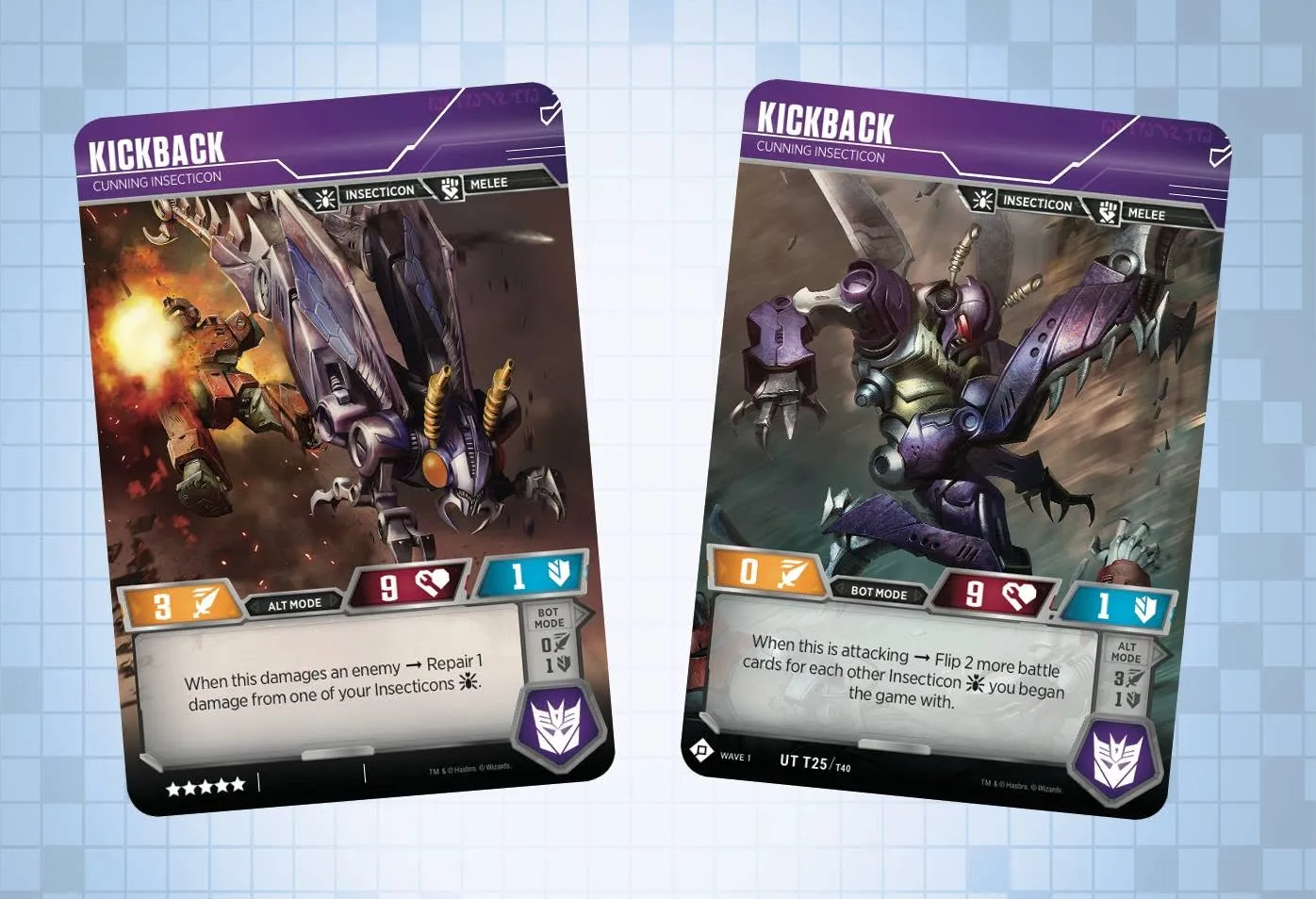
We obviously want characters to do damage so the game progresses, but we would like small characters to do less damage than large ones. It’s hard to draw the line.
This whole “5 star characters do 5 damage” vs “10 star characters do 10 damage” would be a perfectly fair holistic approach. Each 25 star team would do around 25 damage per round. Since each team has somewhere around 50 effective health (factoring in defense and health) the game lasts between 2 and 3 rounds.
That’s not how the characters we’ve printed line up, but maybe we can move it one step closer. Introducing Hold the Line:
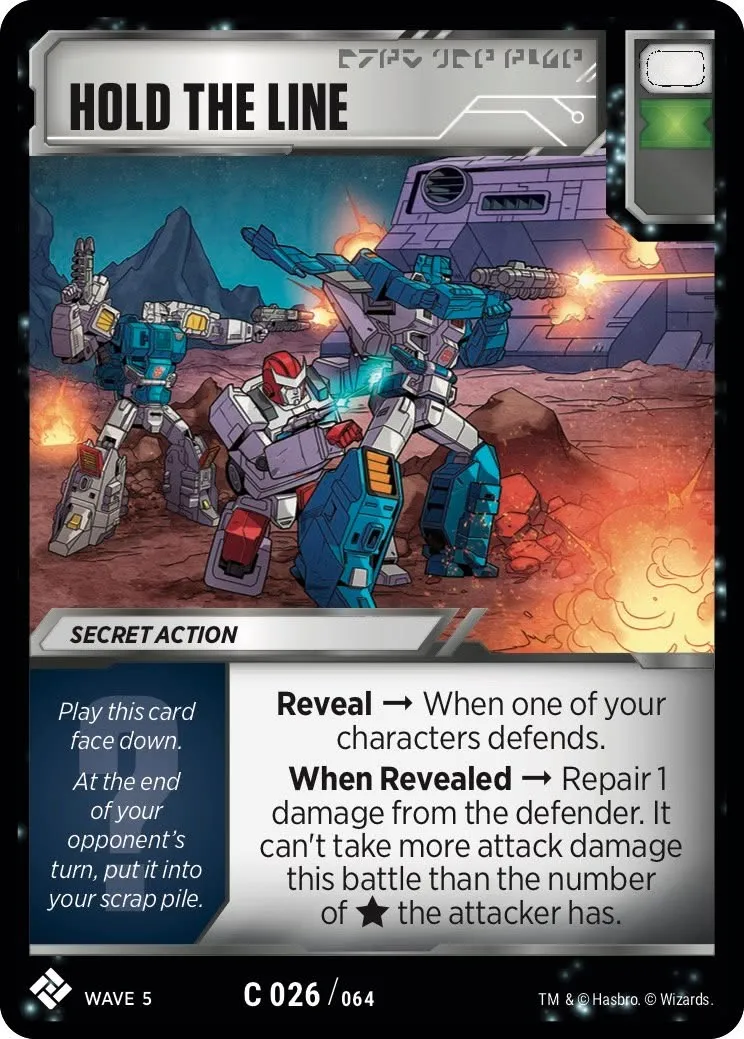
Hold the Line is a new common, defensive Secret Action in Titan Masters Attack. It has generous battle icons with a green and a white so it’s something to consider for every deck. What’s more, it always repairs 1 damage which can mess up your opponent’s math as a surprise.
The real metagame-shifting part is that Hold the Line will cap damage taken to the attacker’s stars. This will even apply to incoming Pierce damage. A 5-star attacker will only be able to do 5 damage maximum (possibly 4 given the repair 1).
For a while now, we’ve loved how Force Field is sometimes the best and sometimes the worst card on the battlefield. Force Field can swing the game but also has plenty of counterplay. There’s always some damage going through so the game does progress forward to a conclusion.
Hold the Line is another version but helps little against gargantuan star characters like a Combiner where Force Field could work wonders. However, if you’re getting trampled by tiny characters, Hold the Line will shine. It won’t stop everything, but it can buy you more time. This is what we’re aiming for with all our defense cards – they buy you time but can’t stop your opponent’s offense indefinitely.
Hold the Line is particularly potent in Titan Masters Attack because there are some tiny Head mode characters in the set, like Arcana.
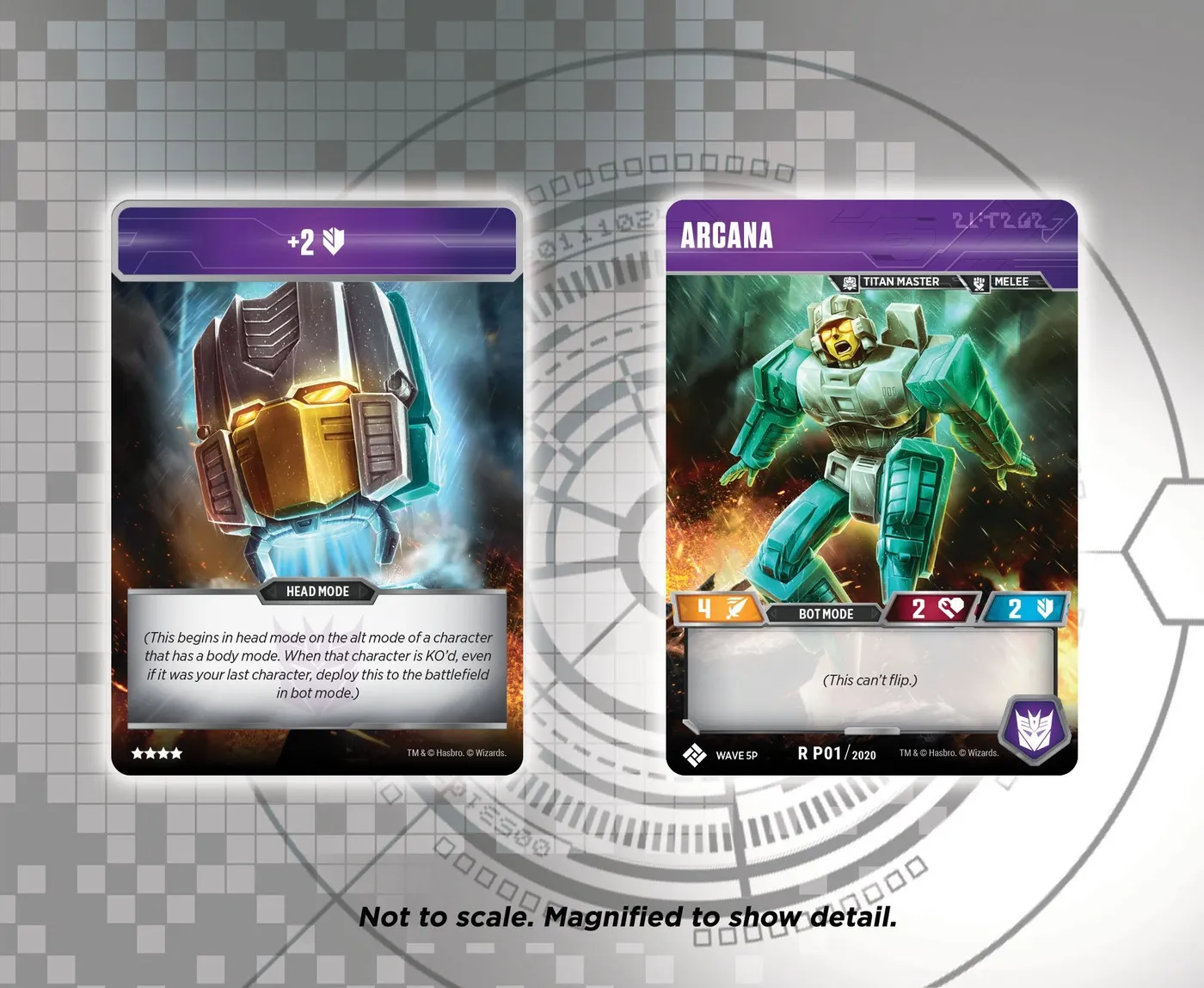
If you haven’t noticed, all the head characters attack relatively big for their star costs. We can all thank designer Lukas Litzsinger for this: in his very first playtest of the Body + Head character, he felt dejected because his freshly severed head character had no chance of attacking back for enough damage to win the game. So, I cranked up all the attack stats of heads and cranked down their defense and health and indeed some games were now won on the back of a Head pop crack back. Sometimes my Head would attack for 10! That was fun, until it happened so often that maybe it wasn’t, so Hold the Line entered the set as a meta check on extremely tiny characters attacking for the win.
Speed Trap
We the design team have embraced that combo should be an archetype we actively support. I know it’s controversial among fans, but we think the added vector helps in more ways than it hurts.
The good:
- It lets us make powerful Specialist characters that feel dangerous and impactful in their own way
- It makes certain aspects of the game far more relevant than others. For example, hand or flip disruption might suddenly be the most important of the game.
- From turn to turn, game to game, match to match, expansion to new expansion, it lets us make characters and cards that are increasingly more different from each other.
The bad:
- In my more than a decade experience, trading card games that keep adding new cards will naturally progress to a primarily combo deck metagame. We could just do nothing out of the ordinary and it will happen on its own, no need to accelerate it.
- Battle between characters is generally the most interactive part of the game using modes, upgrades, and your deck’s flip composition all to determine the result. Making games less about battling naturally makes them less interactive unless we specifically insert interaction points into the game.
My next preview card is trying to address that very last point. What can you do if your opponent is just playing Action card after Action card and you feel powerless to stop them? There’s direct support for chaining Action cards thanks to the highly synergistic battle card Brainstorm:
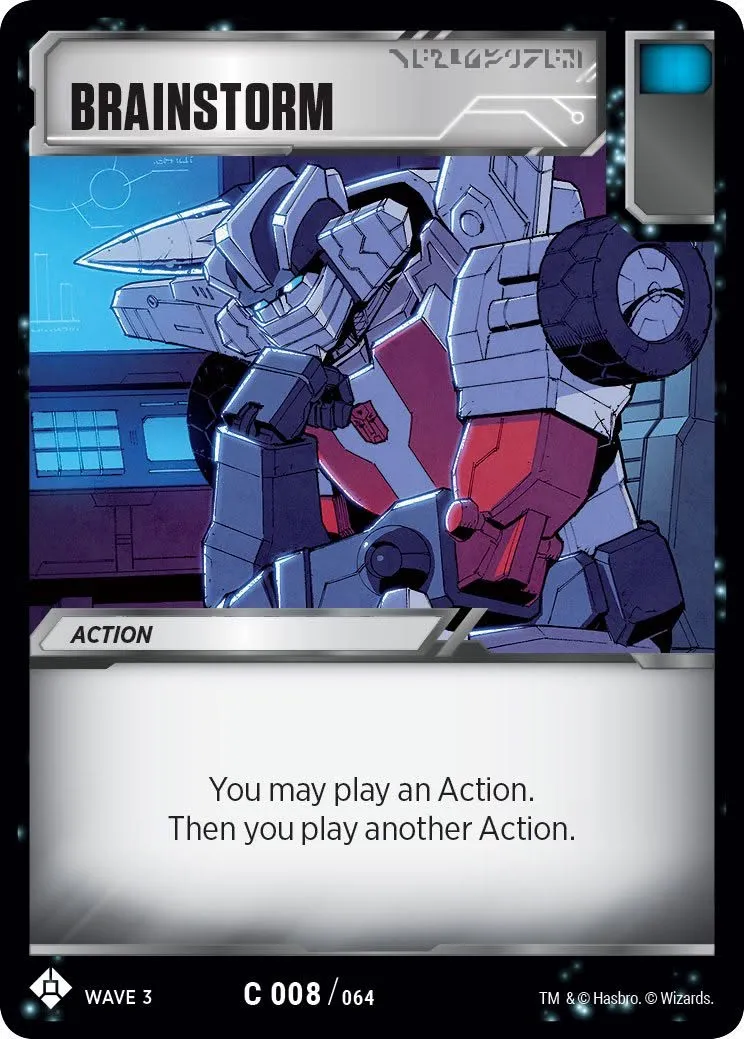
We like Brainstorm, we like fancy plays, we like big turns, but we also like some danger to it all. In the beginning with just Wave 1, playing my Brainstorm-based team of Thundercracker included the danger of drawing 1, 2, or even 3 Brainstorms but nothing to do with them.
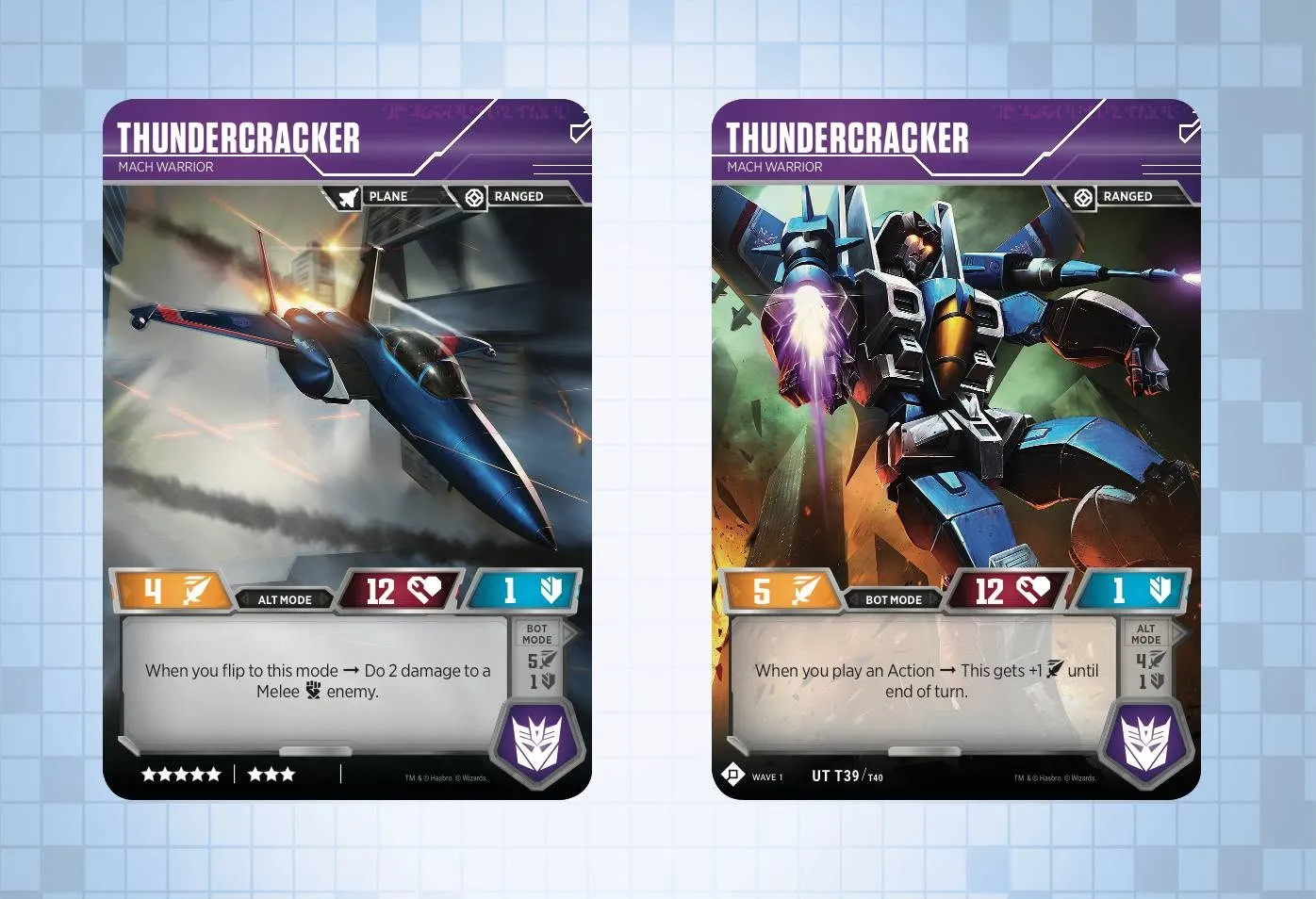
Since then, we’ve ramped up heavily on card drawing effects since every deck wants that. The game naturally draws 1 card per turn but plays 2 cards per turn. You can solve for this deficit as part of team building and deckbuilding. It’s a relatively deep design space for both us the designers and you the players. But it also means we just can’t keep making Brainstorm-like extra play cards unless they are gated somehow. We’ve relegated extra plays to exist on characters now. Card drawing is in such abundance (also green battle icons for smoothing) that there’s a much-reduced danger for going for multiple Actions during your turn.
But now there is! Introducing Speed Trap:
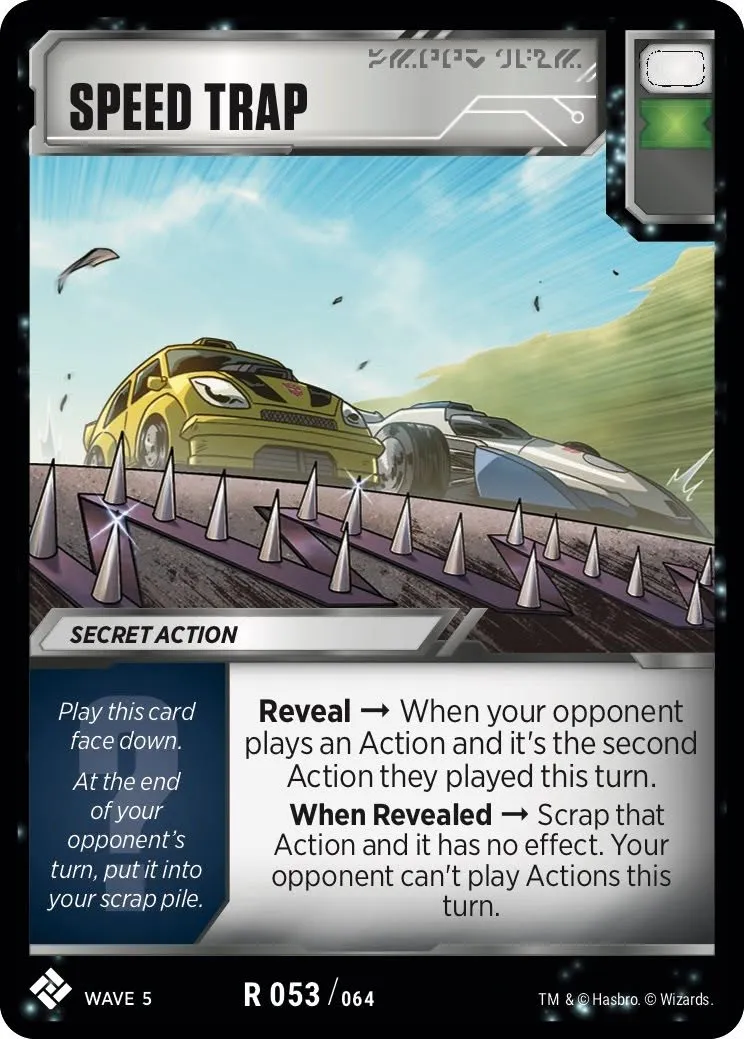
Speed Trap is directly designed to stop Brainstorm-based decks that often fall into the combo “bad” category above. Imagine this: You play a secret Speed Trap. When your opponent plays Brainstorm, then plays another Action, your secret Speed Trap reveals and just stops all that nonsense cold! For the rest of the turn!
Speed Trap will do nothing almost all the time. Any “fair” deck playing just one Action and one Upgrade is completely immune. However, there’s a time and place for Speed Trap where it’s the hero and the only card that matters.
Right Back at Ya!
We’ve gone over how extra plays are dangerous and proven to be the strongest mechanic in the game when left unchecked. There’s another mechanic that’s gone too long without enough checks. I’m talking about direct damage (rules call it “non-attack” damage to be clearer).
When designing the game in the beginning, we had a vague separation that Ranged characters were good at dealing non-attack damage with their “ranged weaponry”.
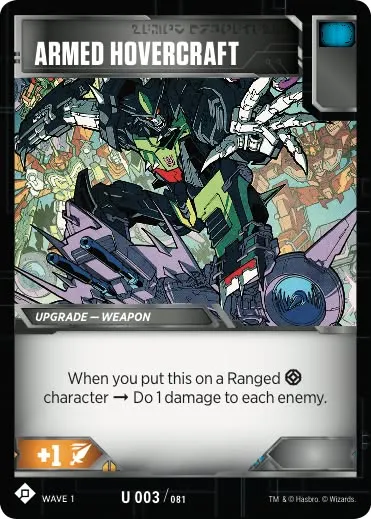
This turned out to be an unsustainable model since the winning vector of the game is just dealing enough damage to KO each enemy character. What’s more, you gain a huge tempo swing if you can direct damage an enemy character without using an attack, and even more tempo if that enemy character is untapped and never got to attack that round.
Case in point, one of the most played direct damage cards is the epically named:
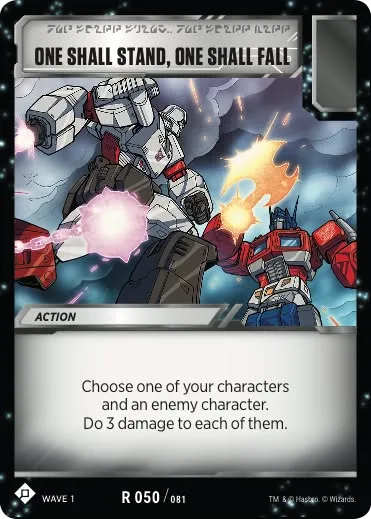
We knew the ability to do 3 damage outside of battle was commanding, even with a 3 damage drawback, so we gave this a quotable card name. With Titan Masters Attack, who stands and who falls will be more up the in air – introducing Reflect Damage:
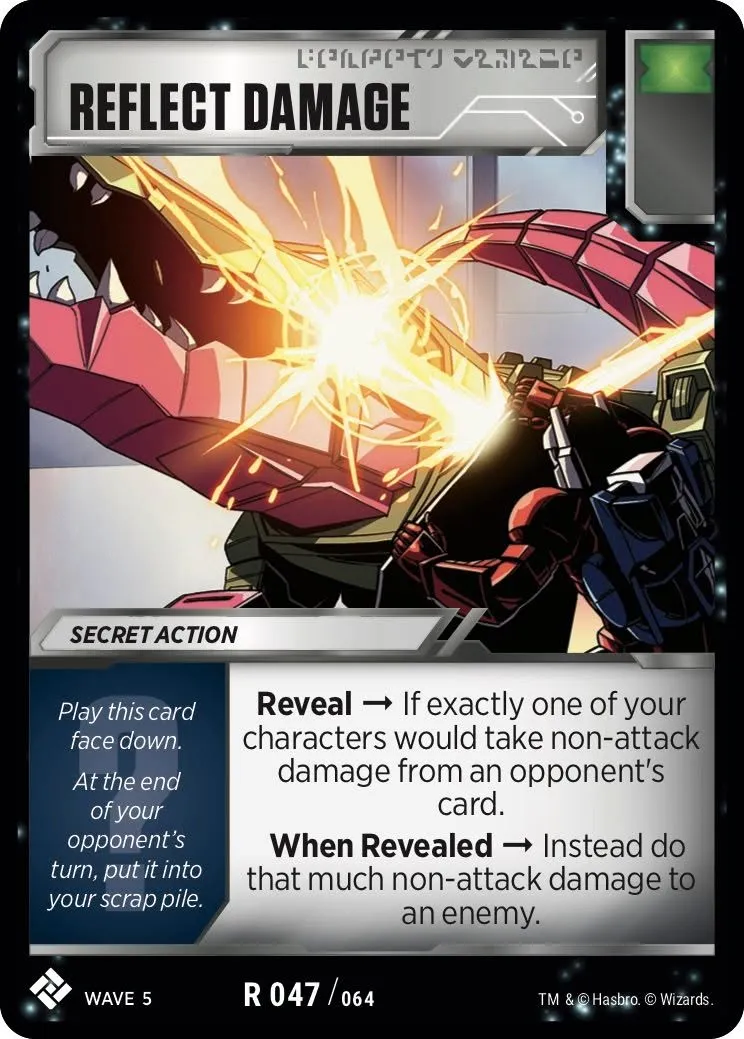
Reflect Damage will be a crushing reversal of fortune to any direct damage your opponent aims at one of your characters. Direct damage is so prevalent I suspect you can play 1 Reflect Damage in all your decks and you’ll get significant mileage from it. Just 1 means you can flip it during battle and your opponent will now be afraid of more of them. You can grab it because of its green icon. It will also make any other Secret Actions you have more ambiguous.
If you think your opponent can just not play any direct damage effects, you should pay close attention to their characters. Your opponent might be playing some required damage triggers like:
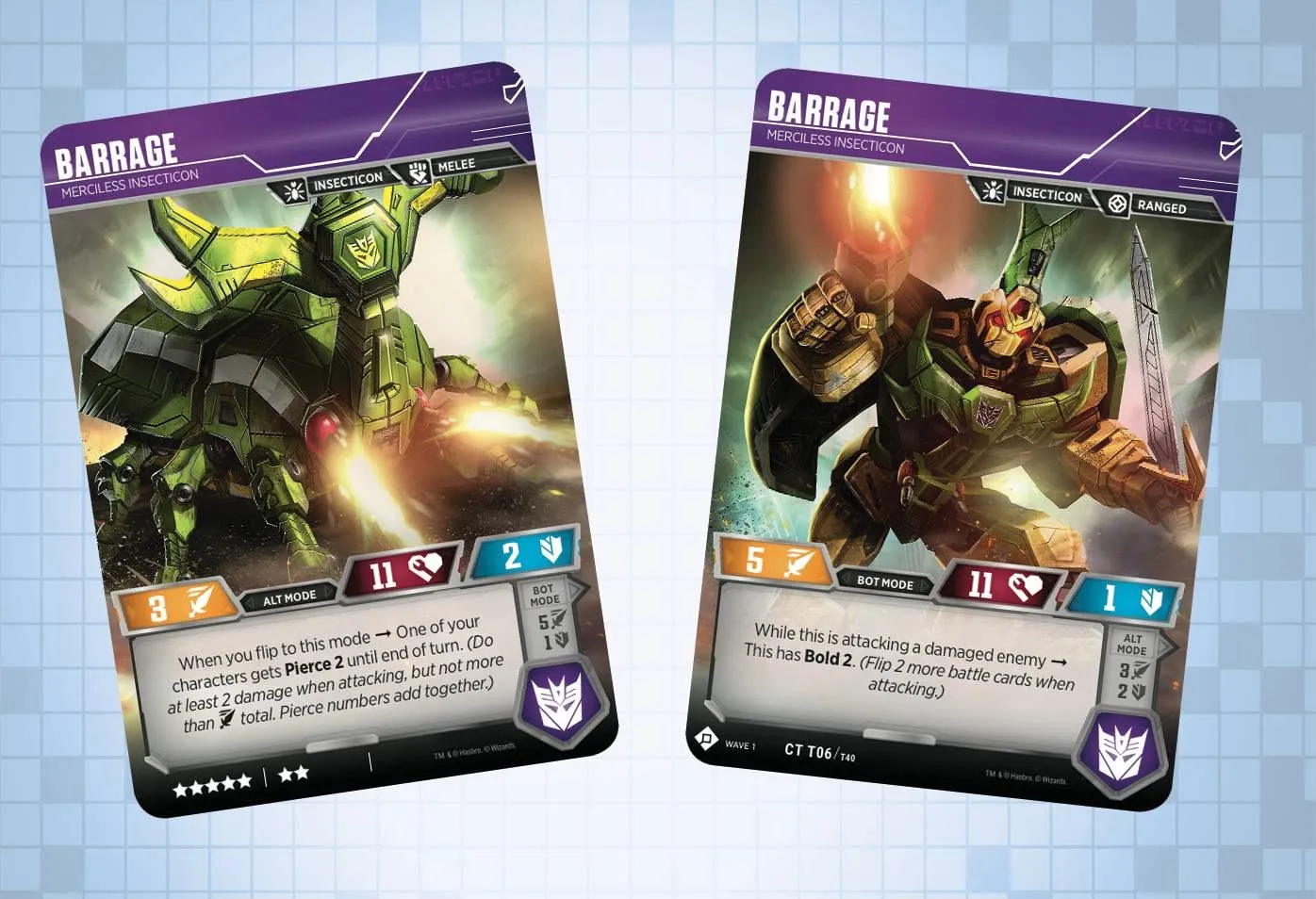
In some instances, you can force your opponent’s direct damage effect and use Reflect Damage on it. Perhaps your opponent believed they had an Overwhelming Advantage?
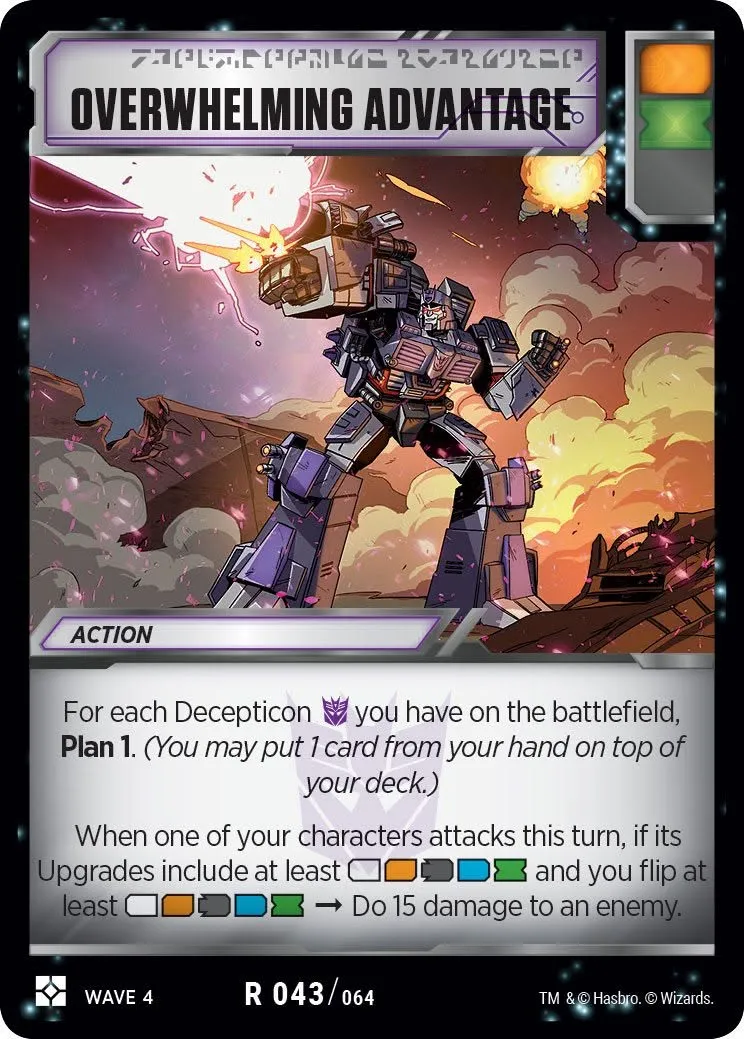
That’s a lotta damage! Back at ya!
Conclusion
That’s it for today’s previews. What do you think of Speed Trap, Reflect Damage, and Hold the Line? Do you envision your opponents falling right into your awaiting secret action reveals, swinging the game in your favor, and laughing maniacally? Do these cards answer frustrating systemic problems you’ve faced in your games? There are more secret actions hidden in Titan Masters Attack! but they will be revealed in the future.
Thanks for reading my article. Titan Masters Attack! goes on sale April 17th. I can’t wait!
Until next time, may you turn an opponent’s overwhelming advantage into an overwhelming defeat.