


This was originally posted on the Transformers TCG Facebook Page.
Greetings! I’m Ken Nagle, Design Lead for TransformersTCG.
Today I have 2 more battle card reveals for War for Cyberton: Siege I, which is Wave 3 of our releases.
They are both star cards, but I’ll be using them to illustrate the star system in general. Since your team can have up to 25 stars only, these stars are precious during deck building. I’ll reveal one preview now get us started:
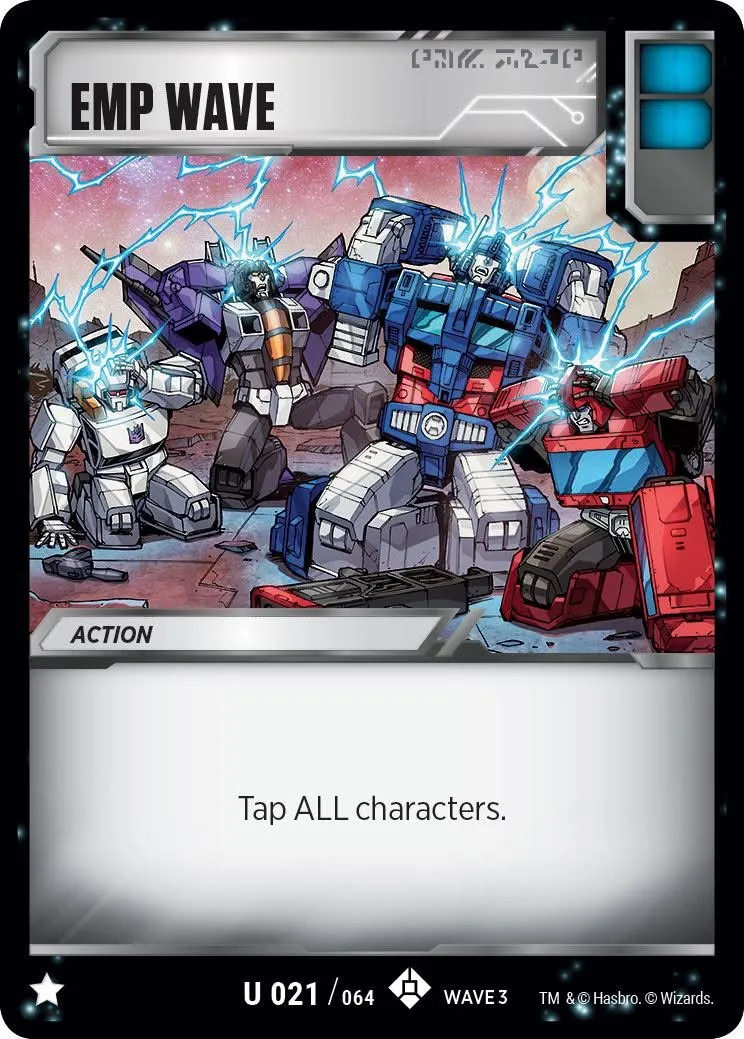
EMP Wave is better than a normal battle card so it also costs a star. I’ve written about how much we like star battle cards, but I haven’t mentioned the origin of the star system in the first place. Why have a star system at all? Is it really that useful? Why not have some other resource system?
I joined the Transformers TCG team early on, but not at the very beginning. The final prototypes were all being conglomerated and a final handoff was given to me by Bryan Hawley. It was then up to me to create the initial card set from these system rules. I’ll break it down:
- Each player starts with 3 Transformer characters. KO the enemy characters to win the game!
- You can flip one of them each turn.
- You can play 1 Action card and 1 Upgrade card each turn.
- You attack once a turn, which involves flipping cards off the top of your deck.
- Oranges add to attack, and blue adds to defense.
Today, I’ll just focus on the first point and tackle others in later articles. If every team were 3 characters, then every character would need be approximately the same power level. Also, creating a team like Metroplex and his minions or the 6 Constructicons would have to deliberately break the deck building rules by writing something like “You can have 6 characters if all of them are Constructicons” on the characters themselves. There was a “there’s probably some kind of points system here” on the prototypes but it wasn’t being enforced because it was another variable that wasn’t as important as the other changing variables in the prototypes.
When push came to shove, there needed to be an enforced costing system for characters so that big and small characters could be conveyed. We knew we wanted to be able to eventually support teams from 1, 2, 3, 4, 5, or 6, which led me to suggest 24 as the maximum star points. 24 is highly composite since it can be divided by 1, 2, 3, 4, 6, 8, 12, and 24. We landed on 25 stars as the final number since 25 stars can do everything 24 stars can but humans like counting in 5s and 10s because most of us have 5 fingers on each hand.
From that point forward, the characters cards were moved up and down in star costs where it seemed appropriate. Optimus Prime and Megatron were given 13-star versions as the largest, while the smaller Motorcycles like Arcee and Flamewar given the smallest at 5 stars.
The star system allows players to begin the game on even footing with the most important part of the game – the characters – ready to battle immediately.
If you choose to go below 25 stars, you can make up the difference with cards like EMP Wave. During these early prototypes we tried many “tap” effects that flavorfully stun, freeze, or otherwise incapacitate a character. Everything we tried was just too strong in playtesting, but now that star battle cards are an options, we decided to try again. EMP Wave in particular felt correct for War for Cybertron: Siege I because you can use a Micro Master’s tap ability to have a fully tapped team then fire off the EMP Wave to tap out the enemy team. This way you don’t “lose” an attack when you must tap your own characters. EMP Wave is when best you are outnumbered, where it can work wonders to briefly alter the battle into a 1v1 or 2v2 fight. Emphasizing its defensive nature, it has 2 blue icons to help slow down the game where it has more time to shine.
Fully Loaded
Perhaps you’re not into defense. You want to attack! You’re also pretty miffed when you only get to play one card going second. Then my next preview card is for you.
Introducing Introducing Full Loadout:
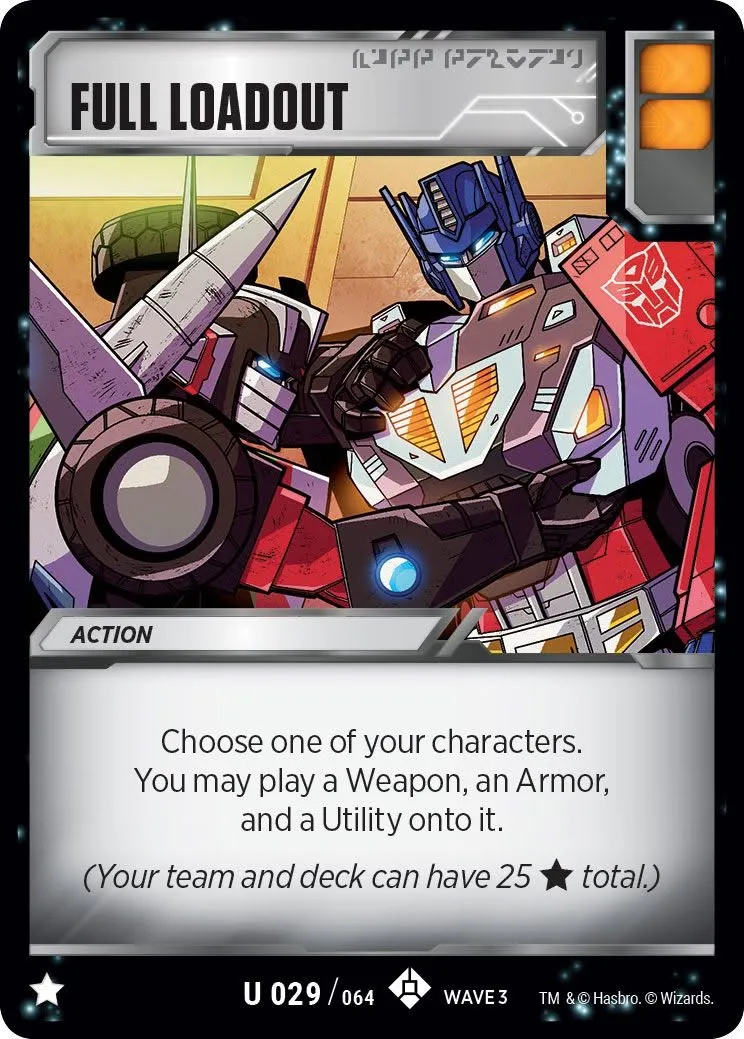
Full Loadout asks you to pile a full suite of upgrades onto one character all at once. Since, your opponent hand starts at 3 and you draw during your first turn 4, those 4 cards could be 1 Full Loadout, 1 Weapon, 1 Armor, and 1 Utility. What’s the best thing that could happen?
Conclusion
Today we discussed the star system and why it’s important. EMP Wave and Full Loadout are two new battle cards for your arsenal depending if you want defense or offense.
Thanks for reading this preview. I hope you enjoy War for Cybertron: Siege I on sale June 28th!
Until next time, may you push the brake or the gas pedal depending on the circumstance.