

Why Cards Are Banned or Replaced
Part of: Transformers TCG Ban List
Last updated October 4, 2026.
The Ban List says what is legal. This page says why.
Each entry covers one card, or a group of cards removed in a single decision: what it did, what went wrong, and what was weighed before the decision. Some of these bans and replacements are ours. Others were made by Wizards of the Coast while the game was still in print, or by the community bodies that maintained the rules afterward. Where the reasoning was published at the time, it is quoted rather than paraphrased, and the source is named. Where no formal rationale survives, the case here is reconstructed from tournament records, rulings, archived commentary, organizer accounts and the card pool itself, and each entry says so.
A ban is a last resort and reads better as a record than as an announcement. A card that had to be removed usually had something to teach about the game around it, and that is worth keeping.
What gets a card banned or replaced
Two questions sit behind every entry here. The first is what the card did wrong. The second is what to do about it, and the answer is not always a ban.
Why a card is removed
Four standards run through this page. Three are judgments about a card. The fourth is not a judgment at all.
Power. The card wins too reliably. This is the easiest of the four to argue, because you can point at results: win rates, tournament placements, the decks everyone started bringing.
Crowding out. A card does not have to win to be a problem. It can simply answer a question so completely that every other answer stops being worth considering. This is the most common charge on this page, and the one the announcements state most often in their own words. It runs in two directions, and the difference matters.
Looking backward, the card displaces what is already in the pool: Press the Advantage left the competitive field lopsidedly Autobot, Mission Briefing “made many draw cards obsolete,” Fusion Borer “effectively removes many other Weapon choices from deckbuilding considerations and play,” and Impetuous Stand pushed out nearly every other Upgrade-removal card in the game.
Looking forward, it forecloses what has not been written yet: Wizards closed the space behind Multi-Mission Gear by ruling out further Upgrades that buy Actions, Horri-Bull made a ⬛️ battle icon “you may play another…” card unprintable, and protective cards were being templated around Impetuous Stand before it was removed. Mission Briefing did both, and the announcement said so in one breath: it “limited design space greatly.” In each case the complaint is about the cards that disappeared or never arrived, not the games that were lost.
Experience. The card makes games unpleasant to sit through even when it is beatable: solitaire turns where one player watches, play patterns demanding bookkeeping no card asks for, arithmetic that slows a round to a crawl.
Both eras recognized this. They weighted it differently. Wizards of the Coast cited it readily as an aggravating factor, objecting that the fastest Daring Escape builds left no window to interact “while also being frustrating to play against,” and capping Wave 1’s double-icon cards because decks that simply played them all took “a very exciting mechanic” and made it “both dull and frustrating to play against.” What the official era did not do was treat the complaint as sufficient on its own. Decks built around Daring Escape and Sergeant Springer were experientially notorious and neither card was touched: at the Energon Invitational in December 2019 the pilot of the best-known build laid out paper counters so his opponent could follow the stack, and complaints about solitaire gameplay were already loud.
The community era treats it as sufficient. Negative play experience, particularly solitaire-like turns and cumbersome tracking, is cited as a factor in the community bans of Daring Escape, Sergeant Springer // Special Ops • Aerial Defense and Decepticon Quake // Ground Assault, all three of which survived the official era untouched.
That difference produces the sharpest disagreements on this page, and it is worth naming rather than smoothing over. A player who learned the game under the official rules may find a community ban unfamiliar, because it acts on something the earlier stewards were willing to record as a complaint but not to treat as a reason by itself.
Legality. The fourth standard is not a judgment. The card was never legal for tournament play to begin with, and the list says so to end the argument. It is housekeeping, and the only entry of its kind here is Optimus Prime // Inspiring Leader.
Ban, or replace?
Deciding a card is a problem does not settle what to do with it. Of the nineteen covered on this page, nine are banned outright, eight are replaced, and two are both, depending on the format.
What separates them is whether the card was also doing a job the format still needs. Where the effect is simply the problem, the card can go. Where the card additionally fills a role nothing else fills, banning it takes the role away too, and a replacement does the surgery instead: keep the job, remove the property that broke it.
That is why the replacements here sometimes look nothing like the cards they replace. One lost an icon and kept its text; one kept its icons and gained a clause; two kept their icons and lost their effects entirely; one lost a point off each of its numbers; one had only its star count corrected; one kept its effect and lost the reach of it; one was abandoned outright, its job handed to a different card. Each removed the property that caused the trouble and left the rest alone.
Before either: Garrus-9
A permanent decision was not the community’s first instrument. Through Tournament Season One and into early Season Two, a card turning up too often in competitive events could be sent to Garrus-9: a temporary suspension lasting one to three events, the length scaling with how many times that card had been sent before.
It is a graduated and reversible tool, and it does something a ban cannot. It takes a card out of the field long enough to see what the format looks like without it, while leaving open the possibility that the answer is nothing much and the card comes back. A card that keeps returning is a card the format keeps failing to absorb, and the record of repeat sentences is evidence that accumulates on its own.
Four cards are worth reading as a group:
Fangry // Sky Tracker · Horri-Bull // Ground Trooper · Decepticon Quake // Ground Assault · Sky Shadow Sync
Every one of the four is from Wave 5. Every one of the four is permanently banned or replaced today, and their repeat stints in Garrus-9 were cited as a factor in each of those decisions. They were not the only residents: Impetuous Stand, the community’s own card covered below, was sent at least twice. Garrus-9 was not a substitute for the eventual rulings so much as the record that made them straightforward to argue.
The process itself is referenced in the archive by a player asking what became of it, in March 2024 Updates, which places its use in “Season 1 and early Season 2.”
What the event lists show
The events published their own ban lists, and seventeen of those survive, running from Season One Encounter 1 on February 8, 2021 to Season Two Encounter 4 on June 30, 2023. Each names both the permanently removed cards and whatever was serving a suspension at the time, so reading them in sequence shows the instrument working: cards appear on the lists, and some of them disappear again.
Three disappeared and never returned to a list. All three are legal today:
- Fight For Position, suspended for one event, Encounter 4 on July 31, 2021.
- Turnabout Snare, suspended for two, Encounter 5 and the Psi Pre-Invitational, September to November 2021.
- Autobot Pipes // Idiosyncratic Collector, the longest resident to be let go, across July 2022 to January 2023.
Those three are the whole case for a reversible instrument. Each was taken out of the field long enough to see what the format looked like without it, and in each case the answer was that the format did not need the removal made permanent.
Five came off and went back on before anything was settled. Four of them are the group named above; the fifth is a Wave 1 pair:
| Card | First suspended | Times it came off again | Where it ended |
|---|---|---|---|
| Peace Through Tyranny and Security Checkpoint | Encounter 2, April 3, 2021 | once | Replaced |
| Decepticon Quake // Ground Assault | Encounter 4, July 31, 2021 | twice | Banned |
| Fangry // Sky Tracker | Encounter 4, July 31, 2021 | twice | Banned |
| Sky Shadow Sync | Encounter 5, September 25, 2021 | twice | Replaced |
| Horri-Bull // Ground Trooper | Omega Invitational, March 28, 2022 | once | Banned |
That is the shape the section above describes, in the events’ own records: a card that keeps coming back is a card the format keeps failing to absorb, and by the third sentence the argument for a permanent decision is mostly already written.
A caution about reading these lists. An appearance on an event’s list establishes that the card was out of play at that event, not the date a formal decision was taken.
Optimus Prime // Inspiring Leader
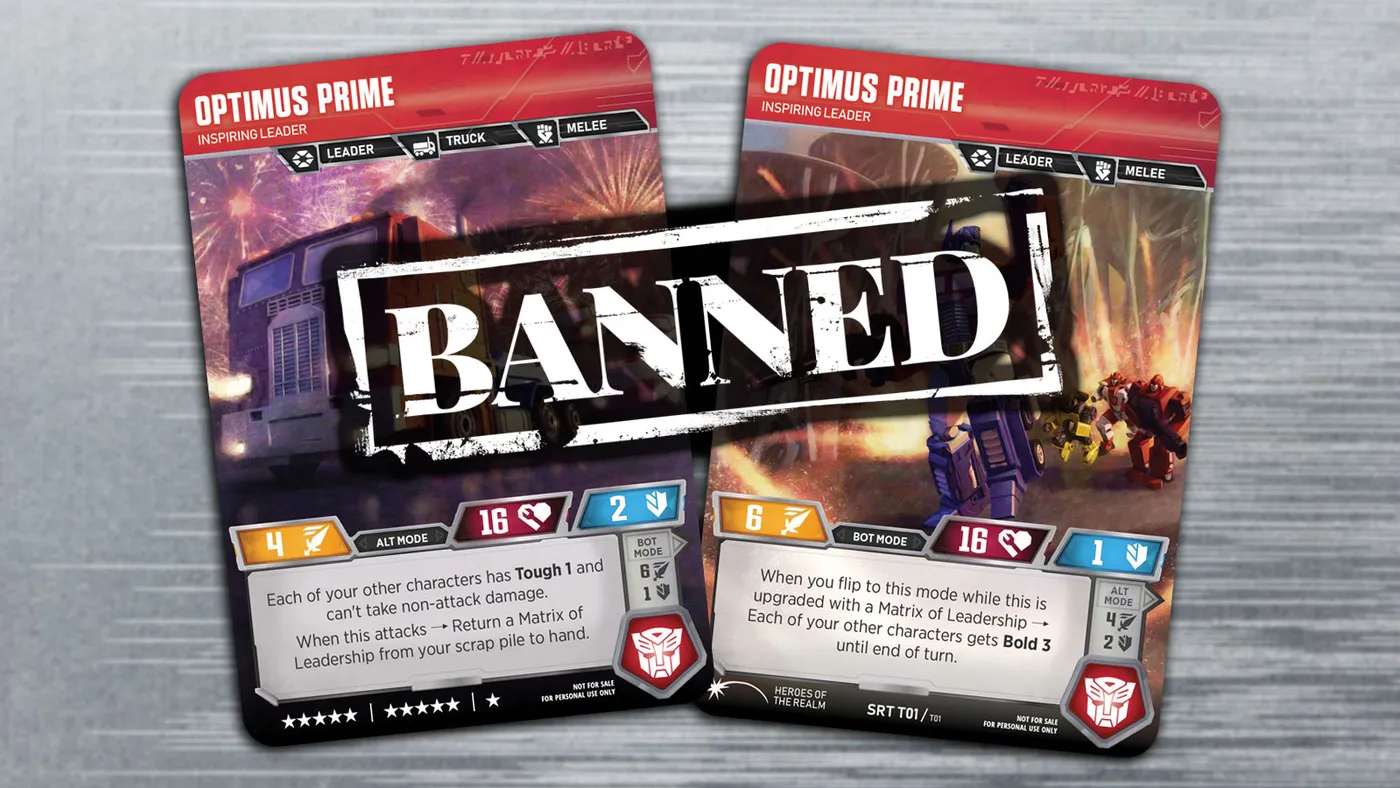
Banned, and the only entry on this page banned for a reason that has nothing to do with how it plays.
Optimus Prime // Inspiring Leader was a Wizards of the Coast house promo, produced in 2018 for staff rather than for sale. It is a Heroes of the Realm card, a line given to Wizards employees and never sold or distributed publicly, and not every employee received one. It was never part of a set, never in a booster, and never intended for tournament play. A small number of copies nonetheless reached the open market, which is where the question starts.
It is also, physically, two games at once. One face is an oversized Magic: The Gathering card; the other carries Optimus Prime’s two modes, laid out like the multi-mode character cards the Transformers TCG already used.
Why a card nobody could buy needs banning
Statements were made at the time about the card’s intended legality. Contemporaneous coverage was unambiguous: Wossy Plays, covering the card in December 2019, closed by noting that it is not legal for tournament play as a Transformers card, and not legal for tournament play as a Magic: The Gathering card either. But it never appeared on an official ban list. That left an odd gap: a card that existed, that a handful of players owned, and that no published document actually excluded. An unanswered question of that kind does not stay unanswered forever. Sooner or later someone brings the card to an event, and a judge has to rule on it with nothing to point at.
The community era closed the gap by listing it. The entry is not a verdict on the card’s power and should not be read as one. It records that the card was never legal, so that nobody has to relitigate it at a table.
What it actually does
Worth recording, because the reason anyone asks about this card’s legality is that it is genuinely interesting. As described in contemporaneous coverage, both of its abilities are built around a single Upgrade, Matrix of Leadership, which is unusual in itself:
- In bot mode, flipping to that mode while upgraded with Matrix of Leadership gives each of your other characters Bold 3 until end of turn.
- In alt mode, your other characters have Tough 1 and cannot be dealt non-attack damage. When it attacks, you search your scrap pile for Matrix of Leadership and put it into your hand, so the card that switches the whole thing on keeps coming back.
It is a Leader in both modes, which matters because Matrix of Leadership rewards Leaders. Note also that neither ability does little for Optimus Prime himself; both primarily support the rest of the team.
The non-attack damage clause is the eyebrow-raiser. The comparable ability on Wave 2’s Motormaster // Stunticon Leader stops non-attack damage from an opponent’s cards. This one stops non-attack damage outright, including your own, which turns a card like Photon Bomb into a potent one-sided direct damage attack.
None of that bears on the ban. It is here because “the card was never legal” reads differently once you know people had a reason to want it.
The modernized version, and where it lives
A modernized version of the card exists in the Black Hole, the archive at the center of the transformerstcg.org Tabletop Simulator table that preserves historical fan material for casual play. Players can pick it up and try it there.
That changes nothing about legality, and the Black Hole’s standing rule is the one that applies: inclusion there is not legality. Every version of this card, the original promo and the modernized one alike, is banned outside casual play. In casual play the ordinary rule governs instead, which is that everyone at the table agrees on the pool beforehand.
Further viewing
- Crazy Rare Optimus Prime is a Magic Card… AND a Transformers TCG Card!, Wossy Plays, December 7, 2019. A full read of the Transformers side, and the clearest contemporaneous statement that the card was legal in neither game’s tournaments.
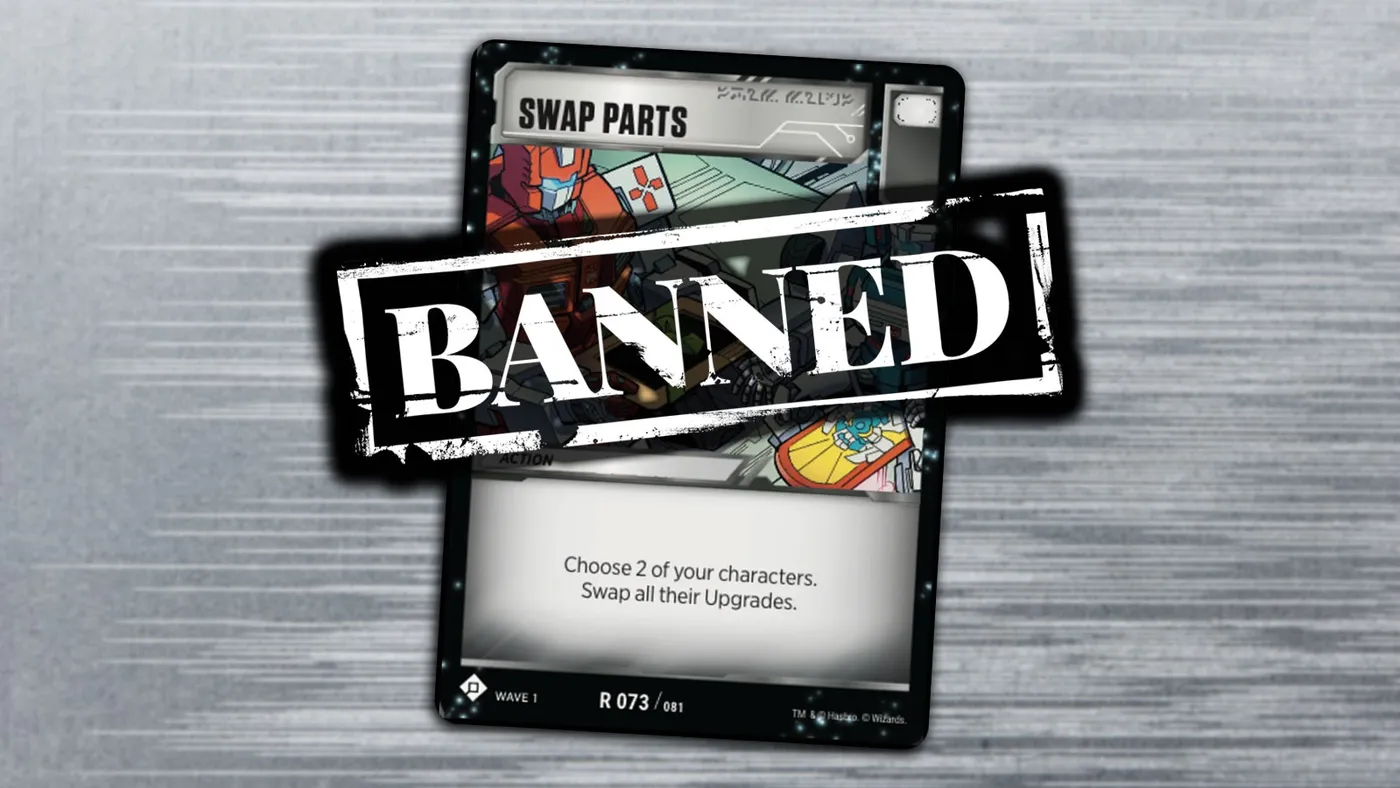
Swap Parts
Banned. Wave 1, R 073/081. An Action with a ⬜️ battle icon, reading “Choose 2 of your characters. Swap all their Upgrades.”
Swap Parts was the first card ever banned in the Transformers TCG, in April 2019, five months after the game’s launch and shortly after Rise of the Combiners arrived. Looking at it, that is hard to believe. It swaps equipment between two of your own characters. It does not draw, damage, or untap anything.
What broke
The problem was never the card. It was a ruling about what counts as attaching an Upgrade.
Several Upgrades do something when they are attached to a Specialist:
- Multi-Mission Gear lets you play an action from your hand.
- Multi-Tool lets you play an upgrade from your hand.
- Field Communicator lets you play the top card of your deck, which does not need to be in hand at all.
Swapping an Upgrade from one character to another counts as attaching it, so those abilities fire again. With three such Upgrades on each of two Specialists, one Swap Parts moves six Upgrades and triggers six abilities: two more actions, two more upgrades, and the top two cards of your deck.
That is a strong turn. On its own it is not a banned card. Two more pieces made it an engine rather than a burst.
Chromia // Special Ops returns a card with at least one ⬜️ icon from your scrap pile to your hand when she flips to alt mode. Swap Parts has a ⬜️ icon, so it comes back every time she flips. The combo stops being something you draw and starts being something you repeat.
Peace Through Tyranny and I Still Function! then removed the turn limit. Peace Through Tyranny grants an extra turn at the cost of KO’ing one of your own characters of six stars or more. I Still Function! returns a KO’d character of twelve stars or fewer to the battlefield. Used together, the character you sacrifice for the extra turn comes straight back to be sacrificed again.
The result was a deck that took effectively unlimited turns, played an absurd number of cards per turn, and did not attack at all. It won with a single copy of Plasma Burst dealing two damage, over and over, across turns the opponent never got to take.
Community estimates at the time put the combo’s success rate near 70%, which in a best-of-three match is close to a guaranteed series win.
What Wizards said
The design team set out their reasoning publicly rather than simply issuing the ban. Their stated vision for the game was that it be “a worthy expression of the Transformers brand and its characters, a fun fast exciting game you can play with your friends, and a game they can keep supporting into the future.”
The combo failed all three. Characters are meant to be the focus of the game, and this deck set them aside: it stopped attacking, left its own characters tapped, and reduced the opponent to a spectator. It also closed off future design. As long as the combo existed, no further card like Peace Through Tyranny, I Still Function!, or Swap Parts could be printed without making it more reliable, and Specialists could not be supported freely because every new Specialist fed it.
What was tried first
A ban was not the first answer. The alternatives considered, and why each was rejected:
| Option | Why it failed |
|---|---|
| Cap extra turns at one | Tested against a burn build using three Strafing Runs. It helped, but not enough. |
| Impose a maximum hand size | Would have had players counting each other’s hands every turn, for an unrelated problem. |
| Limit the deck to one copy of the key cards | The combo still assembled with single copies. |
| Make Swap Parts not re-trigger attach abilities | Introduces a rule the card does not state, which breaks how the cards were designed to read. |
| Errata the pieces to be weaker | Same objection: the card in a player’s hand would no longer say what it does. |
Each surviving option asked players to track something invisible or to learn a rule printed nowhere on the card. Removing one card from one format was the smaller cost.
Was it the right call?
It cost players something real. Swap Parts is a rare, so some players opened a pack whose only rare was a card they could not play, and the card itself was not the problem: the ruling about attach triggers was. Wizards chose the solution that kept the cards readable over the one that kept the collection whole.
At the time, Wossy covered the ban and agreed with it, on the grounds that every other option meant either extra rules to check or card behavior that was not written on the card.
The ban has stood ever since, through the end of official support and across every community rules body that followed. Swap Parts remains banned in transformerstcg.org organized play today.
Further viewing
Three videos in the archive touch this card. Each is described here only as far as its own published description goes.
- First Ever Transformer TCG Card BANNED!, Wossy Plays, April 17, 2019. The ban as it happened, the combo in full, and the alternatives that were weighed first.
- WTF@TCG: Four Spoilers From Three, Vangelus with Drew Nolosco, April 19, 2019. Recorded two days after the ban, with what its description calls discussion of the Swap Parts Infinity Engine: the combo had a name in the community by then.
- New Transformers Infinite Combo Deck Discovered?, Wossy Plays, July 7, 2019. Roughly three months later, its description asks whether Private Red Heat // Infantry • Emergency Response brings the same problem back: “Swap parts got banned a little while ago. Well now we have Red Heat and we might have the whole problem again.”
That last one is the open thread, and it resolved quietly: Private Red Heat was never banned, and the card is legal today.
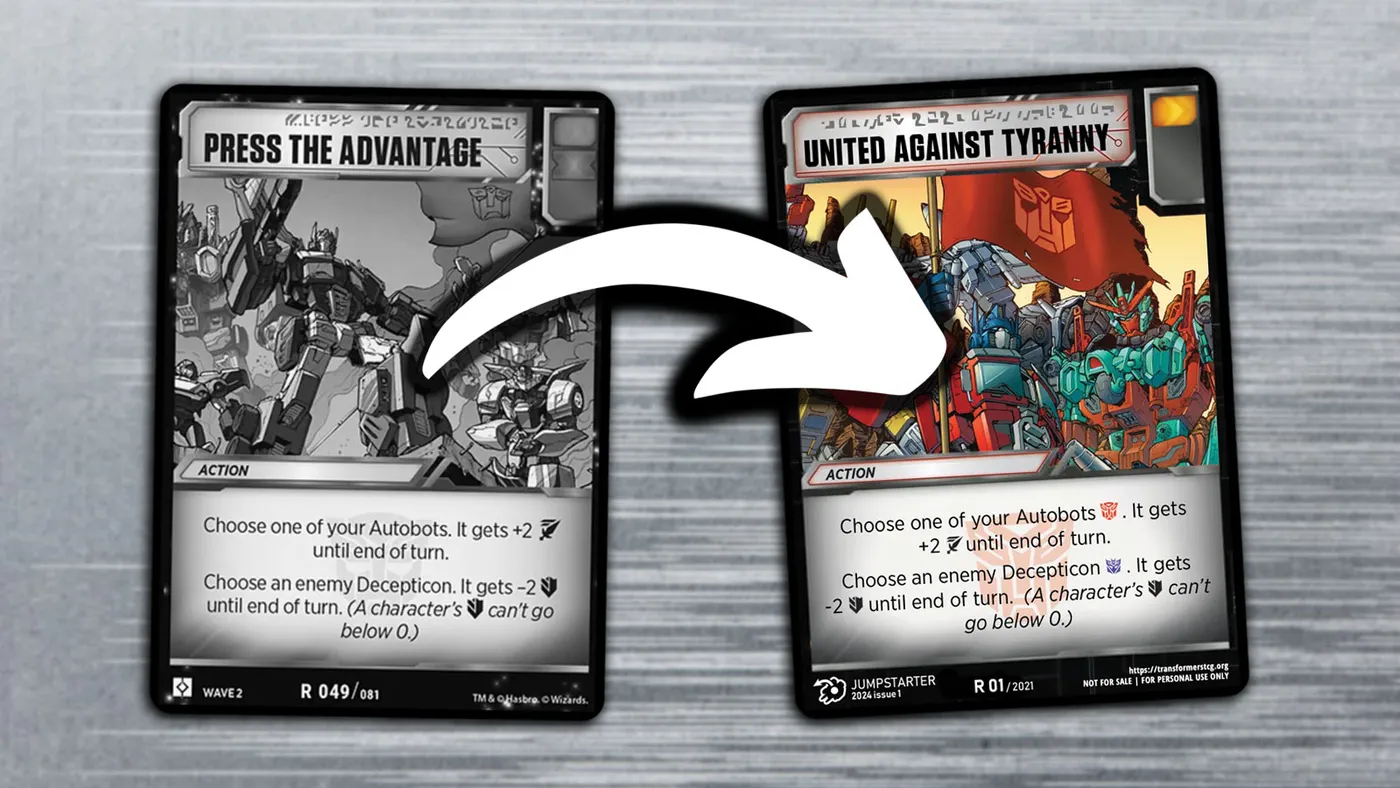
Press the Advantage
Replaced, by United Against Tyranny. Wave 2, R 049/081. An Action with 🟧 and 🟩 battle icons:
Choose one of your Autobots. It gets +2 Attack until end of turn.
Choose an enemy Decepticon. It gets -2 Defense until end of turn. (A character’s Defense can’t go below 0.)
This card has two chapters. Wizards of the Coast banned it in October 2019, the second ban in the game’s history. Years later the community brought the effect back with one icon removed, and that version is what you play today.
What it did
Against a Decepticon team, Press the Advantage is effectively +4 Attack on one swing: +2 to your Autobot and -2 off their Defense. Against a character with no Defense it is only +2, so the floor is lower than the ceiling, but the floor is still a fine card.
For comparison, Wave 1’s Leap Into Battle gave +3 Attack, and Grenade Launcher gave +4 but scrapped itself once the upgraded character attacked, so it was limited to exactly one swing.
Why the 🟩 icon was the real problem
A Transformers TCG deck gives you far more flips than draws. You draw one card a turn; you flip two attacking and two defending, more with Bold or Tough. So a card you can only draw is a card you often never see, even at three copies.
The 🟩 icon changes that. Flip it in a battle and you may swap it for a card in your hand at the end of that battle, which means the card finds its own way into your hand. Press the Advantage was not a card you hoped to draw. It was a card you could count on.
That is the difference between a strong card and a format-defining one, and it is what separates it from its own obvious comparison.
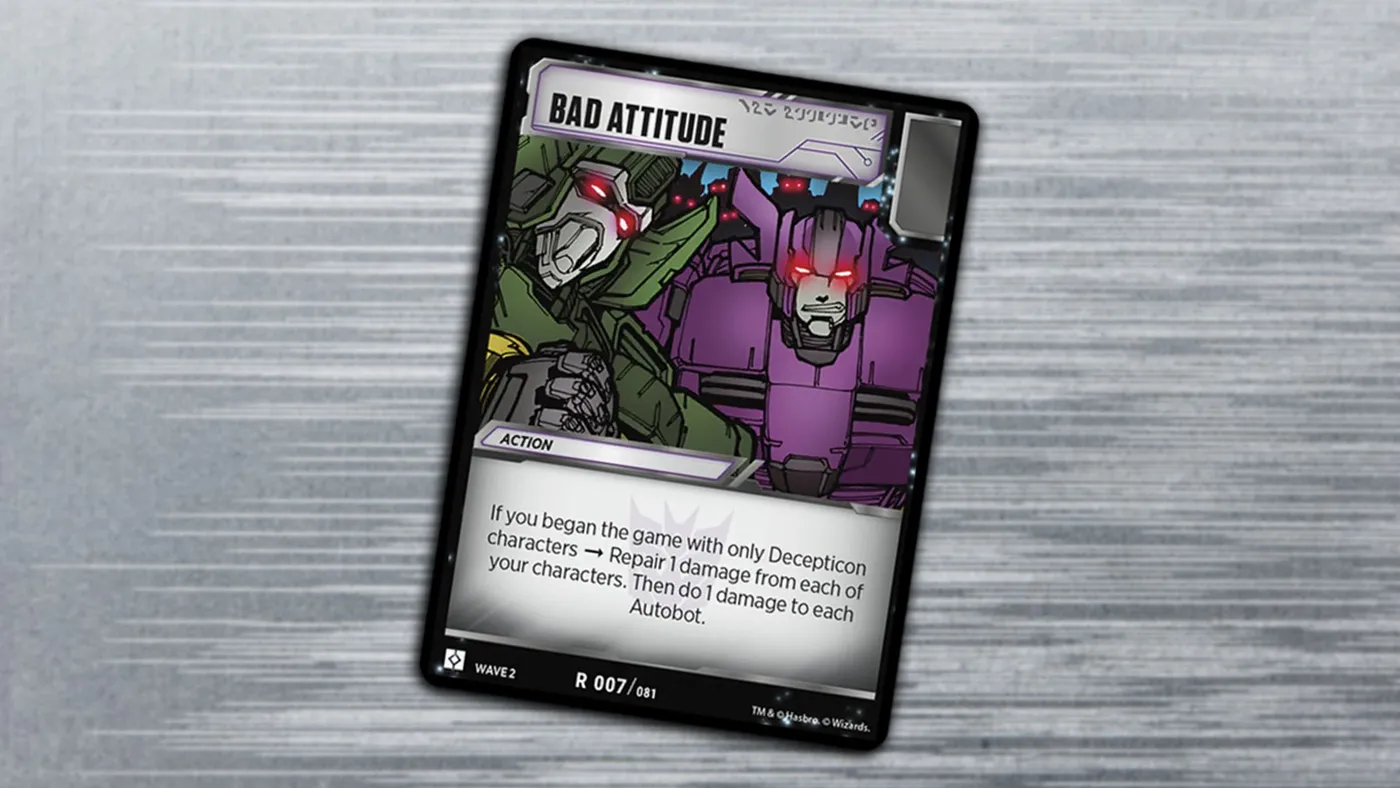
The Decepticon side of the pair
Faction cards in this era usually arrived in matched pairs. Wave 2’s Noble’s Blaster (U 045/081) and Scoundrel’s Blaster (U 055/081) are the clean example: both Weapons, both 🟦🟩, both +2 Attack, each restricted to its own faction, and each granting Pierce 2 while attacking the other faction. Change the faction names and the two cards are the same card.
Press the Advantage had no such twin. The nearest Decepticon card was Bad Attitude (Wave 2, R 007/081):
If you began the game with only Decepticon characters → Repair 1 damage from each of your characters. Then do 1 damage to each Autobot.
It is a reasonable effect, and it has no battle icons at all. That cuts both ways. Cards without icons tend to be strong, because they give up all flip value, but it also means Bad Attitude can only ever be drawn, and a Decepticon player who never draws it gets nothing. Its worst case is doing almost nothing; Press the Advantage’s worst case is +2 Attack on a card you were always going to find.
Why it was banned
By late 2019 the competitive field had gone lopsidedly Autobot. According to contemporaneous coverage of the announcement, the design team had asked players directly why they were not building Decepticon decks, and the most common answer was this card.
The alternatives, and why each was rejected:
| Option | Why it failed |
|---|---|
| Limit it to one copy per deck | The 🟩 icon means even a single copy is findable, so the restriction does little. |
| Errata the 🟩 icon away | A new player’s card would no longer do what it says, and they would learn that at a tournament from an opponent. |
| Print a Decepticon or Mercenary equivalent | Pushes deck building further toward a small set of must-play cards rather than opening it up. |
| Wait for Mercenaries to dilute the matchup | Press the Advantage only gives its full value against Decepticons, so a third faction weakens it. But that depended on Mercenaries actually seeing play, which was a hope rather than a plan. |
The ban went out on Thursday, October 17, 2019.
The second chapter: United Against Tyranny
The community did not leave it there. United Against Tyranny first appeared in Wave 6: World|Strike (R 057/062), Team Bayformers’ January 2021 release, and it carries Press the Advantage’s text word for word. What it does not carry is the 🟩 icon. It has 🟧 only. Its flavor line says the quiet part out loud: “Pressing a better advantage.”
That is a precise piece of surgery. Every diagnosis at the time of the ban pointed at the same culprit: not the +4 swing, but the reliability the 🟩 icon gave it by letting the card fetch itself out of a battle. Remove the icon and the card becomes what it always should have been, a strong Autobot effect you have to draw. Keep the text and nobody has to learn that a card means something other than what it says, which was the objection that killed the errata option in 2019.
It has since been reprinted in the Jumpstarter Update Booster (2024 issue 1), which is how a player updates an older collection without rebuying a Wave.
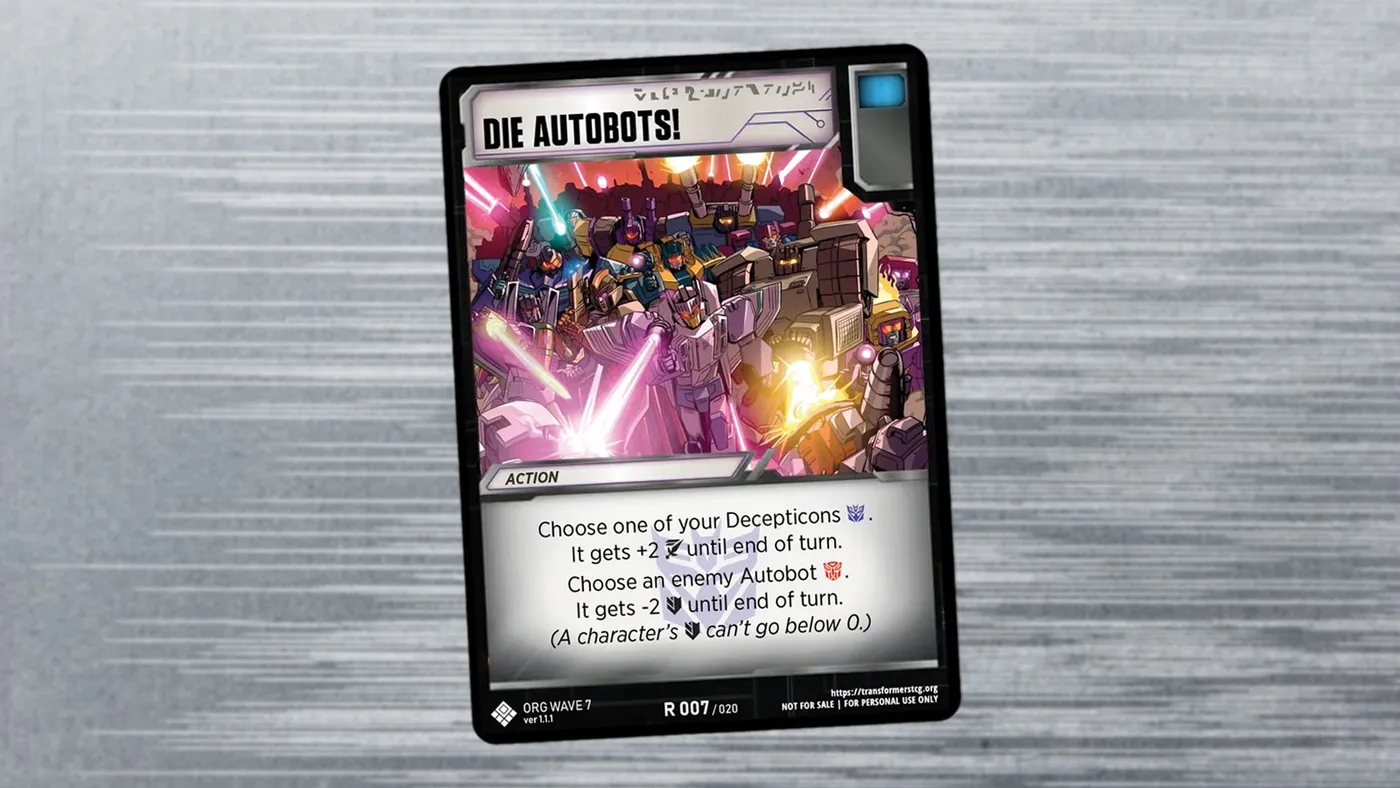
The twin it never had: Die Autobots!
Press the Advantage was banned partly for having no Decepticon counterpart. The community eventually printed one.
Die Autobots! mirrors United Against Tyranny exactly, with the factions swapped:
Choose one of your Decepticons. It gets +2 Attack until end of turn.
Choose an enemy Autobot. It gets -2 Defense until end of turn. (A character’s Defense can’t go below 0.)
It carries a single 🟦 icon, as its counterpart carries a single 🟧. Neither has 🟩, so neither can go looking for itself, and the matched pair that Wave 2 never printed exists now on both sides.
The card was introduced in Turbo Revving Old Punks’ Phase One, folded into Wave 7: Monster Menagerie when that group’s two releases were combined, and remastered as Org Wave 7 (R 007/020), where it is legal today.
Press the Advantage itself remains illegal in its original printing.
Further viewing
Six entries in the archive touch this card, more contemporaneous video coverage than any other ban of the official era received, including two videos in the week it happened. Each is described here only as far as its own published description goes.
- Press The Advantage Raises Your Attack AND Lowers Their Defense, Wossy Plays, February 17, 2019. The card as a new spoiler, eight months before the ban.
- A Second BANNED card?! / Rotation Specualtion?!, Powered by Primus, October 17, 2019. Same day as the ban.
- Card BANNED! (2nd Ever!) (Autobots Too Good!), Wossy Plays, October 19, 2019. The ban covered in full, including the alternatives weighed and the mercenary question.
- Unban? Ban? (Talk), Powered by Primus, June 29, 2020. Its description offers thoughts on unbanning one card and banning another, nine days before the game’s cancellation was announced.
- Catching up? SDotBattlegroundz? … Press The Advantage?!!, SDotTCG, November 10, 2020. The card still under discussion months into the community era.
- Org Wave 0 announced!, transformerstcg.org, June 2, 2024. Not about this card, but the clearest statement of the replacement program it belongs to: a release built to house replacements for banned cards.
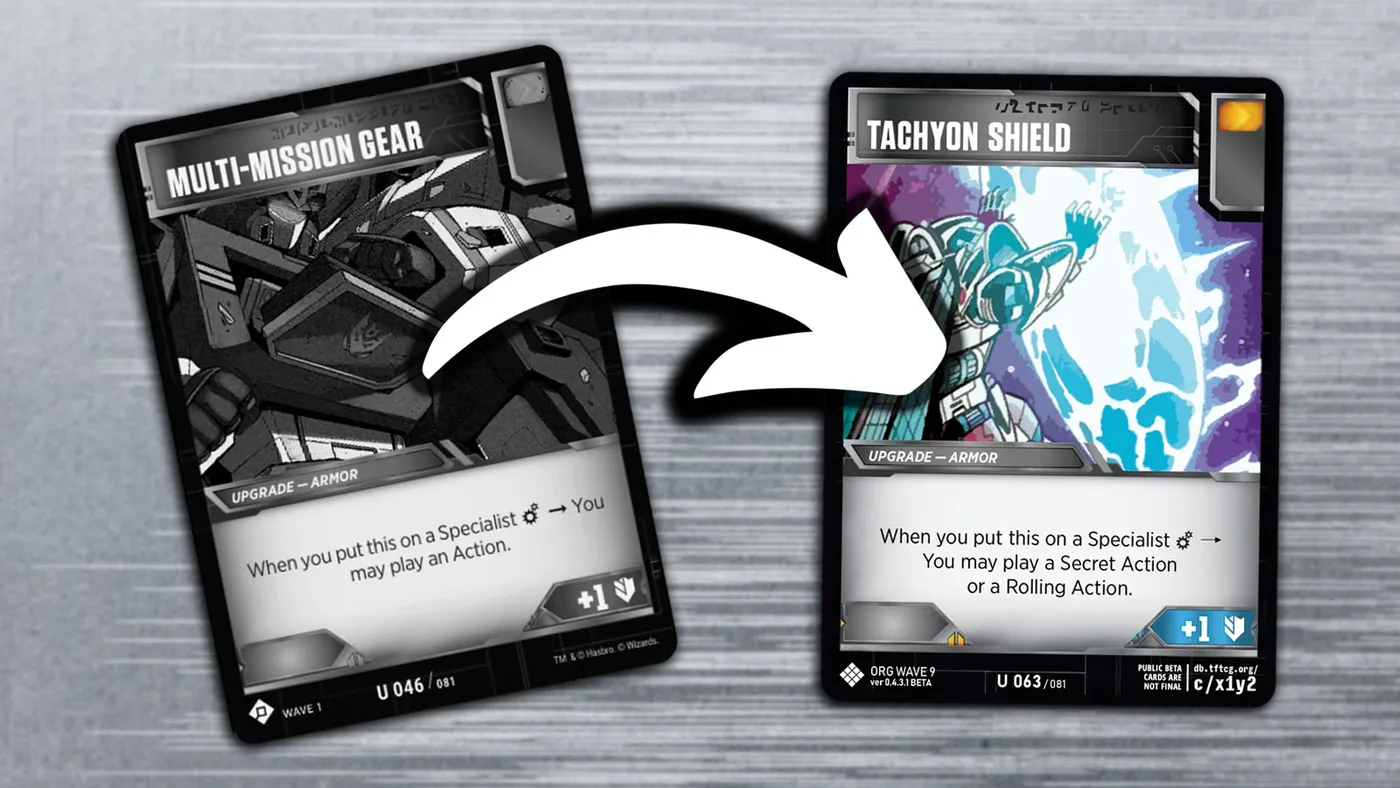
Multi-Mission Gear
Banned at non-Harmony events, and replaced by Tachyon Shield at Harmony ones. Wave 1, U 046/081. An Upgrade (Armor) with a 🟧 battle icon and +1 Defense:
When you put this on a Specialist → You may play an Action.
This is the third card ever banned, in November 2019, and it is the only one of the three banned for what a different card could do with it.
The rule it bends
A turn normally allows one Action and one Upgrade. Multi-Mission Gear is an Upgrade that buys an Action, so it quietly doubles the most restrictive part of a turn. It has two siblings: Multi-Tool (an Upgrade that buys an Upgrade) and Field Communicator (which plays the top card of your deck). Those three Specialist tools also powered the combo behind the game’s first ban, covered under Swap Parts above.
On its own that is a fun, slightly pushed card. The problem arrived with a win condition that rewarded playing your entire deck.
The deck it fed
Daring Escape (Wave 4, R 014/064) is an Action with 🟦🟩 icons:
For each Autobot you have on the battlefield, put the top card of your deck into your KO area face up.
If your deck and scrap pile are empty → You win the game.
That is an alternate win condition: empty your own deck and scrap pile, with every other card in hand, attached to a character, or in the KO area. Getting there means drawing and playing an enormous number of cards in a short time, which is exactly what the Specialist tools do.
Two Wave 3 cards made it fast:
Private Red Heat // Infantry • Emergency Response is a Specialist whose tap skill reads “Scrap a ⬜️ card from your hand → Choose 2 of your characters and swap all their Upgrades.” That is Swap Parts on a character, at the cost of a tap and a card. Because swapping an Upgrade counts as attaching it, two Specialists each carrying Multi-Mission Gear, Multi-Tool and Field Communicator fire all six abilities at once.
Sergeant Cog // Artillery • Mechanic does it on the opponent’s turn. When Cog is KO’d he becomes Heavy Force Defensebreaker Cannon, an Upgrade reading “When you put this on a character → Draw a card for each character you have on the battlefield. Then you may play an Upgrade onto each of your characters.” One of those Upgrades can be Multi-Mission Gear, which then buys an Action, and the chain starts on a turn that is not yours.
Add the cards that already multiply actions and draws, Brainstorm, Confidence, Leap of Faith, Pep Talk, Equipment Enthusiast, and the deck plays itself out and wins without ever attacking.
The build that was circulating
This was not theorycrafting. Four days before the ban, Wreck ‘n Rule published a guest article by Carl Endres (Technomagus) laying out “Specialist Escape”: Private Red Heat, Sergeant Chromia // Special Ops • Counterintelligence and Sergeant Springer // Special Ops • Aerial Defense, running Multi-Tool and Field Communicator with Daring Escape as the win condition.
Its own description of the key turn is the clearest summary of the problem anyone wrote at the time: transform Red Heat, pitch a ⬜️ card to swap Upgrades between two characters, and “a flurry of triggers then happen”, chaining draws and actions into the win. The author described the deck as needing “an intimate understanding of trigger timing”, which is another way of saying the turn is long and hard to follow.
A published, reproducible list carrying a non-interactive win condition, four days out, is the context the ban was issued into.
Why this card, and not the others
The obvious objections were raised at the time, and answered.
Why not ban Daring Escape? Because an alternate win condition is a legitimate thing for a card game to have. Daring Escape was not the problem; the engine that assembled it in a couple of turns was.
Why not change the rule so swapping an Upgrade does not re-trigger it? That rule is what made Swap Parts bannable too, so it looked like the root cause. The designers declined, on the basis that the interaction itself was not the problem, and said instead that no further Upgrades would be printed that buy Actions. That answer is also why Private Red Heat was never banned despite reproducing the banned card’s effect.
Why Multi-Mission Gear specifically? It is the only Upgrade in the game that buys an Action. Plenty of cards let you play extra Actions; none of the others let you start or restart that chain from the Upgrade slot, which is what let the deck recover after running out of steam.
The published reasoning was explicit that combo decks were not the target:
We believe that combo decks are an important part of a healthy metagame, but implicit in that belief is that the combo decks are slow enough to race and provide windows for interaction. We originally believed that the hate cards that came out in Siege II gave players multiple avenues to fight the combo. The most cutting-edge versions of the fast Daring Escape combo deck, including a variant that goes off on your opponent’s turn, meet neither of those requirements while also being frustrating to play against.
The timing
The ban landed roughly a week before the Energon Invitational, the championship of Wizards’ organized-play season, whose prize was designing a card with the game’s designers. Banning a card that close to a major event is unusual, and the announcement acknowledged it: the alternative was a tournament decided by whoever assembled the combo first.
Private Turbo Board // Air Command • Evac (Wave 4) was the designated counter, limiting an opponent to two cards on their turn. It was not enough. transformerstcg.org’s own January 2024 review of nerfs puts it plainly: “Despite its apparent design intent as a silver bullet against Daring Escape decks, Private Turbo Board, Air Command • Evac did not defend against the most abusive competitive decks.”
What happened next
Banning Multi-Mission Gear slowed the deck rather than killing it. The archive bears that out: Daring Escape gameplay videos continue through 2020, months after the ban.
The community eventually went further than Wizards had, but not quickly. Daring Escape stayed legal through most of 2020 and well into the post-cancellation era; what finally moved the community was a tournament result in early 2021. See Daring Escape below.
Multi-Mission Gear itself has the most unusual status on the Ban List. It is banned at ordinary events, and replaced at Harmony events by Tachyon Shield (Org Wave 9, U 063/081), which keeps the Armor frame, the 🟧 icon and the +1 Defense, and narrows the payoff:
When you put this on a Specialist → You may play a Secret Action or a Rolling Action.
Still an Upgrade that buys something. No longer an Upgrade that buys any Action, which is the specific property that made the chain restartable.
The replacement went through the Org Wave 9 alpha and early Beta under a different name. It was revealed in September 2024 as Aspis of the Soothsayer, and renamed Tachyon Shield on December 17, 2025, once a canon source for the name was found in Transformers: Cybertron. Anyone reading the older announcement is looking at the same card.
Further viewing
- Multi-Mission Gear BANNED! (Game-Breaking Combo!), Wossy Plays, November 28, 2019. The ban, the deck, the alternatives, and the Energon Invitational timing.
- DARING ESCAPE Deck vs General Optimus/Smokescreen/Turbo, Wreck ‘n Rule, November 10, 2019. The deck in play, eighteen days before the ban.
- Jan 2024 Big Beta Bash Nerfs, or Transforming With Intent, transformerstcg.org, February 9, 2024. The community-era view of counter cards, nerfs, and why Daring Escape was eventually banned.
- Revealed from Org Wave 9: Aspis of the Soothsayer!, transformerstcg.org, September 4, 2024. The replacement’s first public appearance, under the name it carried before Tachyon Shield.
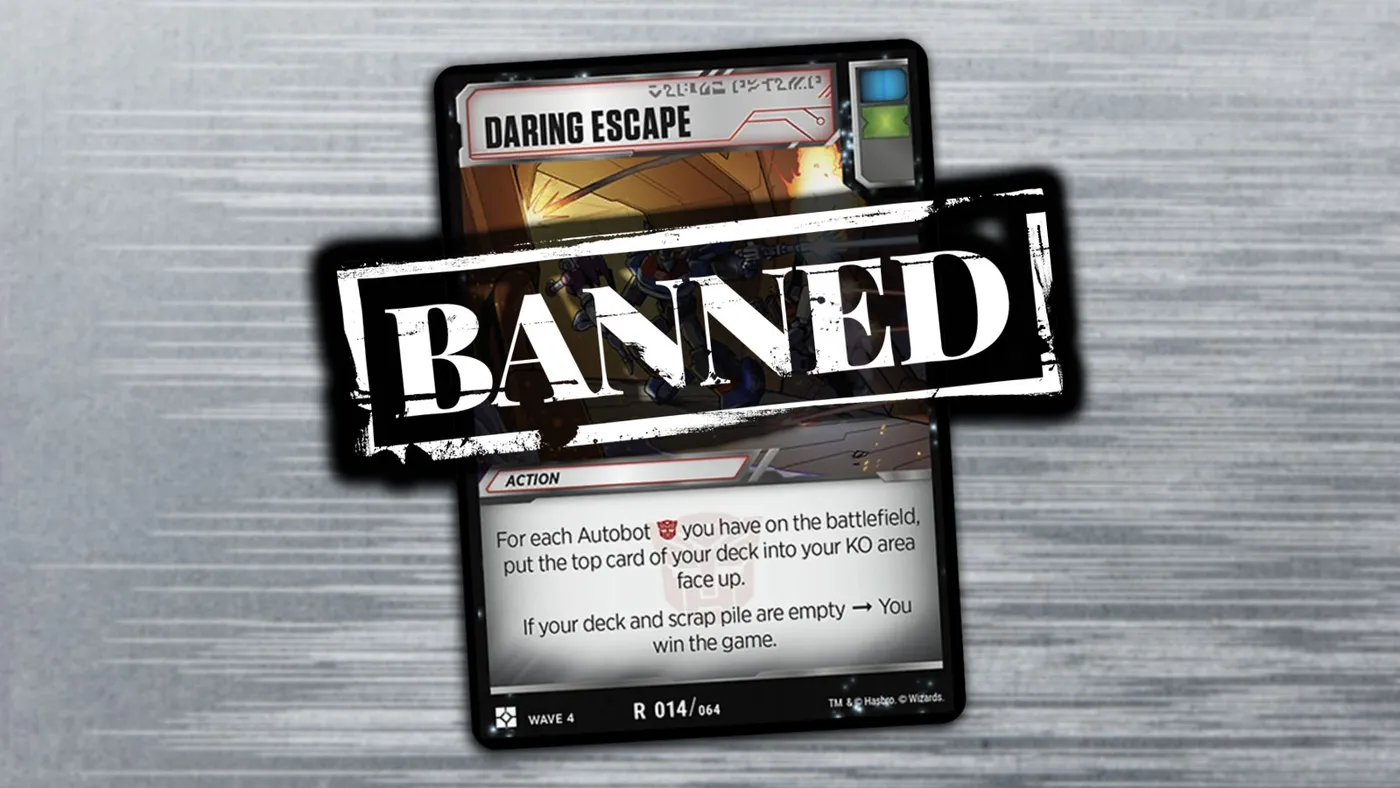
Daring Escape
Banned. Wave 4, R 014/064. An Action with 🟦 and 🟩 battle icons:
For each Autobot you have on the battlefield, put the top card of your deck into your KO area face up.
If your deck and scrap pile are empty → You win the game.
Daring Escape is an alternate win condition: empty your own deck and scrap pile and you win outright, without the need to fulfill the regular win condition of KO’ing all of your opponent’s characters. Wizards of the Coast considered a ban and declined, on the reasoning that an alternate win condition is a legitimate thing for a game to have and that the engine assembling it was the real problem. That is why Multi-Mission Gear was banned in November 2019 instead.
“Swoop, There It Is”, and the bookkeeping problem
The clearest look at the deck in the official era comes from Blaine Bublitz, who went undefeated in the constructed portion of the Energon Invitational at PAX Unplugged in December 2019 and finished Top 16 overall. His build paired Daring Escape with Sergeant Springer // Special Ops • Aerial Defense, Private Firedrive and Dinobot Swoop, using Equipment Enthusiast and Conversion Engine to draw and cycle toward Springer’s bot mode ability.
Two things about it matter for this page.
The first is that the pilot himself documented how much counting the deck demanded. Writing it up afterward, he noted that the arithmetic cost him a game: “In the actual tournament, it caused me to miscalculate by one card, and I lost that game.” When he demonstrated the deck on camera he laid out paper counters so viewers and his opponent could follow the stack, which is a generous thing to do and also an admission that the deck is hard to follow without aids the game never asked for.
The second is the reaction. Watching the deck work, the response ran from admiration for its construction to blunt dislike of playing against it. Vangelus called it “a beautiful and terrifying machine” while noting that no obvious answer to it had emerged. Others were less kind, and one comment put the experiential case in a sentence years before the community acted on it: “You may not get to play a full turn and you just watch your opponent play by themselves.”
Blaine’s own position was not that the deck should be protected. He argued in the same article that Swap Parts should stay banned, because restoring it would add “this additional layer of consistency to the deck” and take it too far.
The ban came much later than the combo
It is tempting to read the 2019 bans as having settled this, and they did not. Daring Escape remained legal through most of 2020, through the end of official support, and into the community era. The archive shows the deck in regular play across that period.
What moved the community was a result. At Season One Encounter 1, which ran from February into March 2021, a Daring Escape deck placed second, losing the final only to severe bad luck. A deck that reaches a final on the strength of a non-interactive win condition has made the argument that no amount of theory can: the deck worked, and the counters available did not reliably stop it.
The case against it was never only about win rate. Daring Escape decks are the clearest example of the solitaire problem described above: the pilot spends a long turn drawing, playing and cycling while the opponent waits, and the board state that results takes real bookkeeping to track. Players built their own aids for it during the official era rather than being asked to stop. That is the experiential standard, and it is a large part of why the community acted where the official game had not.
The Season One Encounter 1 deck
Recorded here because a banned card’s case rests on what people actually played, not on what was theoretically possible.
Characters
- Prowl // Military Strategist
- Cliffjumper // Renegade Warrior
- Dead End // Doomed Loner
- Beachcomber // Geologist
Battle cards
| Count | Card | Count | Card |
|---|---|---|---|
| 3 | Brainstorm | 3 | New Orders |
| 3 | Inspiring Leadership | 3 | Wedge Formation |
| 2 | New Designs | 2 | Lock On Target |
| 3 | Ready For Action | 2 | Scouting Mission |
| 3 | Start Your Engines | 3 | Open Agenda |
| 2 | Pep Talk | 1 | Scavenge the Battlefield |
| 2 | Reclaim | 2 | End Hostilities |
| 1 | Daring Escape | 3 | Anticipation Engine |
| 3 | Data Pad |
Worth noting what is not in it. There is no Multi-Mission Gear, because it had been banned fifteen months earlier, and no Specialist tool engine at all. A single copy of Daring Escape sits on top of a deck built to draw and cycle hard. The combo Wizards banned in 2019 was not required to make the win condition competitive, which is the strongest argument that the card itself, rather than its enablers, was the thing that had to go.
Status
Daring Escape is banned in transformerstcg.org organized play today, in both Constructed formats. It has no replacement card.
The community ban was issued in March 2021, immediately after the last match of Season One Encounter 1, the event at which the deck placed second. The archive brackets the timing: the World|Strike 1.1 release note of March 22, 2021 is already looking ahead to Encounter 2, so the event had finished by then.
The event ban lists corroborate the timing. Daring Escape is absent from the Season One Encounter 1 list of February 8, 2021 and present on the Encounter 2 list of April 3, 2021, which brackets the ban to the gap between the two events. It is on every list thereafter. Any formal published reasoning is not recorded on this page.
Further viewing
- Guest Deck Spotlight: Blaine Bublitz: “SWOOP, THERE IT IS”, Wreck ‘n Rule, December 13, 2019. The deck played out on camera, paper counters and all, against Joe.
- DARING ESCAPE Deck vs General Optimus/Smokescreen/Turbo, Wreck ‘n Rule, November 10, 2019.
- Daring Escape Cars vs Detritus and Crew, Wreck ‘n Rule, December 23, 2019.
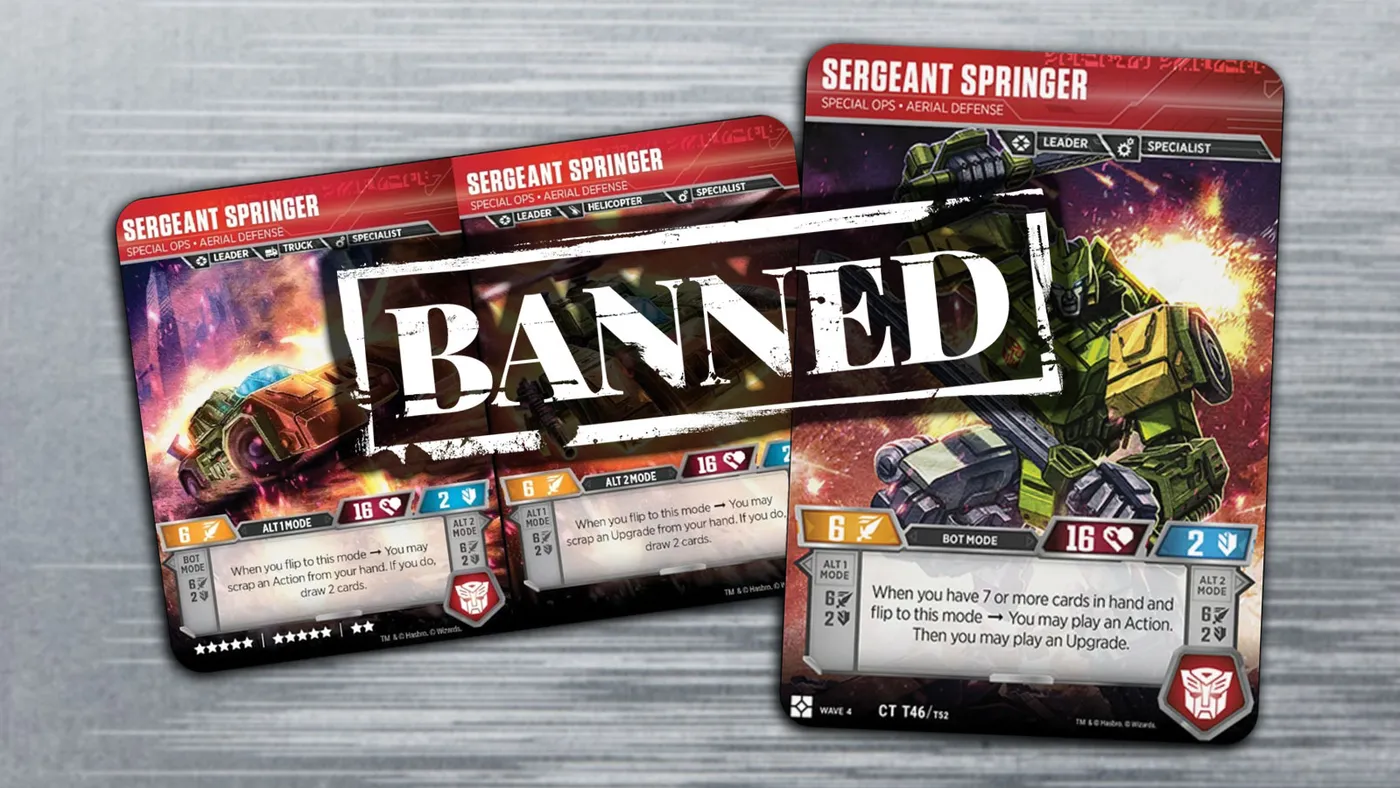
Sergeant Springer // Special Ops • Aerial Defense
Banned. Wave 4, CT T46/T52. A Triple Changer with the Leader and Specialist traits, 6 Attack, 16 Health and 2 Defense in every one of its three modes:
Bot mode. When you have 7 or more cards in hand and flip to this mode → You may play an Action. Then you may play an Upgrade.
Alt 1 mode (Truck). When you flip to this mode → You may scrap an Action from your hand. If you do, draw 2 cards.
Alt 2 mode (Helicopter). When you flip to this mode → You may scrap an Upgrade from your hand. If you do, draw 2 cards.
Wossy Plays previewed it a month before Wave 4 reached shelves under a title that turned out to be the whole story: “New Triple Changer Lets You Play a LOT of Extra Cards!”
Every mode pays
Most characters have one mode that does something and one that is mostly a statline. The usual cost of transforming is that you give up an ability to gain another. Springer has three modes and all three pay, with no stat penalty anywhere: the numbers are identical in bot, truck and helicopter.
The two halves are built to feed each other. The alt modes turn a card you cannot use into two cards you might. The bot mode turns a full hand into two free plays, on a turn that normally allows one Action and one Upgrade in total. So the alt modes fill the hand toward the seven-card threshold, and the bot mode spends it. Nothing else has to be drawn for the engine to run, because the engine is one card.
The scrap clause reads like a cost and is closer to a convenience. A deck that wants a large hand is a deck holding cards it cannot deploy yet, and Springer lets you throw the wrong half away two cards at a time. Pitching an Upgrade you were never going to equip in order to draw two is not a price. It is filtering with a profit attached.
The one brake, and why it does not hold
The seven-card requirement is the card’s only restraint, and an official ruling confirmed it is weaker than it looks:
Let’s say I have exactly 7 cards in my hand when I flip Sergeant Springer to bot mode. Its ability triggers and I play an Action. Now I only have 6 cards in hand. Do I still get to play an Upgrade?
Yes. Once the ability triggers, you’ll do everything it says. The trigger condition doesn’t recheck in the middle.
Seven cards is therefore a gate you pass through, not a level you have to hold. You need the hand size at the instant of the flip and never again, which means the threshold constrains the turn you set up rather than the turn you cash in.
A second ruling, from Wizards of the Coast on November 22, 2019, shows where players were pushing next. Asked whether Showing Off let them flip Springer to one alt mode, use that mode’s effect, then flip to the other and use its effect too, the answer was no: Showing Off resolves completely before the triggered abilities happen. The ruling closed the door, but the question is the tell. Within weeks of release, the live question about this card was how many of its triggers could be collected in a single turn.
It is also a Specialist
Springer carries the Specialist trait, which connects it to the engine described under Multi-Mission Gear above. Multi-Mission Gear is an Upgrade that reads “When you put this on a Specialist → You may play an Action.”
Springer’s bot mode hands you a free Upgrade. Put Multi-Mission Gear on Springer himself and that free Upgrade immediately produces another free Action. One flip, with no other card drawn, yields two Actions and an Upgrade against a turn’s normal allowance of one and one.
That is why Springer appears in the Daring Escape lists rather than merely alongside them. It is in Carl Endres’s “Specialist Escape” from November 2019 and in Blaine Bublitz’s Energon Invitational build that December, both covered above. Wizards banned Multi-Mission Gear on November 28, 2019 and left Springer legal, which is the same choice made over Daring Escape: remove the enabler, keep the engine.
Conversion Engine, and the end-of-turn problem
The nastiest pairing is with Conversion Engine (Wave 4, R 010/064), an Upgrade (Utility) with a ⬜️ battle icon and +1 Attack:
Put only on a character that has more than one alt mode.
At the end of your turn → Flip the upgraded character to another mode.
The first line restricts it to Triple Changers, so it was printed for a handful of characters, and Springer is the one that converts a flip into cards. The second line hands out a second flip every turn, for free.
That breaks the assumption limiting every other character in the game. One transform per turn is the budget, and each of Springer’s modes pays on being flipped to, so a second flip is simply a second payoff. Springer with Conversion Engine collects two mode triggers a turn, every turn, for one Upgrade slot.
The timing is what makes it brutal rather than merely strong. The extra flip resolves at the end of your turn, which is both the moment your opponent has watched the turn apparently finish and the moment your hand is at its largest, after a turn of drawing and cycling. So the seven-card condition is easiest to satisfy exactly when the free flip arrives. Spend your own transform going to an alt mode, scrap the half of your hand you cannot use and draw two, then let Conversion Engine flip Springer into bot mode after the fact and cash a full hand for a free Action and a free Upgrade. With Multi-Mission Gear as that Upgrade, the free Action becomes two.
None of this is theoretical. Conversion Engine is in Blaine Bublitz’s Energon Invitational list described above, where it does exactly this job.
It was not only a combo piece
The archive makes a point the combo story would obscure. Springer headlined several unrelated archetypes across the format’s final competitive months, and they were not fringe:
- 3 Wide Springer, played against Decepticon Cars in December 2019.
- Overwhelming Advantage Springer, usually shortened to OA Springer, the subject of its own deck showcases that December and January.
- Airstrike Patrol Springer, a four-wide orange aggro list running Springer alongside Nightflight, Storm Cloud and Tailwind, tested in a mirror match in January 2020.
- Springer Patrol, which took third at TAAO and was still being played as a meta deck in March 2020.
A card that anchors a draw-combo deck, a three-wide midrange deck and a four-wide aggro deck is not being carried by any one shell. The common factor across all of them is a 16-health body that costs nothing to transform and generates cards every time it does.
Two Springers, one subname
A smaller point, and a real source of confusion. Wave 2 printed Autobot Springer // Aerial Defense; Wave 4 printed Sergeant Springer // Special Ops • Aerial Defense. Both carry “Aerial Defense,” and at least one card was written without accounting for it. Aequitas had to rule on October 1, 2020 that the stratagem Better Things To Do Than Die could not be used on Sergeant Springer:
No. It is solely for Autobot Springer - Aerial Defense. The lack of “Autobot” in the stratagem target is believed to be unintended.
The ruling matters practically, because only one of the two Springers is banned. See Status below.
Why the community banned it
Wizards never acted on this card. The community did, on the experiential standard described at the top of this page rather than on results alone.
The objection is visible in the card’s own text. A Springer turn is a sequence: flip, decide whether to scrap, draw two, check the hand against the threshold, play a free Action, play a free Upgrade, and resolve whatever that Upgrade in turn permits. Every step is legal and each one is small. Together they produce exactly the pattern the community proved unwilling to keep tolerating, a long solo turn that the opponent watches, with enough moving parts that following it is work.
Negative play experience, specifically solitaire-like turns and the bookkeeping they demand, is cited as a factor in the community bans of Daring Escape, this card, and Decepticon Quake // Ground Assault. Springer is the clearest of the three, because the solitaire turn is not an interaction between cards that designers failed to foresee. It is printed on the card, in three modes, each of which rewards doing more on your own turn.
Status
Sergeant Springer // Special Ops • Aerial Defense is banned in transformerstcg.org organized play, in both Constructed formats. It has no replacement card.
Autobot Springer // Aerial Defense (Wave 2) is a different card and is unaffected by the ban.
It is on the earliest surviving event ban list, Season One Encounter 1 of February 8, 2021, and on every one of the seventeen that follow, so the ban predates the record rather than appearing inside it. The formal reasoning is not recorded on this page.
Further viewing
- New Triple Changer Lets You Play a LOT of Extra Cards!, Wossy Plays, October 21, 2019. The card as a Wave 4 preview, a month before release.
- Energon Hustlers: Decepticon Cars vs 3 Wide Springer, Energon Hustlers, December 21, 2019. Its description asks which player will “out-shenanigan the other.”
- Overwhelming Springer VS 3 Wide Prime, Powered by Primus, December 31, 2019. A deck showcase for the Overwhelming Advantage build.
- Arbitrary Hero: Airstrike Springer Mirror, Arbitrary Hero, January 21, 2020. Two four-wide Airstrike Springer lists played against each other.
- Meta Mondays: Springer Patrol: 3rd TAAO VS Nemesis Prime, Blues on Attack, March 16, 2020. The deck as a tracked meta list months after Wave 4.
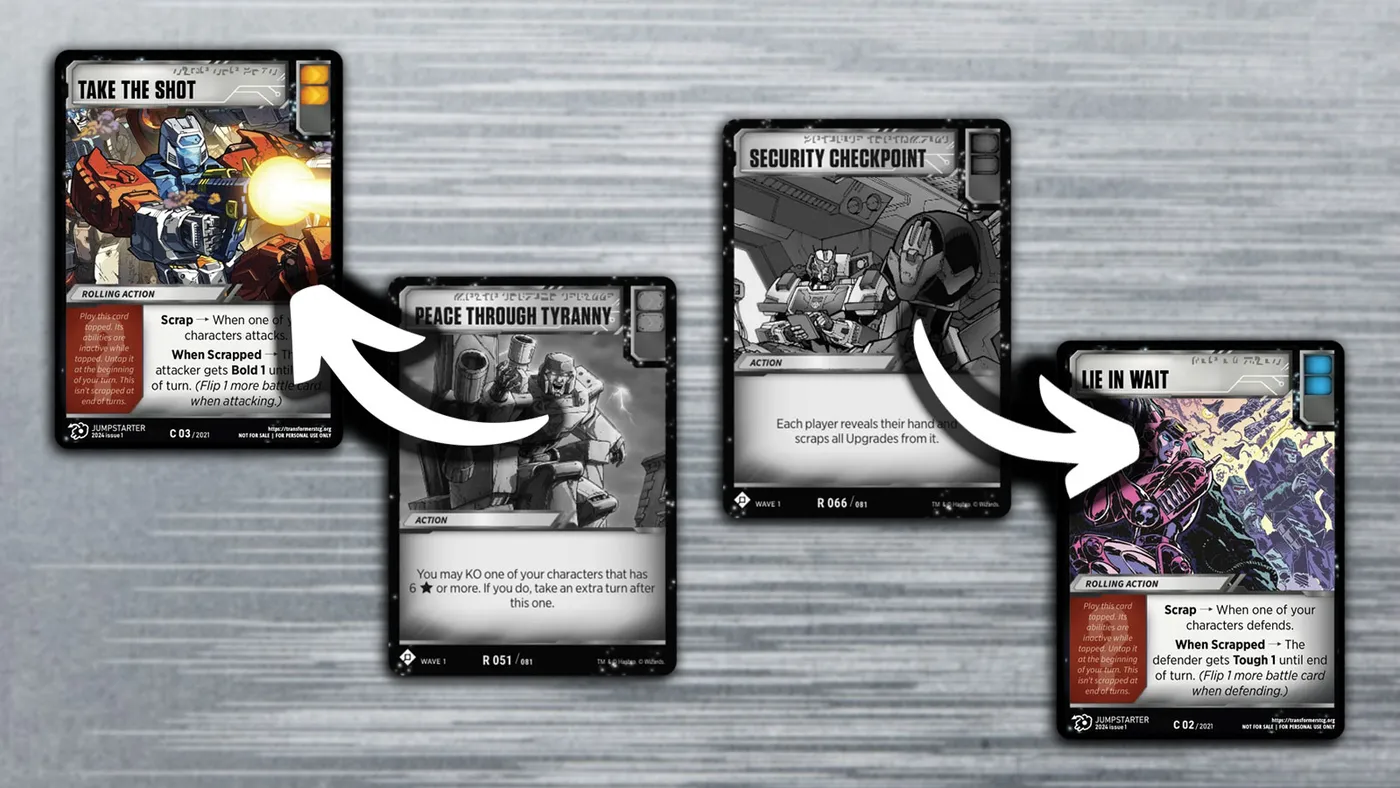
Peace Through Tyranny and Security Checkpoint
Replaced, by Take the Shot and Lie in Wait. Both are Wave 1 Actions, both were replaced in a single decision in July 2021, and they are covered together because the reasoning, the timing and the method are shared.
Peace Through Tyranny (R 051/081), with two 🟧 battle icons:
You may KO one of your characters that has 6 ★ or more. If you do, take an extra turn after this one.
Security Checkpoint (R 066/081), with two 🟦 battle icons:
Each player reveals their hand and scraps all Upgrades from it.
What they did
An extra turn is the largest effect a card can offer. Peace Through Tyranny charges a real price for it, since characters are the closest thing the game has to a life total and a 6-star character is not a spare part, but a player who can choose the moment is choosing to trade a character they were going to lose anyway for a free turn.
Security Checkpoint looks symmetrical and is not. Both players scrap, but only one of them knew it was coming. Play it from a hand you have already emptied of Upgrades, or out of a deck that runs few, and the symmetry collapses into a one-sided hand attack. Against an Upgrade-heavy opponent it is a blowout; in the mirror it does nothing. The announcement’s description of the pair was “excessive, swingy.”
Two of the only four
The more important property is one neither card’s text mentions: both carry two battle icons.
Scott Van Essen, writing for the official Transformers TCG site in March 2020, described how deliberately that was rationed. Early Wave 1 design was “much more liberal with double-pip cards” until the team found that some decks
just played them all, trading away the more efficient main card effects in exchange for consistent flips, taking a very exciting mechanic and making it both dull and frustrating to play against.
They cut back to four for the released set: Improvised Shield, Handheld Blaster, Security Checkpoint and Peace Through Tyranny. Van Essen adds that double-icon cards playable in any deck were “a non-renewable resource.”
So these two are half of Wave 1’s entire double-icon suite, by design. A deck that wanted reliable 🟧 flips had one obvious card, and a deck that wanted reliable 🟦 flips had the other. Much of the time the text was incidental to why they were in the deck, which is the exact pattern the designer describes as the reason the suite was capped.
That is also why banning them outright was the wrong tool. Remove them and you remove a scarce deckbuilding resource that nothing else in the card pool supplies.
The replacements keep the icons and drop the effects
Both replacements are Rolling Actions, a subtype introduced in Wave 8: Waste|Lands, carrying the reminder “Play this card tapped. Its abilities are inactive while tapped. Untap it at the beginning of your turn. This isn’t scrapped at end of turns.”
Take the Shot (C 068/081), with two 🟧 battle icons:
Scrap → When one of your characters attacks.
When Scrapped → The attacker gets Bold 1 until end of turn. (Flip 1 more battle card when attacking.)
Lie in Wait (C 033/081), with two 🟦 battle icons:
Scrap → When one of your characters defends.
When Scrapped → The defender gets Tough 1 until end of turn. (Flip 1 more battle card when defending.)
The icon counts and colors match the originals exactly, so every deck that played the old cards for their flips can still fill the slot. What changes is everything the cards do once drawn. An extra turn becomes Bold 1 for a single turn. A two-sided hand wipe becomes Tough 1 for a single turn.
Two further things fall out of the choice of subtype. A Rolling Action enters tapped and inactive and cannot be used until your next turn, so the replacement for “take an extra turn” is a card that costs you most of a turn before it does anything at all. And the two new cards are a matched pair, one attacking and one defending, where the originals had nothing to do with each other.
Three different ways to replace a card
Three of this page’s replacements show how differently the same job gets done:
| Card | What was kept | What changed | The property that broke it |
|---|---|---|---|
| Press the Advantage | The text, word for word | The 🟩 icon was removed | It could fetch itself out of a battle |
| Mission Briefing | Both icons | The text gained a clause | It rewarded you earlier for playing characters that started in bot mode like Battle Masters and Weaponizers |
| These two | Both icons, in count and color | The effect entirely | The effect itself |
Each fix removes the specific property that caused the problem and leaves the rest of the card alone. A card played for its icons keeps its icons; a card broken by an icon loses it.
A seasonal experiment that stuck
The pair had already been off the table once. Both are on the Season One Encounter 2 ban list of April 3, 2021 and off it again by Encounter 3 on May 30, a suspension served and ended before any replacement existed. That is the argument for the replacement in miniature: taking the cards away for one event settled nothing, because the deckbuilding resource they supplied went away with them and came back with them.
The replacements were announced on July 28, 2021, twelve days after Waste|Lands entered Public Beta and well ahead of the Tournament Season Two it would support, which launched on August 16, 2022. They were explicitly provisional:
Depending on the community’s reception, these cards may be simply Seasonal replacements. With success, they may become something more permanent within the Team Bayformers competitive community.
The same announcement offered them outward rather than keeping them in-house: “In the spirit of community, we’ll be offering these cards as PTT and SecCheck replacements for any group to use. Any competitive scene is free to use the cards as replacements as they see fit.”
Reception bore out both halves of the pitch. A commenter on the announcement, livingsteelsaga, endorsed the mechanic and the diagnosis in the same breath: “I really like the idea of rolling action cards. It allows you to do cool set ups down the road. Also, yes peace through tyranny is way too strong.” That the complaint about the original and the enthusiasm for its replacement came from the same player is the clearest sign the swap was reading as intended rather than as a nerf being tolerated.
They passed. Both were reprinted in the Jumpstarter Update Booster (2024 issue 1) and both are the legal version today, which makes this the rare case where a season-long trial is documented from proposal through to permanence.
Status
Peace Through Tyranny and Security Checkpoint are legal only as Take the Shot and Lie in Wait. The original printings are not tournament-legal in either Constructed format. Both returned to the event ban lists permanently at Harmony: Waste|Lands 1 on January 12, 2022, by then as replaced cards rather than suspended ones.
Further reading
- Take the Shot; don’t Lie in Wait in Season Two!, bayformers.net, July 28, 2021. The announcement, including the teased wave symbol it ends on.
- Robots in Design #14: The Apple of My I(con), Scott Van Essen, March 5, 2020. Official design commentary on why Wave 1 shipped only four double-icon cards.
- 5-0 Undefeated Sentinel Deck Profile @ Top Deck Games, SDotTCG, May 9, 2019. An undefeated list walked through, with two worked examples of using Peace Through Tyranny.
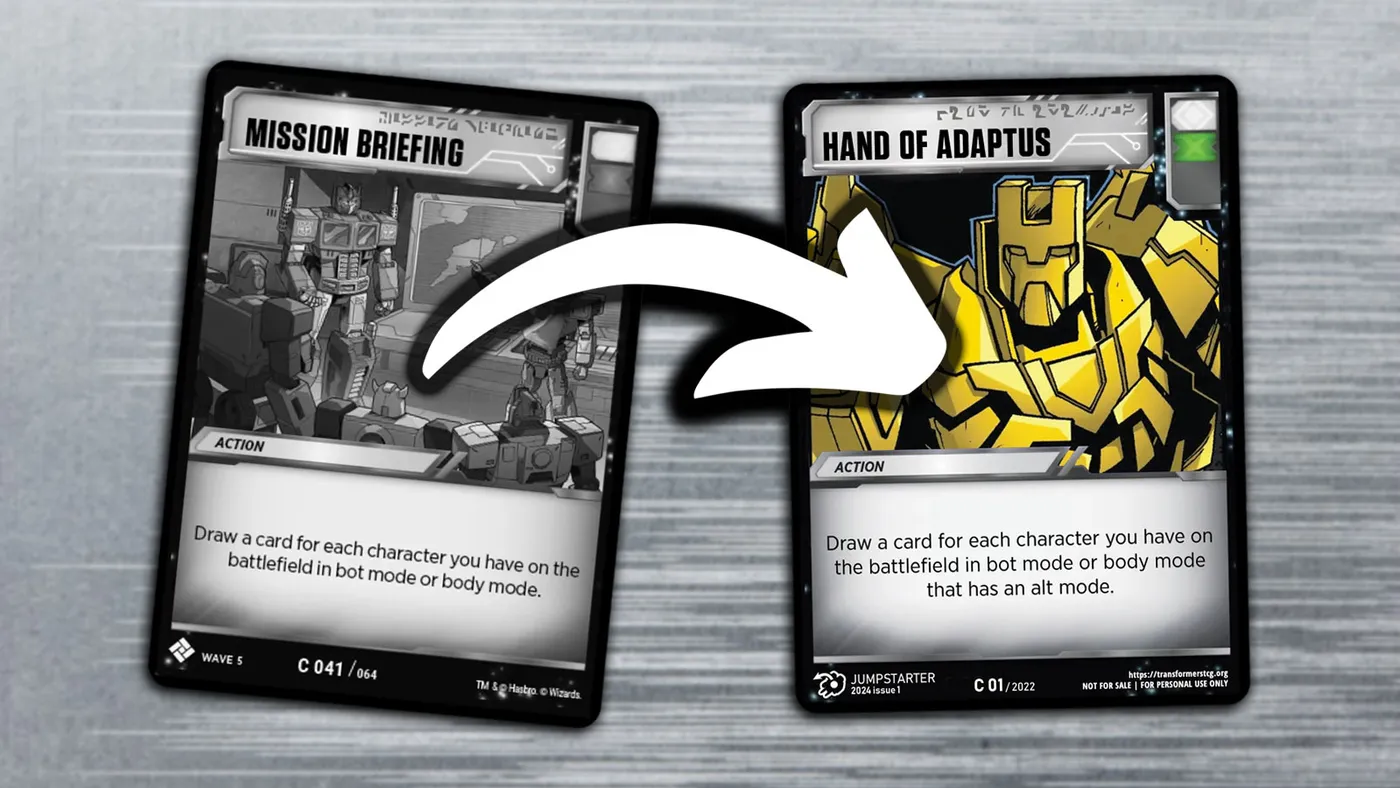
Mission Briefing
Replaced, by Hand of Adaptus. Wave 5, C 041/064. An Action with ⬜️ and 🟩 battle icons:
Draw a card for each character you have on the battlefield in bot mode or body mode.
What it did
Ordinary characters begin the game in alt mode, so Mission Briefing counts none of them until they flip. What it counted for free were the characters with no alt mode to begin in. A Battle Master has only a bot mode, so it starts there and stays there, and deployed characters arrive in bot mode as well, Titan Master heads and Mini-Cassettes among them. Three of those draw three cards for one Action, from the first turn, with no setup and no condition to build toward, against a normal turn’s one card.
It also carries 🟩, which matters here for the same reason it mattered to Press the Advantage: flip the icon in a battle and the card can swap itself into your hand at the end of it. Mission Briefing was not a card you hoped to draw. It was a card that went looking for you, and then replaced itself several times over.
Why the draw scaled wrong
Paying per character rewards teams that field more of them. A deck built on three large characters drew three once they had flipped; a deck built wide on low-star ones drew four or five, and the archetypes that never had to flip drew it from the start. The effect was strongest in exactly the archetypes built around small characters, and the announcement named them: Battle Masters, Weaponizers and Quintesson Specialists.
That is the structural complaint. A card that can draw three or more cards on turn 1 with teams that start in bot mode quietly taxes every future draw card the game might print, because the comparison is never “is this good” but “is this better than drawing three for free.”
What the announcement said
transformerstcg.org announced Hand of Adaptus as the next 1C Open candidate on January 20, 2022, and stated the case against the card it was replacing directly:
We’ve long wanted to ban Mission Briefing due to its extreme draw power. This wish combined with the fact that it made many draw cards obsolete. Any deck with Battlemasters, Weaponizers, Quintesson Specialists, and the like had an immediate advantage in card draw with Mission Briefing in their decks – and the very existence of the card limited design space greatly.
The same announcement is explicit that a straight ban was rejected, and why:
However, the white/green nature of the card was desirable to certain deck comps, so we didn’t want to simply ban Mission Briefing without some sort of replacement.
That is the reasoning behind the whole Replaced category rather than this card alone. A card can be a problem in its current form and still be doing a job the format needs done. Banning it outright removes the job as well as the problem.
The build that was circulating
The archive has a worked example from two and a half months before the announcement. A November 2021 deck profile for “Soundwave Superior” ran two copies alongside a team of Mini-Cassettes, and its author described the payoff without being asked to justify it:
Mission Briefing in this deck at the right time almost always draws 2 cards, and sometimes you will draw 4 cards. The characters are all in bot mode as they deploy, including Parsec.
Four cards from one Action, as an unremarkable line in a deck guide. That is the scaling problem stated from the pilot’s side.
The replacement
Hand of Adaptus keeps the text and both battle icons, and adds one clause:
Draw a card for each character you have on the battlefield in bot mode or body mode that has an alt mode.
A Battle Master “begins in bot mode and can’t flip,” as its own reminder text puts it; its Upgrade side is played only once the character is KO’d. A Weaponizer is built the same way, a bot mode and an Upgrade mode and nothing else. Titan Masters likewise can’t flip. None of them has an alt mode, so none of them counts any more, while all of them sat in bot mode counting for Mission Briefing all along. The clause reaches the first two archetypes the announcement named, and leaves the card intact for teams that are not built to farm it.
This is a different kind of fix from the one applied to Press the Advantage. There the icon was removed and the text left alone, so the card still does what it says but is harder to find. Here the icons are untouched and the text is narrowed, so the card is as findable as ever and simply counts fewer characters.
How it was released
1C Open cards were tested in Allied Crossplay play before being adopted, and Hand of Adaptus went through that process rather than being published by fiat. The daily roundup covering March 30, 2022 recorded the result:
After weeks and weeks of testing, our beta testers have signed off – Hand of Adaptus is certified as released!
The program’s standing offer was attached to each card: these were released “as a solution to long-standing issues in core Hasbro/WotC #transformerstcg play without an expectation of credit.”
That clause is the program rather than a courtesy attached to it. 1C Open existed to put fixes for the original card pool, the one pool every group shared, into anyone’s hands on terms that cost them nothing: a group adopting a 1C Open card could use it without crediting Allied Crossplay at all. The scene at the time was divided between groups with little habit of working together, and waiving credit removed the most obvious reason to turn down a fix that had come from somebody else’s side of it.
Status
Mission Briefing’s original printing is not tournament-legal in either Constructed format. It first appears on an event ban list at Two Lwosers 1 on February 10, 2022, between the January announcement and the March certification, and is on every list after it. Hand of Adaptus is the legal version, printed in Wave 8: Waste|Lands (C 021/081) and reprinted in the Jumpstarter Update Booster (2024 issue 1), which carries the collector number C 01/2022 after the year the card was designed.
Further reading
- <REDACTED> presents “Soundwave Superior”, bayformers.net, November 2, 2021. A Mini-Cassette deck running two copies, with the draw counts spelled out.
- Omega Invitational Daily Roundup for March 30th, transformerstcg.org, March 31, 2022. The release announcement, alongside the note that the next 1C Open card was a day away.
- Mecha Star is much less Fusion Boring!, transformerstcg.org, April 1, 2022. That next card, and the clearest statement of how the 1C Open testing cycle was meant to run. Covered under Fusion Borer below.
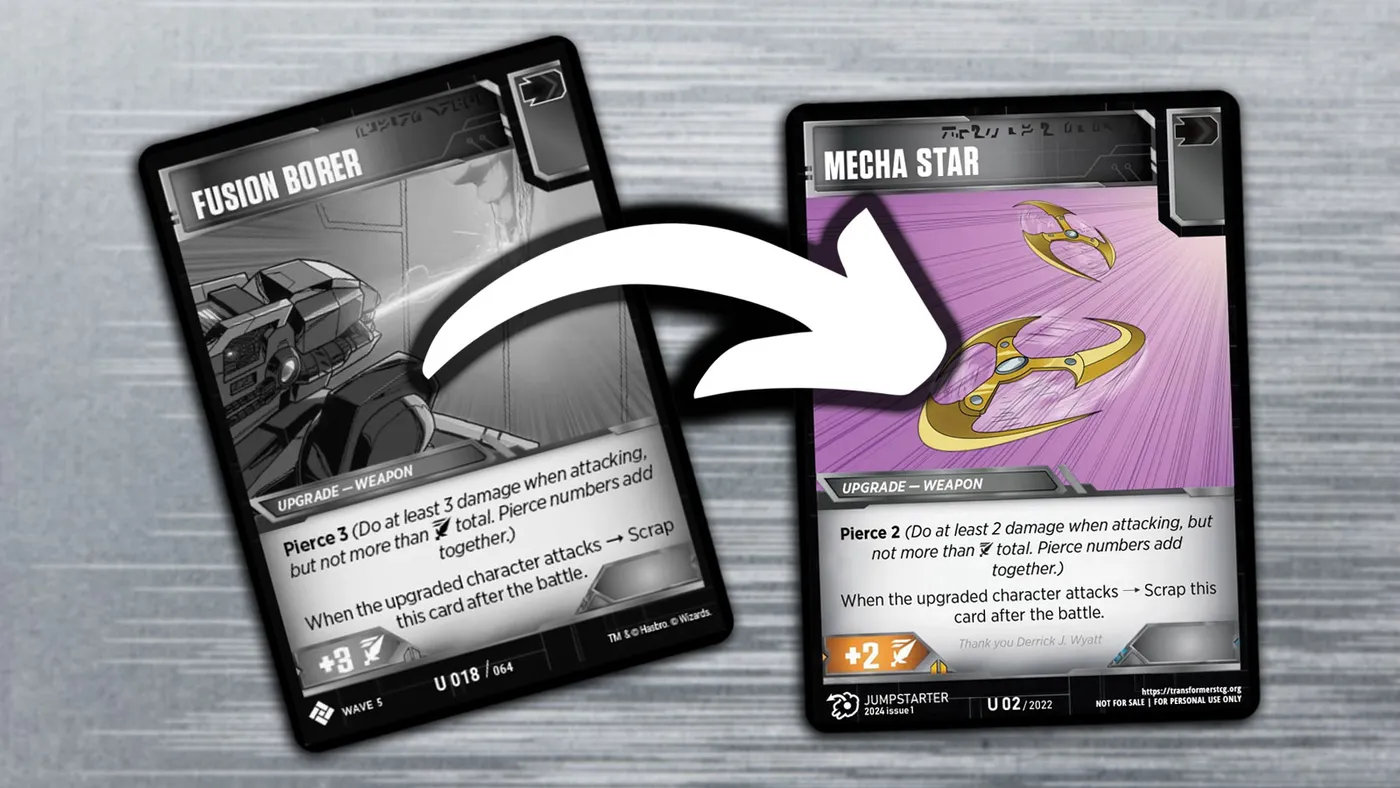
Fusion Borer
Replaced, by Mecha Star. Wave 5, U 018/064. An Upgrade (Weapon) with a single ⬛️ battle icon and +3 Attack:
Pierce 3 (Do at least 3 damage when attacking, but not more than ⚔️ total. Pierce numbers add together.)
When the upgraded character attacks → Scrap this card after the battle.
What Pierce buys
Pierce sets a floor under an attack. Whatever the defender does, the attack does at least that much damage, capped only by the attacker’s own Attack total. Defense and defensive flips can reduce a normal attack to nothing; they cannot take a Pierce 3 attack below 3.
That is why the card is not simply “+3 Attack.” Against the defensive decks that a +3 Weapon struggles with, Pierce 3 is the part that matters, and the two numbers are doing different jobs: the +3 raises the ceiling, the Pierce 3 raises the floor.
Why it crowded out the other Weapons
Set against its contemporaries, the problem is visible in a table:
| Card | Attack | Pierce | Icons | Who can use it | After the attack |
|---|---|---|---|---|---|
| Grenade Launcher (Wave 1) | +4 | none | 🟧 | anyone | scrapped |
| Noble’s / Scoundrel’s Blaster (Wave 2) | +2 | 2, against the other faction | 🟦🟩 | one faction only | stays on |
| Fusion Borer (Wave 5) | +3 | 3 | ⬛️ | anyone | scrapped |
Grenade Launcher hits one point harder and does nothing about Defense. The Blasters persist and carry two icons including the 🟩 that fetches them, but they cost you a point of Attack, give Pierce only against the opposing faction, and lock you into a faction to begin with. Fusion Borer asks nothing of your deck and beats both where it counts.
transformerstcg.org put the deckbuilding consequence plainly when announcing the replacement:
In many scenarios, Fusion Borer simply outperforms venerable Weapons like Grenade Launcher – and given factional limitations to weapons like Noble’s Blaster and Scoundrel’s Blaster, Fusion Borer is often picked over them, even with the green battle icons on those Blasters. […] Fusion Borer’s value is so great that it effectively removes many other Weapon choices from deckbuilding considerations and play.
That last clause is the actual charge. The complaint is not that the card wins games; it is that it answers the question “which Weapon?” so completely that the question stops being worth asking. A deck profile from November 2021 runs it as a full three-of.
The Pierce 3 tier it landed in
Fusion Borer did not arrive in empty space. Pierce 3 was an established effect with several Weapons already supplying it, and the comparison is lopsided:
| Card | Wave | Attack | Pierce | Icon | Who can use it | After the attack |
|---|---|---|---|---|---|---|
| Piercing Blaster | 1 | +0 | 3 | ⬜️ | anyone | stays on |
| Laser Cutlass | 3 | +1 | 3 | 🟦 | 7 ★ or fewer | stays on |
| Grav-Inhibitor | 5 | +0 | 3 | ⬛️ | anyone | stays on |
| Fusion Borer | 5 | +3 | 3 | ⬛️ | anyone | scrapped |
Every tenured Pierce 3 Weapon gave +0 or +1 Attack. Fusion Borer gave +3, triple the best of them, for the same Pierce, with no star cap and no faction restriction. The sharpest case is its own wave mate: Grav-Inhibitor (C 020/064) has identical Pierce, the identical ⬛️ icon and the same set, and differs by three Attack, with permanence as its entire compensation.
The drawback that was not one
“Scrap this card after the battle” reads as the price. The same announcement argues it was close to free:
Sure, the Fusion Borer is scrapped after the battle, but given existing retrieval methods such as Dual Wield and Raider Triggerhappy, its “cost” of play is minimal, even in WotC-only play.
Worth stating the mechanism precisely, because the retrieval is narrower than the sentence suggests. Dual Wield grants an extra Weapon slot for the turn, and only “if that character is a Mercenary” does it replay a Weapon from your scrap pile. The recursion is real but gated behind a faction.
The broader point stands without it. A Weapon that is spent after one battle is also a Weapon your opponent cannot strip, and one battle is frequently all a Pierce 3 swing needs to be worth the card.
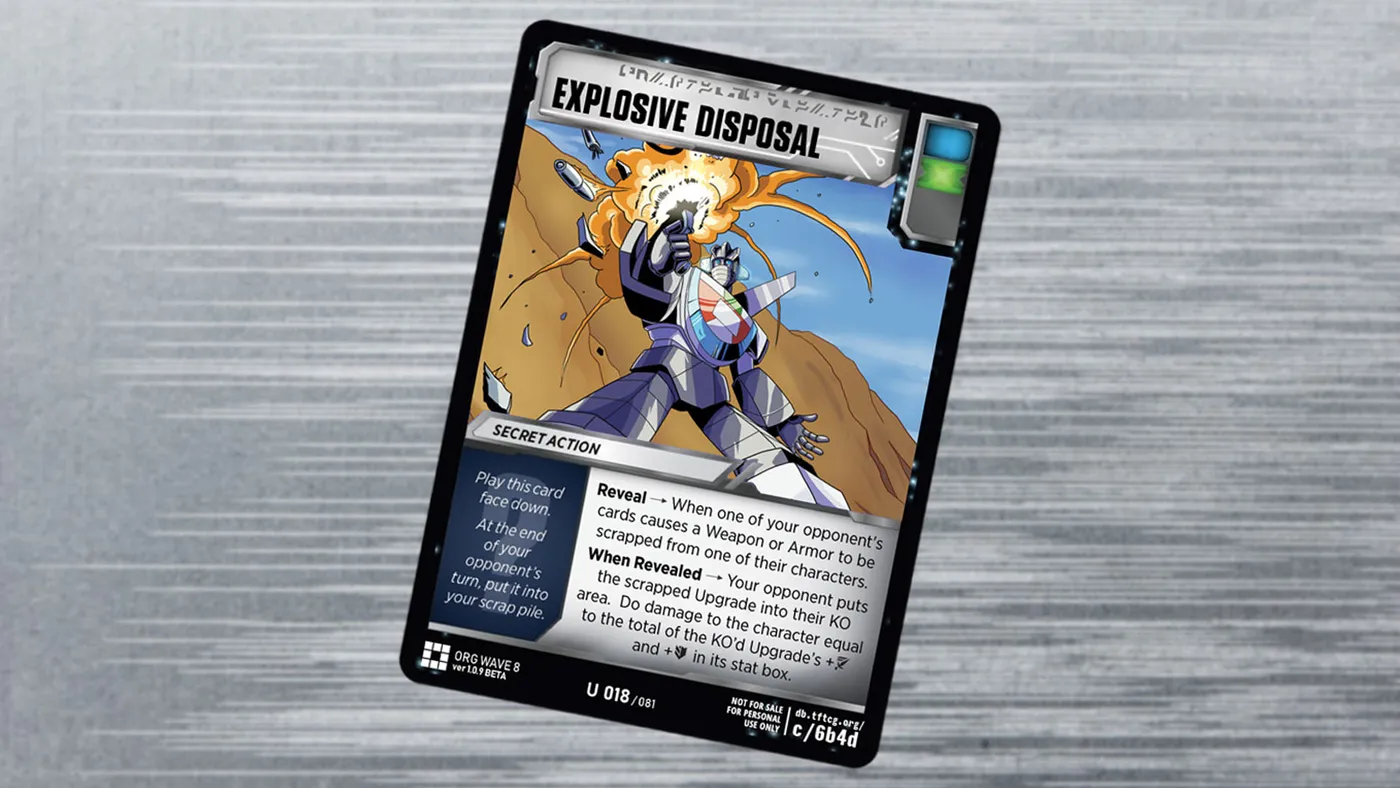
The card printed to answer it
The community reached for a counter before it reached for a replacement. Explosive Disposal (Wave 8: Waste|Lands, U 018/081) is a Secret Action with 🟦 and 🟩 battle icons, and it is written against this exact pattern:
Reveal → When one of your opponent’s cards causes a Weapon or Armor to be scrapped from one of their characters.
When Revealed → Your opponent puts the scrapped Upgrade into their KO area. Do damage to the character equal to the total of the KO’d Upgrade’s +⚔️ and +🛡️ in its stat box.
Both halves answer the argument above. The Upgrade goes to the KO area rather than the scrap pile, which puts it beyond the retrieval the announcement named, and the self-scrap stops being free, because the card charges the attacker for the size of the Weapon they just spent.
| Upgrade it catches | +⚔️ | +🛡️ | Damage |
|---|---|---|---|
| Crystal of Power (Wave 5) | +3 | +2 | 5 |
| Grenade Launcher (Wave 1) | +4 | 4 | |
| Fusion Borer (Wave 5) | +3 | 3 |
It catches more than its target, Grenade Launcher and Crystal of Power among them, which is what a hate card written for a format rather than for one card looks like. Fusion Borer is the card that prompted it. The 🟩 icon means it could also go looking for itself out of a battle, so this was not an answer a player had to happen to draw.
It still did not work, and it failed the way Private Turbo Board failed against Daring Escape. A hate card only helps the player holding it, in the matchup where it applies, while the card it answers is in everybody’s deck doing its job every game. Fusion Borer remained the most played Weapon in the format, and what finally moved it was changing the card itself.
The replacement: one point off each
Mecha Star is the same card made smaller. Same type, same single ⬛️ icon, same scrap clause word for word, same reminder text. Two numbers moved:
| Fusion Borer | Mecha Star | |
|---|---|---|
| Attack | +3 | +2 |
| Pierce | 3 | 2 |
Nothing else differs. Neither the text nor the icons were touched, only the size of the effect, which is a different method again from the three in the table above.
The landing spot was not arbitrary. Calculated Strike (Wave 3, C 009/064) is an Action with the same ⬛️ icon that gives a character “+2 ⚔️ and Pierce 2 until end of turn”, which is Mecha Star’s two numbers exactly. The announcement said the new card “highly aligns with other cards in its space such as Calculated Strike,” and the match is precise rather than approximate: the replacement was tuned to a benchmark already sitting in the card pool and already accepted.
What changed when Mecha Star replaced it
Organizers in Allied Crossplay, who ran the events this card pool was played in, report a visible shift in what players chose. By their account Fusion Borer became the most played Weapon in the game after Wave 5’s release, on consistency and power together, pushing aside Piercing Blaster, Laser Cutlass, the faction Blasters and Grav-Inhibitor alike. Once Mecha Star took the slot, Pierce selection diversified again, with Piercing Blaster, Laser Cutlass and Grav-Inhibitor all competing for space alongside the new card.
What makes that shift more than an impression is that the numbers predict it. Mecha Star is Pierce 2, not Pierce 3. Dropping that single point did not only make the card smaller; it vacated the Pierce 3 tier entirely. A deck that specifically wants the Pierce 3 floor can no longer get it from the format’s default Weapon and has to go back to the cards that still offer it, every one of which had been sitting unplayed behind Fusion Borer.
The replacement therefore did two things at once. It reduced a card that was too strong, and it handed a whole category back to the cards that had been shut out of it. That is the test of the charge in the announcement: if Fusion Borer really did remove other Weapon choices from deckbuilding, then removing Fusion Borer should bring them back. It did.
The card is a memorial
Mecha Star carries something no other card on this page does. Its flavor line, on both printings, reads “Thank you Derrick J. Wyatt.”
Wyatt was the character designer behind Transformers: Animated, and the announcement is explicit that the replacement slot was used deliberately:
Additionally, we were heartbroken at the news of Derrick J. Wyatt’s passing. For those of us that were introduced or reintroduced to Transformers via the Animated series, Derrick’s designs and vision deeply marked our Transformers experience. We wanted to homage Derrick in an upcoming card – and Mecha Star was that opportunity. We hope Animated Prowl’s iconic stars will provide much of the same value Fusion Borer did, without the excessive swing.
The art is Animated Prowl’s shuriken, drawn by Jamesotron in the Animated style. It is a replacement card doing two jobs at once, and the second one is the reason the first is remembered.
How it was released
Mecha Star was the 1C Open candidate announced immediately after Hand of Adaptus was certified, on April 1, 2022, with testing scheduled for roughly a month once the Omega Invitational closed. It passed, and it is in print twice: in the Jumpstarter Update Booster (2024 issue 1) as U 02/2022, and in Org Wave 9 as U 037/081. The Jumpstarter denominator is the year the card was designed, the same convention Hand of Adaptus carries as C 01/2022.
Status
Fusion Borer is legal only as Mecha Star. The original printing is not tournament-legal in either Constructed format. It first appears on an event ban list at Harmony: Waste|Lands 3 on May 25, 2022, once Mecha Star had finished testing, and is on every list after it.
Further reading
- Mecha Star is much less Fusion Boring!, transformerstcg.org, April 1, 2022. The replacement announcement, the case against Fusion Borer, and the Wyatt memorial.
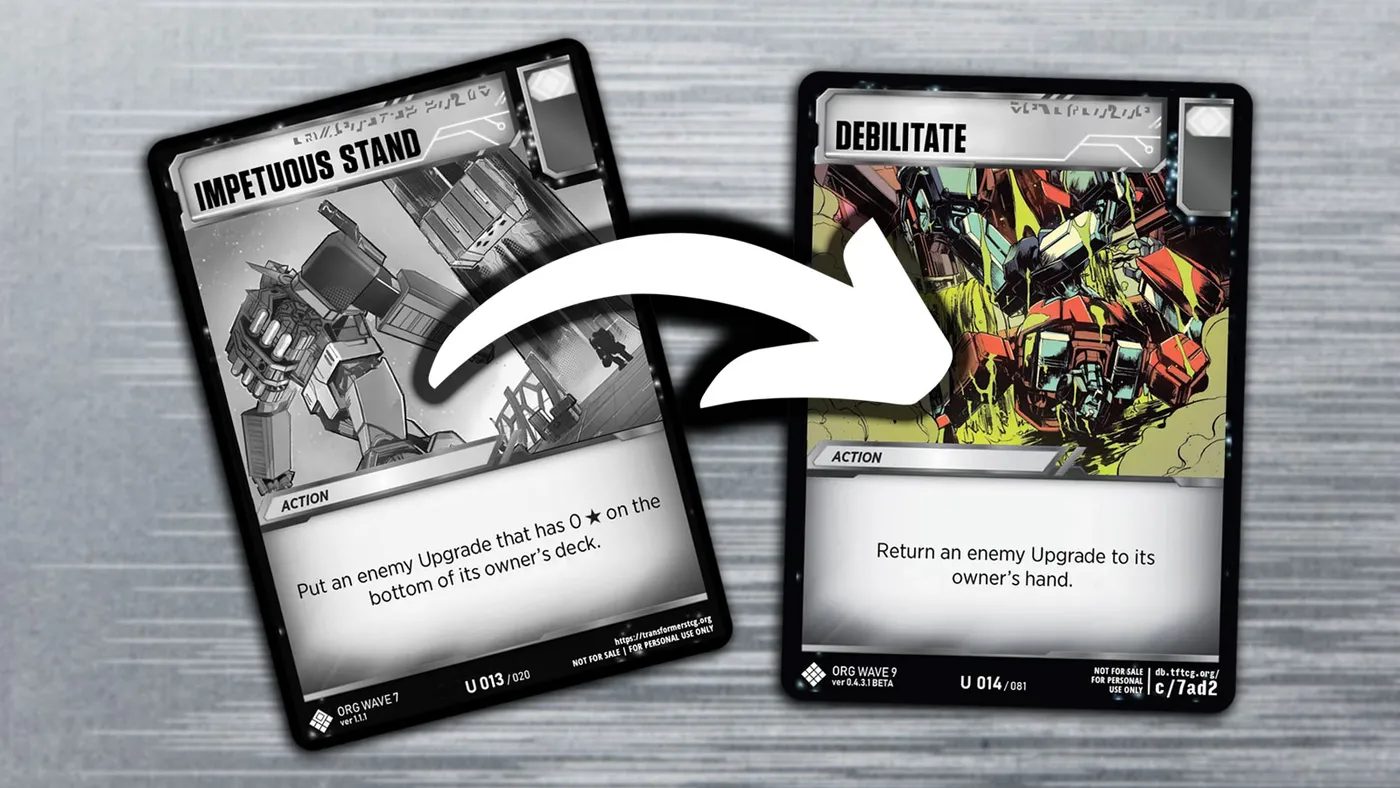
Impetuous Stand
Main article: The Impetuous Stand Controversy
Replaced, by Debilitate. The only community-made card on the Ban List; every other entry on this page is a Wizards of the Coast printing. Org Wave 7, U 013/020. An Action with a single ⬜️ battle icon:
Put an enemy Upgrade that has 0 ★ on the bottom of its owner’s deck.
The short version
Impetuous Stand removed an Upgrade by putting it on the bottom of its owner’s deck instead of scrapping it. That one word is the whole problem.
The game’s protective cards were written against scrapping. A card that never scraps anything walks past all of them, and it takes the Upgrade out of the match entirely rather than putting it somewhere its owner can get it back. It became the default Upgrade removal in the format and pushed the alternatives out of decks.
The more expensive consequence was what designers started doing in response. Protective abilities being written for future releases were moving away from triggering when an opponent scrapped an Upgrade and toward triggering whenever an Upgrade left the battlefield by any means. That wording would have caught Impetuous Stand, and it would have caught older removal cards that had never caused the problem along with it. The card had stopped merely competing with its alternatives and started dictating how later ones were being written.
That trajectory, rather than its win rate, is why the ban was eventually made permanent. One card was on course to set the wording of an entire category for as long as it stayed legal. Removing it stopped those designs before they reached print rather than locking the pattern in: the scrap and anti-scrap conventions came through intact, and new cards of both kinds parse for the scrap event itself rather than the catch-all the arms race had been heading toward.
It was sent to Garrus-9 at least twice along the way. Those suspensions reinforced the case rather than revealing it, since the argument that the card had displaced the category was already being made before the first one.
The text quoted above is already the reworked version, which is why it looks modest. The original read “Put an enemy Upgrade on the bottom of its owner’s deck. That player draws a card,” with a 🟩 icon that let it fetch itself out of a battle and no star restriction on what it could hit. The rework was not purely a narrowing: it capped targets at 0 ★ and dropped the 🟩, but it also deleted the compensating draw the opponent used to get. What it kept was the bottom-of-deck mechanism, so the wider problem survived the fix. It was returned to the ban list afterward.
Debilitate
The resolution stopped revising the card and replaced it. Debilitate (Jumpstarter Update Booster, 2024 issue 1, U 03/2024) is an Action with the same ⬜️ icon:
Return an enemy Upgrade to its owner’s hand.
The useful job survives and the mechanism changes. Returning an Upgrade to hand is the pattern the game already used: it is Wave 1’s Debilitating Crystal effect, lifted out of that card’s Upgrade frame and attack trigger and printed as a plain Action. The opponent keeps the card and can play it again, so the removal buys tempo rather than permanently stripping a resource, and nothing has to be rewritten around it.
The battle icon carries the rest of the justification. ⬜️ flips two more cards, which is a strong icon to be holding, and the card pool pays for it by narrowing the printed effect: a ⬜️ card is routinely a reduced cut of something a 🟧 or 🟦 card does in full.
Debilitate is the reduced cut of Disarm (Wave 1, U 023/081), an Action with a single 🟦 icon:
Return all Upgrades on a character to their owner’s hand.
Same verb, same destination. Disarm clears every Upgrade off any character; Debilitate takes one, and only an enemy’s. The same relationship appears elsewhere in the pool: Leap Into Battle (Wave 1, C 043/081) is 🟦 and gives a character +3 Attack until end of turn with nothing attached, while Head-On Collision (Wave 4, C 025/064) is ⬜️ and gives the same +3 only “while attacking in alt mode this turn.” Identical number, narrower window, better icon.
So Debilitate is not a new design at all. It is Debilitating Crystal’s mechanism doing Disarm’s job, sized to the slot a ⬜️ card is expected to occupy. That is the concrete sense in which replacing Impetuous Stand returned Upgrade removal to patterns the game already had, rather than inventing another one.
Debilitate was proposed during the January 2024 Big Beta Bash discussions and has since been folded into Org Wave 9’s card pool as well. Its collector number carries 2024 as its denominator, the same convention marking Hand of Adaptus and Mecha Star as 2022 designs.
Status
Impetuous Stand is legal only as Debilitate, in either Constructed format. Both the original Phase One printing and the reworked Org Wave 7 version are banned. It first appears on an event ban list at Two Lwosers DEAD LWOSER’S SWITCH on November 3, 2022, and is on every list after it. The earlier ban was lifted by the rework, so that date is where the permanent one begins.
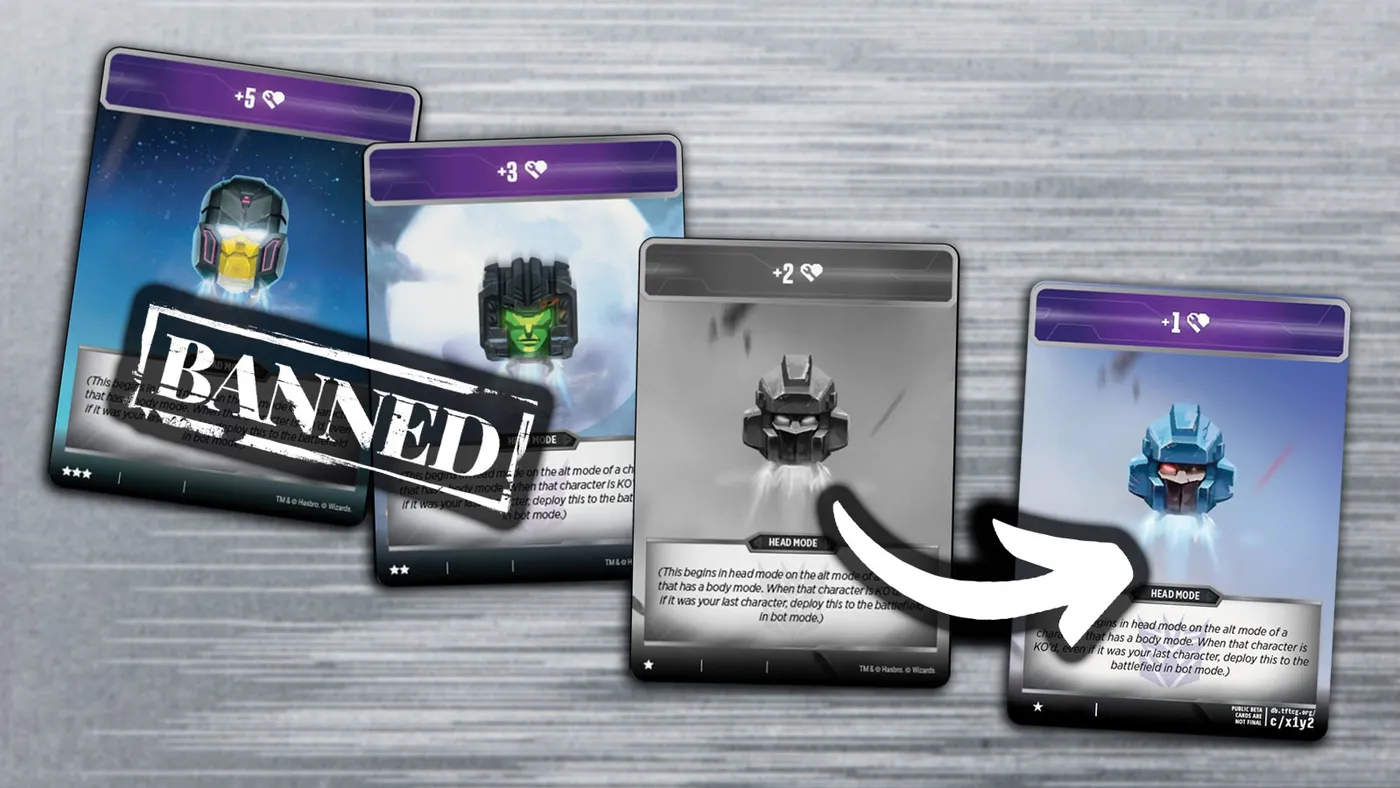
Kreb, Brisko, and Grax
Banned, and Kreb additionally replaced by Kreb // Krushed at Harmony events. Three Wave 5 Titan Master heads, covered together because they were removed for a single reason and that reason is arithmetic.
A Titan Master head begins attached to the alt mode of a character that has a body mode, granting its bonus to that character. When the body is KO’d, “even if it was your last character,” the head deploys to the battlefield as its own character in bot mode. Every head in the wave works this way, so nothing below turns on the rule itself.
| Head | ★ | Head mode grants | Bot mode ⚔️ / ❤️ / 🛡️ |
|---|---|---|---|
| Kreb | 1 | +2 ❤️ | 2 / 2 / 0 |
| Brisko | 2 | +3 ❤️ | 3 / 3 / 0 |
| Grax | 3 | +5 ❤️ | 4 / 5 / 0 |
What the same wave gave at every other star count
Wave 5 printed eighteen heads. Laying them out by star count makes the problem visible without any play data at all:
| ★ | Health head | Every other head at that star count |
|---|---|---|
| 1 | Kreb +2 ❤️ | Parsec Bold 1 · Vorath Tough 1 |
| 2 | Brisko +3 ❤️ | Autobot Stylor +1 🛡️ · Monxo +1 ⚔️ · Autobot Teslor Focus 1 |
| 3 | Grax +5 ❤️ | Apex Stealth · Doomshot Brave · Flameout Bold 2 · Freezeout Tough 2 · Ominus Pierce 4 |
| 4 | none | Arcana +2 🛡️ · Chasm +2 ⚔️ · Clobber Bold 3 · Convex Safeguard 3 · Flintlock Tough 3 |
The wave’s other two numeric stats scale consistently, and they agree with each other exactly. Attack and Defense both move by one point for every two stars. Monxo gives +1 Attack for 2★ and Chasm +2 for 4★; Autobot Stylor gives +1 Defense for 2★ and Arcana +2 for 4★. Four cards, one rate, no exceptions.
Health is not on that scale. Kreb returns two points for one star, Brisko three for two, Grax five for three: between 1.5 and 2 points per star, against 0.5 for Attack or Defense. The same wave, the same card type, the same slot on the same body, at three to four times the rate. A point of Health is not a point of Attack, so the ratio is not a claim that these heads are three times better; it is a claim that the wave priced one stat on a different scale from the two it priced consistently.
That is what a stat audit by star count is for, and auditing per star count is long-standing practice among community designers rather than something invented for these three cards. It is also the kind of finding that does not require a metagame to confirm. The numbers are printed on the cards.
The bodies are better as well
The keyword heads give up body stats in exchange for an ability. The Health heads give up nothing. At every star count where a Health head exists, it has the largest body in its bracket too:
| ★ | Head | Bot mode | Total |
|---|---|---|---|
| 1 | Kreb | 2 / 2 / 0 | 4 |
| 1 | Parsec | 2 / 1 / 0 | 3 |
| 1 | Vorath | 2 / 1 / 0 | 3 |
| 2 | Brisko | 3 / 3 / 0 | 6 |
| 2 | Monxo | 3 / 2 / 0 | 5 |
| 2 | Autobot Stylor | 2 / 1 / 1 | 4 |
| 3 | Grax | 4 / 5 / 0 | 9 |
| 3 | Apex, Doomshot, Freezeout | 3 / 3 / 0 | 6 |
| 3 | Ominus | 2 / 3 / 0 | 5 |
| 3 | Flameout | 2 / 2 / 1 | 5 |
Grax is the clearest case. At three stars it is a 4/5/0 character, three points of raw stats above every other head at that star count, and it grants the largest head bonus in the wave. There is no trade being made.
The health bar break
The per-star rate understates it, because of what happens when the body is KO’d.
Grax grants +5 Health to its body and then arrives as a character with 5 Health of its own. Three stars therefore bring ten points of Health. The comparison at the same star count is Doomshot, which grants a keyword and arrives with 3.
Ten points spread across two health bars is worth more than ten points on one, and the gap is not small. Damage dealt beyond a character’s remaining Health is wasted rather than carried over, so an opponent who overcommits into the body gets nothing for the excess and then faces a fresh character at full Health. Every effect keyed to damage already on a character resets. The attacker has to find and spend attacks on a second target that was not on the board when the turn started.
A flat +10 Health on one body would already be the strongest result in the wave at three stars. The bar break is the part that made it more than that.
What the designers said at the time
Wizards published its reasoning about how Titan Masters were balanced while Wave 5 was current, and it is worth setting against the numbers above rather than leaving the arithmetic to speak unopposed.
Scott Van Essen’s Robots in Design #16: Heads of the Class, published April 2, 2020, gives the design team’s answer to exactly this kind of stat audit:
The first was that simply being a body that can absorb an attack was very powerful. A surprising amount of the card value is locked up in that invisible ability, which is why looking at the stats vs stars, they might seem underwhelming (trust me, they’re quite potent).
That is a fair caution, and it is the reason the tables above compare heads only against other heads. Every head in the wave carries that invisible value equally, so it cannot account for a gap between one head and another at the same star count.
The same article explains why head bot modes hit as hard as they do. The originals, Van Essen writes, “looked more like scaled-down versions of normal characters, which meant that their attack values were miniscule and often irrelevant, while their defense and health values were still not large enough to fend off most attacks,” so the team “shifted the majority of them to be much more aggressive,” giving them “one last chance at victory” when they deploy. The feel being designed for is a playtesting habit of fellow designer Ken Nagle’s, replaying a lost game one turn further to see whether the loser would have won on the swingback.
That decision is a plausible source of the inflated Attack figures across the whole head cycle, Grax’s 4 Attack included, and it was made for a defensible reason.
What it does not explain is the Health bonus, and the article contains the sharpest argument against it:
The second is that the abilities they grant in head mode to their partner bodies don’t scale linearly. It’s amplified by the power (and especially the durability) of their bodies.
The design team had identified the amplification and said so in print. A head bonus is worth more on a durable body, and the Health heads are the ones that supply durability, so a Health head amplifies itself. Van Essen adds that the team put “a lot of constraints on the cost and power ranges of both the heads and the bodies” to hold the combinations near “the linear region,” while allowing that “there are definitely some spicy combinations in there for you to find.”
Three of those combinations were eventually banned.
Remember the Titans
The archive holds the deck this produced. On July 26, 2020, six days after Wizards announced the game’s cancellation, TransformYourGame.net published a profile of a Titan Masters build whose own title lists it by its pairings: Quake/Grax, Fangry/Kreb, Horri-Bull/Brisko.
That is all three Health heads at once, each mounted on one of the three lowest-star body-mode characters in the wave.
| Pairing | ★ | Body ❤️ with the head on | Head’s own ❤️ | Effective ❤️ |
|---|---|---|---|---|
| Decepticon Quake // Ground Assault + Grax | 10 | 8 + 5 = 13 | 5 | 18 |
| Fangry // Sky Tracker + Kreb | 7 | 11 + 2 = 13 | 2 | 15 |
| Horri-Bull // Ground Trooper + Brisko | 8 | 9 + 3 = 12 | 3 | 15 |
| Team | 25 | 48 |
Effective health here means the damage an opponent has to deal to clear the team, counting each head’s own body once the character it was riding is KO’d.
Forty-eight, on a team spending exactly the 25 stars the format allows. Community designers put a well-built starting team somewhere between 30 and 40 effective health, and treat anything above 35 as already above the curve. This team clears the top of that range by eight points without going a star over.
Every one of those six characters is on the Ban List today. Not one of them survived into transformerstcg.org organized play in its original printing, which is as complete a verdict on a single decklist as this page records anywhere.
By community accounts the deck was one of a handful, three to five in all, that dominated the Wave 5 metagame and produced what is widely held to be the most solved competitive state in the game’s history. That is the narrow field the wave is remembered for, and this deck is the clearest single illustration of how the Health heads contributed to it: three overstatted heads turning three low-star bodies into a team whose health pool broke into six bars instead of three.
Why they were banned
Wave 5 is widely regarded in the community as the least successfully balanced official release, a reputation set out on How the Official Waves Aged, which also notes that the circumstances of the wave’s development have never been publicly documented. The Health heads are among the strongest single pieces of evidence for that reputation, because the imbalance is not a subtle interaction between cards. It is a stat line visible in a table.
The three go onto the event ban lists together at Season One Encounter 5 on September 25, 2021 and never come off one, so unlike the repeat residents of Garrus-9 above, the case against them was not assembled from a run of suspensions. It was settled in a single decision and stayed settled. The effect on deck building is what a dominant option looks like, and the two advantages compound rather than simply adding up: the better rate brings more Health, and the bar break makes each point of that Health worth more than a point. Together they pushed the wave’s other fifteen heads into second-tier status as a group. Those heads did continue to see play, but by community accounts the question asked first was whether the Health head at that star count was already on the team. A head that is only considered once the obvious one is spoken for is not competing for the slot; it is taking what is left of it.
That is the crowding-out standard described at the top of this page, arriving through the numbers rather than through any one card’s text. None of these three does anything unusual. They are simply given more at their star count than anything else in their slot, by a margin wide enough that leaving them out weakens the team.
What changed after the ban
Removing the three had the immediate effect you would expect: the other fifteen heads started being chosen on their own merits rather than as whatever was left.
The more telling change happened one slot over. By community accounts, low-star characters with a body mode began seeing noticeably less play, losing ground to characters with ordinary bot modes.
That follows from what the Health heads had been propping up. A low-star body-mode character is a host, and a good deal of its appeal was what you could attach to it: a Health head made it durable far beyond its star count, then replaced it with a second character when it was finally KO’d. Take that away and the host has to justify its own stat line, which several of them could not. The three heads were not only beating the other heads. They were holding up a whole class of bodies that could not stand without them.
A distortion that reaches past its own slot and into which characters a team is built from is a wider failure than one overstatted card, and the reorganization in both places at once is the clearest evidence the removal was the right call. Diversity rose immediately, in the head slot and in team construction alike.
One qualification, so that conclusion is not overdrawn. The lowest-star body-mode characters did not lose ground purely because their heads had gone. Fangry // Sky Tracker, Decepticon Quake // Ground Assault and Horri-Bull // Ground Trooper carry stat and ability problems of their own, and all three are banned in their own right. Their cases are taken up separately rather than folded in here.
Salvage, rather than removal
Not every designer read the Health heads as irredeemable. The view among many Allied Crossplay designers was that these cards were overstatted rather than broken in concept, and that a Health head could work at a lower stat line. Kreb // Krushed is that proposition put into print.
The change is narrow and easy to state. The body is untouched: both printings are a 2/2/0 character for one star. What moved is the head bonus alone, from +2 ❤️ to +1 ❤️, taking Kreb from two points of Health per star down to one. That is still ahead of the one-point-per-two-stars rate the wave uses for Attack and Defense, and deliberately so. The question being tested is not whether a Health head can sit at the same rate as an Attack head. It is whether one can sit above them without flattening the slot.
So far the answer appears to be yes. Through Org Wave 9’s Public Beta the card has performed without reproducing the original’s dominance, which is the result the replacement was built to test for. It remains a Public Beta card whose printing is not final, so the finding is provisional by design.
Status
Brisko and Grax are banned in transformerstcg.org organized play, in both Constructed formats. Neither has a replacement.
Kreb is banned at non-Harmony events and replaced at Harmony ones by Kreb // Krushed (Org Wave 9, UT T26/T43), described above.
All three first appear on the Season One Encounter 5 list of September 25, 2021 and are on every list after it, with no event in between where any of them came back. The formal reasoning is not recorded on this page.
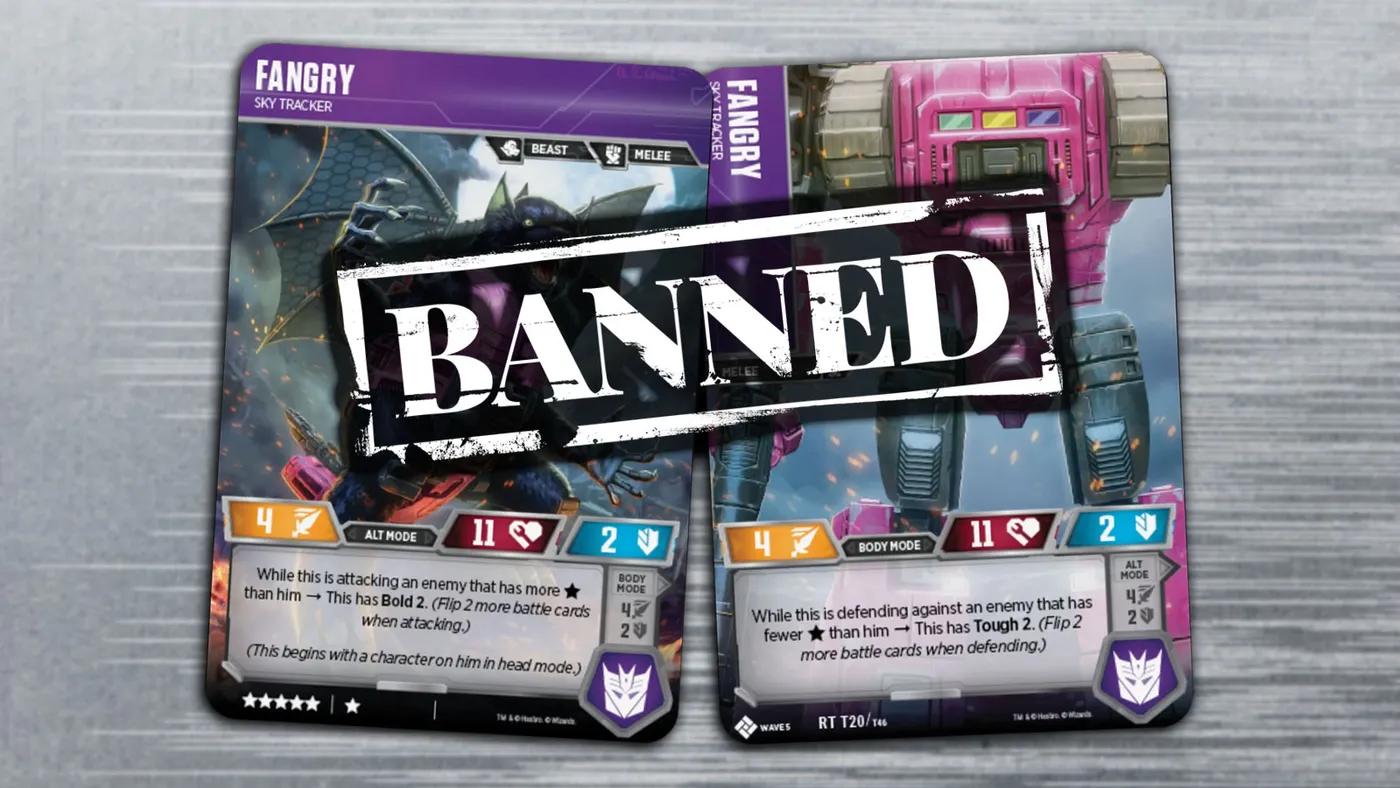
Fangry // Sky Tracker
Banned. Wave 5, RT T20/T46. A six-star Decepticon body-mode character, 4 Attack, 11 Health and 2 Defense in both modes, with an ability on each face:
Body mode. While this is defending against an enemy that has fewer ★ than him → This has Tough 2.
Alt mode. While this is attacking an enemy that has more ★ than him → This has Bold 2.
Its alt mode also carries the line that governs everything below: “This begins with a character on him in head mode.” A body-mode character is never played alone. It always arrives with a head attached, so its real star count is its own plus the head’s, and the comparison that matters is against whatever else a team could field for that combined total.
What body mode usually meant
Wave 5 generally statted its body-mode characters at or below the bot-mode characters they competed with, which reads as the design team allowing for the health bar break described above. A body-mode character is two characters in sequence rather than one, so a slightly thinner stat line is the obvious way to pay for that.
The wave bears this out. Horri-Bull // Ground Trooper is also a six-star body, at 4 / 9 / 1, and with a one-star head it fields 16 points of stats against the 17 of Crankcase // Data Collector, a seven-star bot-mode character. Slightly behind, with the second body as the compensation. That is the pattern working.
Fangry does not follow it
Fangry carries 4 / 11 / 2 for six stars. Set against the other six-star body in the wave, the gap is three points before anything is attached:
| ★ | Character | Mode | ⚔️ / ❤️ / 🛡️ | Total |
|---|---|---|---|---|
| 6 | Fangry // Sky Tracker | body | 4 / 11 / 2 | 17 |
| 6 | Horri-Bull // Ground Trooper | body | 4 / 9 / 1 | 14 |
| 6 | Autobot Outback // Gunner | bot | 4 / 10 / 1 | 15 |
Fangry is not merely ahead of the other body. He is ahead of the bot-mode character at the same star count, which is the comparison the pattern says he should lose.
Attach a head and the result is a seven-star character that beats everything else in the wave at seven stars:
| Combined ★ | Team slot | ⚔️ / ❤️ / 🛡️ | Total | And afterward |
|---|---|---|---|---|
| 7 | Fangry + Kreb | 4 / 13 / 2 | 19 | Kreb deploys as a 2 / 2 / 0 character |
| 7 | Horri-Bull + Kreb | 4 / 11 / 1 | 16 | Kreb deploys as a 2 / 2 / 0 character |
| 7 | Crankcase // Data Collector | 5 / 11 / 1 | 17 | nothing |
| 7 | Windcharger // Autobot Warrior | 3 / 11 / 2 | 16 | nothing |
Health is where it tells. Count it the way a game does, as damage an opponent has to deal before the slot is empty:
- Fangry + Kreb: 13 Health on the body, then 2 more on Kreb. Fifteen, across two bars.
- Crankcase: 11 Health, on one bar.
- Windcharger: 11 Health, on one bar.
Nearly half as much Health again as either seven-star peer, split so that overkill damage on the first bar is wasted and the second arrives fresh. The one-star Kreb is the sharpest pairing of all, because it is the smallest step into the bracket and because the two points it adds are Health, the stat Fangry is already best at using, and because those two points arrive twice: once on the body and once more when Kreb deploys.
Against the benchmark wave
Wave 5 is the wrong yardstick on its own, since the whole wave is the thing under suspicion. Wave 4 is the fairer test, because the community treats it as its balance benchmark. It printed five characters at seven stars:
| Character | ⚔️ / ❤️ / 🛡️ | Total |
|---|---|---|
| Sergeant Mirage // Special Ops • Spy | 4 / 13 / 1 | 18 |
| Sergeant Barricade // Infantry • Enforcer | 5 / 12 / 1 | 18 |
| Captain Impactor // Special Ops • Wrecker | 4 / 12 / 1 | 17 |
| Raider Chop Shop // Infantry • Soldier | 5 / 11 / 1 | 17 |
| Raider Nova Storm // Infantry • Combustion Specialist | 5 / 12 / 0 | 17 |
A tight band: 17 or 18 points, 11 to 13 Health, 0 or 1 Defense. That is what a seven-star character looked like in the wave transformerstcg.org uses as its balance benchmark.
Fangry with Kreb is 4 / 13 / 2, which matches the best Health in that band, beats every one of them on Defense, carries 19 points rather than 17 or 18, and then leaves a second character on the board when it is KO’d. Sergeant Mirage is the closest thing Wave 4 has to it and still ends up a point of Defense and an entire extra body short.
Nobody flipped him
Aequitas ruled on October 1, 2020 that star-counting effects use the sum of the head and the body, so a head raises the number both of Fangry’s abilities measure against. At seven stars each has a live range: Bold 2 when attacking the eight and nine-star characters that anchor most teams, Tough 2 when defending against anything smaller.
Players took the first and ignored the second. Fangry was run in alt mode, in orange shells built around attacking, and the body mode went mostly unused. The community had a joke about it: “Fangry doesn’t have a body mode.”
The joke is the useful part of this entry. Flipping is free, and the stat line is identical in both modes, so passing on half the card was not a sacrifice anyone was making reluctantly. Fangry simply did not need his second ability to be worth the slot. What a deck wanted was primarily the body, and conditionally the alt mode ability.
Why it was banned
Fangry was one of the four repeat residents of Garrus-9, and by community accounts it became the default seven-star character in the game, pushing its peers in that bracket out of consideration rather than competing with them. That is the crowding-out standard again, and it arrives the same way it did for the Health heads: not through an unusual ability, but through a stat line that does not sit where the rest of its category sits.
The ban is separate from the Health heads ban and rests on Fangry’s own numbers. Its best partner happened to be Kreb, but a body statted three points above its own category would have been a problem with any head on it.
Status
Fangry // Sky Tracker is banned in transformerstcg.org organized play, in both Constructed formats. It has no replacement card.
Fangry // Cursed Nightmare (Org Wave 7) is a different card and is unaffected by the ban.
It first appears on the Season One Encounter 4 list of July 31, 2021, came off twice, and has been on every list since Season Two Encounter 1 of August 16, 2022. The formal reasoning is not recorded on this page.
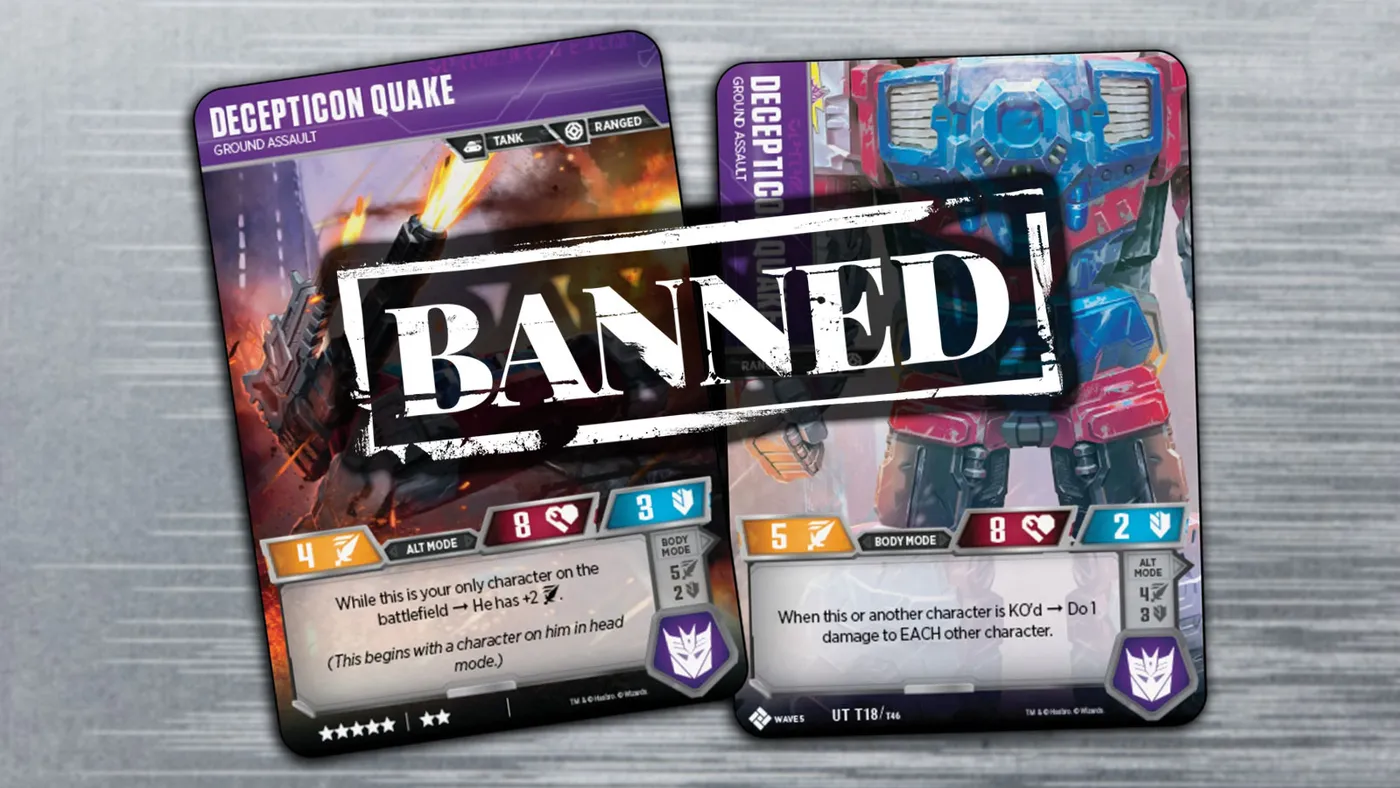
Decepticon Quake // Ground Assault
Banned. Wave 5, UT T18/T46. A seven-star Decepticon body-mode character, Tank and Ranged, with an ability on each face:
Body mode (5 Attack, 8 Health, 2 Defense). When this or another character is KO’d → Do 1 damage to EACH other character.
Alt mode (4 Attack, 8 Health, 3 Defense). While this is your only character on the battlefield → He has +2 ⚔️.
Not a stat line case
The two entries above turn on numbers. This one does not. Quake carries 15 points of stats for seven stars, the lowest total of any body-mode character in the wave and a point behind Sergeant Kup at the same star count. Nothing about it is overstatted. The ban rests on a single line of text.
The ability has no ceiling
Read the trigger closely, because both halves are wider than they look. “This or another character” fires on any KO anywhere on the board, including ones the opponent causes. “EACH other character” hits everything in play except Quake itself, your own team included. And nothing caps it per turn.
So one KO deals a point to everything else. If that point finishes anything off, that is another KO, which triggers Quake again, which deals another point to everything else. The loop runs until nothing further is KO’d, and the card does not care whose characters it is working through.
Quake’s other face pays out for surviving the result. While this is your only character on the battlefield → He has +2 ⚔️. The two modes are built for the same plan: clear the board, then be the one still standing on it.
Wave 5 supplied the fuel
A cascade needs targets that are KO’d by one point of damage, and Titan Masters Attack is the wave that put them on the board by design. Deployed head health runs low across the whole cycle:
| Health | Heads |
|---|---|
| 1 | Autobot Stylor, Parsec, Vorath |
| 2 | Kreb, Monxo, Flameout |
| 3 | Apex, Brisko, Doomshot, Freezeout, Ominus |
A single Quake trigger removes every one-Health head on the table at once, and each of those removals triggers Quake again. Two passes clear most of the three-Health heads as well. In the wave built around putting extra small bodies into play, Quake turned that same design into ammunition.
Timing nobody could resolve from the card alone
The cascade also raised a question the card does not answer: when a body-mode character is KO’d, its head deploys as a new character, so does that head arrive before or after the wave of damage that just KO’d its body?
Wizards of the Coast answered on June 10, 2020:
A head’s deploy ability is a triggered ability. When both players trigger an ability at the same time the active player’s abilities will complete before the defending player. A player may order their own simultaneous triggers how they wish. The player controlling Quake may order Quake’s damage trigger and Quake’s head’s deploy trigger such that Quake’s damage ability resolves first, and Quake’s head second.
So the head sits suspended mid-deploy while the damage resolves around it, and the Quake player chooses that ordering. The answer carries its own note that it “is an update on the originally published answer,” which is the tell: the body ruling on this interaction had to be corrected after publication.
The correction landed in the middle of people’s work. A Wave 5 deck profile for a build called MegaQuake, posted eight days later, opens by annotating itself: the video “was made BEFORE the rulings update for Octone and regarding how heads resolve,” and then restates the new ordering for viewers. A creator interrupting his own deck profile to correct the rules is a fair summary of where the format was.
Mirrors
Put a Quake on each side of the table and every KO triggers both of them. The first KO of the game can reasonably be the last turn of it, with the two abilities feeding each other through a board of one and two-Health heads until the cascade runs out of characters to KO.
Nothing else on this page is as hard to resolve correctly. Working out what a Quake turn actually did required knowing trigger ordering, active-player priority, and a deploy rule that the game’s own stewards had already revised once.
Why it was banned
The archive shows the potential was spotted immediately. Wossy Plays covered the reveal in March 2020 under a title that needs no gloss, and Wreck ‘n Rule’s early Wave 5 impressions on May 26, 2020, three days before release, predicted “some insane carpet bombing plays using Quake.”
The ban itself rested on two grounds held together rather than on either alone.
The first is experiential, the standard described at the top of this page, and Quake is named alongside Daring Escape and Sergeant Springer among the community bans that rest on it. A cascade that can run the length of a board, in a format where one side is often waiting, with timing the official rulings had already revised once, is the pattern that standard exists to catch. The practical version is blunter: there was no appetite for more players crossing their eyes at a long list of triggered effects that only one side of the table wanted to be resolving.
The second is power, though not in the form of a win rate. Against wide, low-health teams Quake’s potential output is severe, and Titan Masters Attack is the wave that made wide, low-health teams the ordinary thing to build. The table above is the same point from the other direction: the card was pointed at the format the wave had just created.
Neither ground was reached ad hoc. The analysis applied to Quake was the same spreadsheet work the community had already run on cards it had banned before, so the standard it was measured against was the one its predecessors had been measured against. It was also one of the four repeat residents of Garrus-9, sent three times before any permanent decision was taken.
The lesson that outlived it
Quake’s ability had no per-turn ceiling, and the absence is what community designers carried forward. Reactive direct damage is the shape most likely to run away from whoever wrote it, because its own output satisfies its own trigger.
Two Wave 8: Waste|Lands characters show the convention that came out of this card. Both answer non-attack damage dealt by an opponent’s card, which is exactly what Quake deals, and on both the cap is the first thing the ability says.
Crasher // Fractious Fanatic (CT T06/T38), in alt mode:
Once per turn, when two or more characters simultaneously take non-attack damage from an opponent’s card → Choose one:
- Repair 1 damage from each of your characters damaged this way.
- Do 1 damage to each enemy.
Gilthor // Wounded Retribution (RT T09/T38), in alt mode:
Once per turn, when one or more of your characters takes non-attack damage from an opponent’s card → You may do damage to an enemy equal to the number of characters that took non-attack damage this turn.
Crasher’s second option is Quake’s ability restated, and Gilthor’s payout scales with precisely the board-wide ping Quake produced, so a Quake trigger would have fed either of them. Uncapped, both would cascade the way this card did. Those three words at the front are the whole difference.
It is worth setting that against Horri-Bull below, whose uncapped trigger held a design space shut for as long as the card stayed legal. Quake did its damage and then left a rule behind for writing in that space safely, which is the better thing for a banned card to be remembered for.
Status
Decepticon Quake // Ground Assault is banned in transformerstcg.org organized play, in both Constructed formats. It has no replacement card.
It first appears on the Season One Encounter 4 list of July 31, 2021, came off twice, and has been on every list since the Teletraan I one-day tournament of July 30, 2022. The formal reasoning is not recorded on this page.
Further viewing
- Decepticon Quake Hits Everyone & Doesn’t Need Friends!, Wossy Plays, March 5, 2020. The reveal, three months before release.
- Quaking Boots Deck Tech!!, Legendary Void, May 25, 2020. A build prepared before the wave was even out.
- Wave 5 TMA Deck Profile: MegaQuake!, SDotTCG, June 18, 2020. The profile that had to annotate itself after the deploy ruling changed.
- Deck Analysis: Quake & Bake, Energon Hustlers, July 2, 2020.
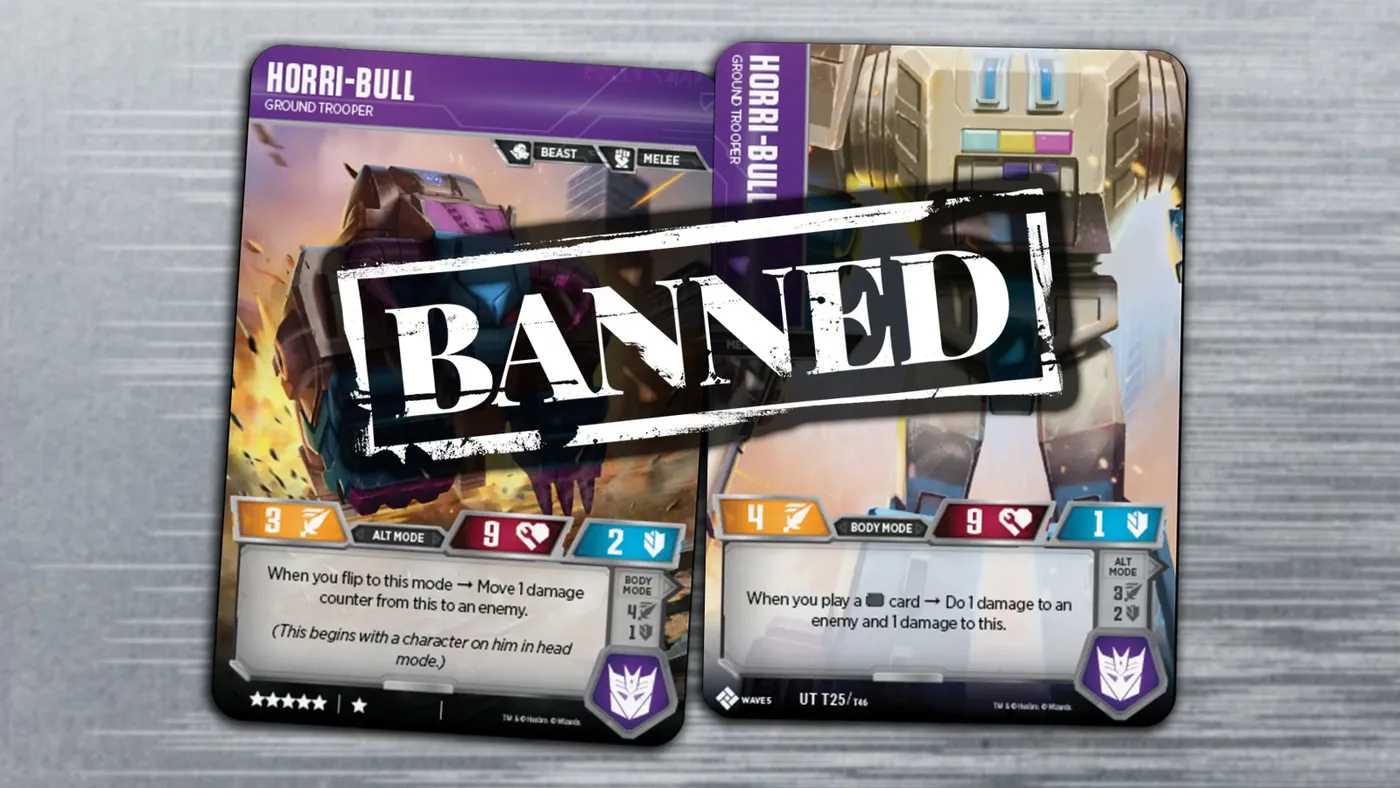
Horri-Bull // Ground Trooper
Banned. Wave 5, UT T25/T46. A six-star Decepticon body-mode character, Melee, with an ability on each face:
Body mode (4 Attack, 9 Health, 1 Defense). When you play a ⬛️ card → Do 1 damage to an enemy and 1 damage to this.
Alt mode (3 Attack, 9 Health, 2 Defense). When you flip to this mode → Move 1 damage counter from this to an enemy.
The most nearly redeemable of the three
Of the three banned body-mode characters, Horri-Bull is the one usually named as closest to recovery in a future refactor, and the least objectionable of the group. The reason is on the card: unlike Quake, every trigger costs it something. It damages itself each time it fires, and at nine Health it cannot do that indefinitely.
That drawback is also what a cap would have fixed, which is why this entry reads as a near miss rather than a design nobody should have attempted.
The cap that is not there
The drawback only binds if the trigger is limited, and it is not. There is no per-turn ceiling: one point of damage to an enemy for every ⬛️ card played, as many as the turn allows.
Worth walking a turn through, because the numbers are larger than the card suggests. Both of these are Wave 5 ⬛️ cards:
- Camien Crash (C 004/064), an Action: “Do 1 damage to one of your characters → Do 2 damage to an enemy.” Two damage from the card, plus one from Horri-Bull’s trigger. Three.
- Enhanced Power Cell (U 016/064), an Upgrade: “The upgraded character has +3 ❤️.” Nothing from the card, one from the trigger. One.
- Then flip to alt mode and move a damage counter across. One more.
Five damage to the opposing team in a turn where Horri-Bull has not attacked yet. Against Flamewar // Veteran Decepticon, a 10-Health character, that is half of it gone before the attack step.
The self-damage, meanwhile, has been paid off rather than suffered. Horri-Bull takes one from each of its own triggers and can absorb Camien Crash’s self-damage as well, and Enhanced Power Cell went onto Horri-Bull for +3 Health, covering all of it. The flip then exports one of the counters it did take.
Moving a counter is not damage
The export has a technical edge that is easy to miss. Aequitas was asked whether moving a counter counts as damaging the target or repairing Horri-Bull, and the answer was flat:
No. Moving damage counters never count as damaging or repairing a character.
So the counter arrives on an enemy without being damage for rules purposes, and leaves Horri-Bull without being a repair. Anything on either side of the table keyed to damage being dealt or healed simply does not see it happen.
What it closed off
The sharper cost is to cards that were never written. The game has a settled pattern for effects you can play several times in one turn, and the pool holds a number of them. Four of the better known:
| Card | Icons | What it does |
|---|---|---|
| Attack Drone (Wave 2, U 005/081) | ⬜️ 🟩 | “You may play another Attack Drone,” up to three in one Weapon slot. |
| Focus Fire (Wave 2, U 032/081) | 🟧 🟩 | Scales with each copy played that turn, and “You may play another Focus Fire.” |
| Extra Padding (Wave 3, U 024/064) | 🟦 🟩 | “You may play another Extra Padding,” up to three in one Armor slot. |
| War of Attrition (Wave 4, C 063/064) | 🟦 🟩 | “You may play another War of Attrition,” with an extra payoff on the third. |
Four cards, three waves, and not one of them carries ⬛️. While Horri-Bull is legal none of them could. A chain card with a black icon would hand its controller a free point of damage per copy, uncapped, for doing the thing the card was already asking them to do. Three Extra Paddings in a single Armor slot would be three damage across the table on top of the armor, and three Attack Drones another three on top of the weapon.
That is the third criterion from the test at the end of this page in its purest form: not a card that wins too often, but a card that forecloses a whole shape of future design for as long as it stays legal.
Why it was banned
The reveal coverage caught the character of the card immediately. Wossy Plays, in March 2020 under the title “This New Card is Horrible!”, wrote that it is a card he loved and also “a pretty nerve-wracking card to play,” which is the self-damage speaking.
Three things carried the ban, and the first is plain power. Five damage across the table in a turn, before the character has attacked, is a great deal of direct damage for one card to produce, and nothing stopped it producing more. Horri-Bull was treated as a strong card throughout, not merely an awkward one. That it is less egregious than Fangry’s stat line or Quake’s cascades is a comparison among banned cards rather than a defense of it.
The second is the shape of the drawback. An uncapped trigger whose self-damage can be bought off inside the same turn that caused it is not functioning as a cost.
The third is the design space it holds shut behind it, which is the part that would have outlived any particular metagame.
What the ban rests on less heavily than Quake’s does is experience: a Horri-Bull turn is arithmetic rather than a cascade, and the opponent can follow it. Horri-Bull was also one of the four repeat residents of Garrus-9, sent twice before any permanent decision was taken.
Status
Horri-Bull // Ground Trooper is banned in transformerstcg.org organized play, in both Constructed formats. It has no replacement card, though it is the one of the three bodies most often discussed as a candidate for a refactored version.
It first appears on the Season One Omega Invitational list of March 28, 2022, came off once, and has been on every list since Season Two Encounter 1 of August 16, 2022. The formal reasoning is not recorded on this page.
Further viewing
- This New Card is Horrible! (Wave 5), Wossy Plays, March 2, 2020. The reveal, three months before release.
- S&S Incredi-Bull: Sky Shadow & Horri-Bull Deck Profile, TransformYourGame.net, June 14, 2020.
- Horri-Bull Jokes Deck Tech!!, Legendary Void, July 12, 2020.
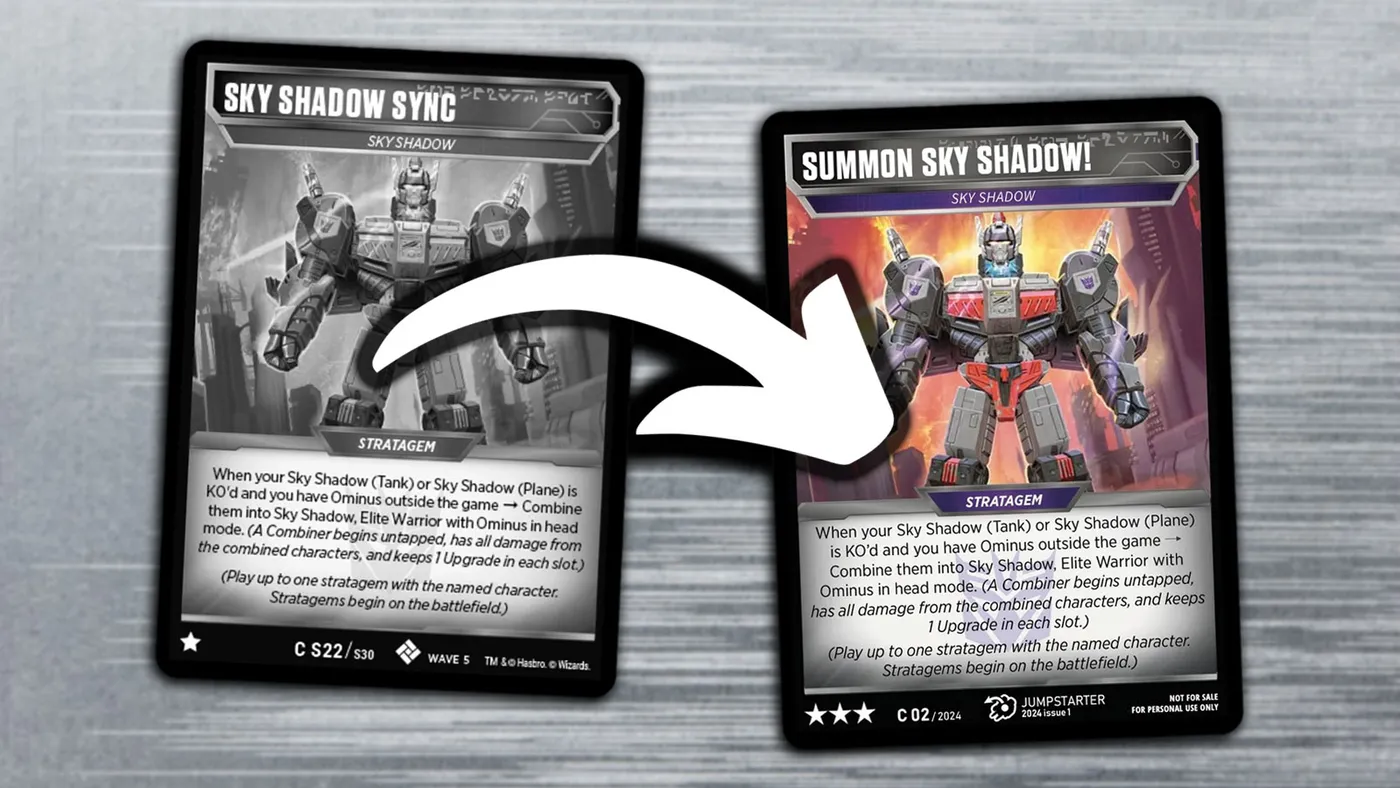
Sky Shadow Sync
Replaced, by Summon Sky Shadow!. Wave 5, C S22/S30. A one-star Stratagem naming Sky Shadow:
When your Sky Shadow (Tank) or Sky Shadow (Plane) is KO’d and you have Ominus outside the game → Combine them into Sky Shadow, Elite Warrior with Ominus in head mode. (A Combiner begins untapped, has all damage from the combined characters, and keeps 1 Upgrade in each slot.)
This is the only stratagem on the Ban List, and the only entry where the problem is not what a card does but what it charges.
What the package already was
Sky Shadow arrives as two seven-star characters, both Ranged, which between them open the whole Ranged support suite:
| ★ | ⚔️ / ❤️ / 🛡️ | Carries | |
|---|---|---|---|
| Sky Shadow (Plane) | 7 | 4 / 10 / 2 | Bold 2, Plane |
| Sky Shadow (Tank) | 7 | 4 / 10 / 2 | Tough 2, Tank |
| Sky Shadow // Elite Warrior | 8 / 20 / 2 | Bold 2 and Tough 2 together |
The combined form also arrives swinging: “When this is combined → Do 3 damage to an enemy Autobot.” That is faction-restricted and still hit about half of what the format was bringing.
With Ominus in head mode it gains Pierce 4 on top, so an eight-Attack body that flips two extra cards attacking, two more defending, and does at least four damage whatever the defender does about it. Ominus then deploys as its own character when the combiner finally falls.
The one-star part
Ominus is a three-star head. The stratagem that fetches it counts one.
Aequitas confirmed the mechanism in November 2020, and the answer is the whole problem stated as a rules nicety:
No. Sky Shadow Sync says “When … you have Ominus outside the game”. If Ominus was on your starting team, then Ominus is inside the game and Sky Shadow Sync will not trigger.
Ominus has to be outside the game, which is precisely why it never counts. Running the arithmetic against the 25 a team is allowed:
| ★ counted | |
|---|---|
| Sky Shadow (Plane) | 7 |
| Sky Shadow (Tank) | 7 |
| Sky Shadow Sync | 1 |
| Total | 15 |
| Ominus, arriving from outside the game | 0 |
Fifteen gets you seventeen stars of material, and leaves ten for the rest of the team.
What ten stars bought
Two of the five decks that dominated the Wave 5 metagame were built in exactly that space:
- “SkyCeptor” decks, pairing Perceptor // Precise Sniper (eight stars) with Brisko in a blue shell.
- “SkyBull” decks, pairing Horri-Bull // Ground Trooper with Grax in an orange shell, with Villainous Spotlight for two extra ★ of 🟧 cards in the deck.
The archive has the two of them playing each other on June 7, 2020, which is a fair picture of how much of the format this one stratagem was underwriting.
Timing, again
Combiners raised their own questions, and Sky Shadow raised more than most. Wizards had to rule on what happens when a part is KO’d during an attack:
The attack continues since “Combiner Mode” is mostly another mode like Alt or Bot mode. […] Note that Sky Shadow will be untapped because the process of combining creates an untapped character.
So an attack that KOs one half runs on into an untapped twenty-Health body. It is untapped but not undamaged: a Combiner “has all damage from the combined characters,” and because the trigger fires on one half being KO’d, Sky Shadow // Elite Warrior normally arrives carrying at least the ten damage that KO’d it. What combining buys is a larger pool and a character that has not spent its turn. Aequitas later had to sequence the combine trigger against another deploy trigger in the same window, noting that “Sky Shadow does 3 damage to an Autobot when it combines” makes the ordering “a very relevant question.” And Wizards confirmed the one place it does not save you: if both parts are KO’d simultaneously as your last characters, you lose, because the stratagem has no text that keeps you in the game.
The fix is arithmetic
Summon Sky Shadow! (Jumpstarter Update Booster 2024 issue 1, C 02/2024; Org Wave 9, C S28/S44) carries the same text, word for word. The only change is the number in the corner: three stars instead of one, matching the Ominus it fetches.
Those two points do more than they look like. The package goes from 15 to 17, leaving eight stars rather than ten, and Perceptor is an eight-star body-mode character that cannot be fielded without a head. The cheapest head in the wave is one star. Nine will not fit into eight.
So SkyCeptor stops being legal without a word of restriction being printed. Where Press the Advantage needed an icon removed and Mission Briefing needed a clause added, this one needed only to be counted honestly, and the deck it carried fell out of the format on its own.
Status
Sky Shadow Sync is legal only as Summon Sky Shadow!. The original printing is not tournament-legal in either Constructed format. It is one of the four repeat residents of Garrus-9, first appearing on the Season One Encounter 5 list of September 25, 2021, coming off twice, and on every list since Season Two Encounter 1 of August 16, 2022. Sky Shadow (Plane), Sky Shadow (Tank), Sky Shadow // Elite Warrior and Ominus are all unaffected and legal.
Further viewing
- Sky Shadow is a Titan Master AND a Combiner? Weird & Awesome!, Wossy Plays, February 21, 2020. The reveal, three months before release.
- Sky Shadow/Perceptor vs Sky Shadow/Horri-Bull, Powered by Primus, June 7, 2020. SkyCeptor against SkyBull, two of the format’s five dominant decks.
- Combiner Tier List, Legendary Void, November 13, 2022. A retrospective placing Sky Shadow among the game’s Combiners.
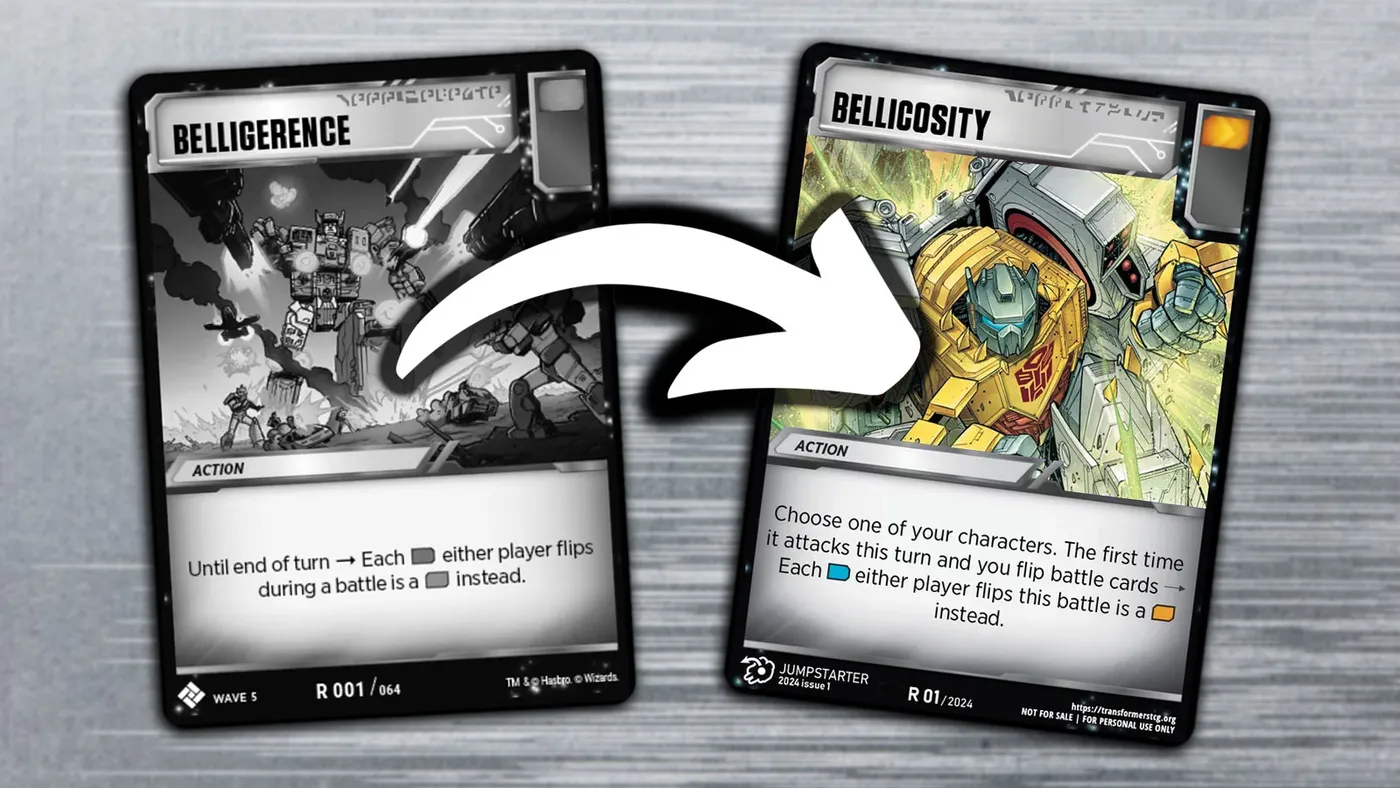
Belligerence
Replaced, by Bellicosity. Wave 5, R 001/064. An 🟧 Action:
Until end of turn → Each 🟦 either player flips during a battle is a 🟧 instead.
Wave 5 printed the icon-conversion idea twice, once in each direction, and the pair is the clearest case on this page of two cards that look like counterparts and are not.
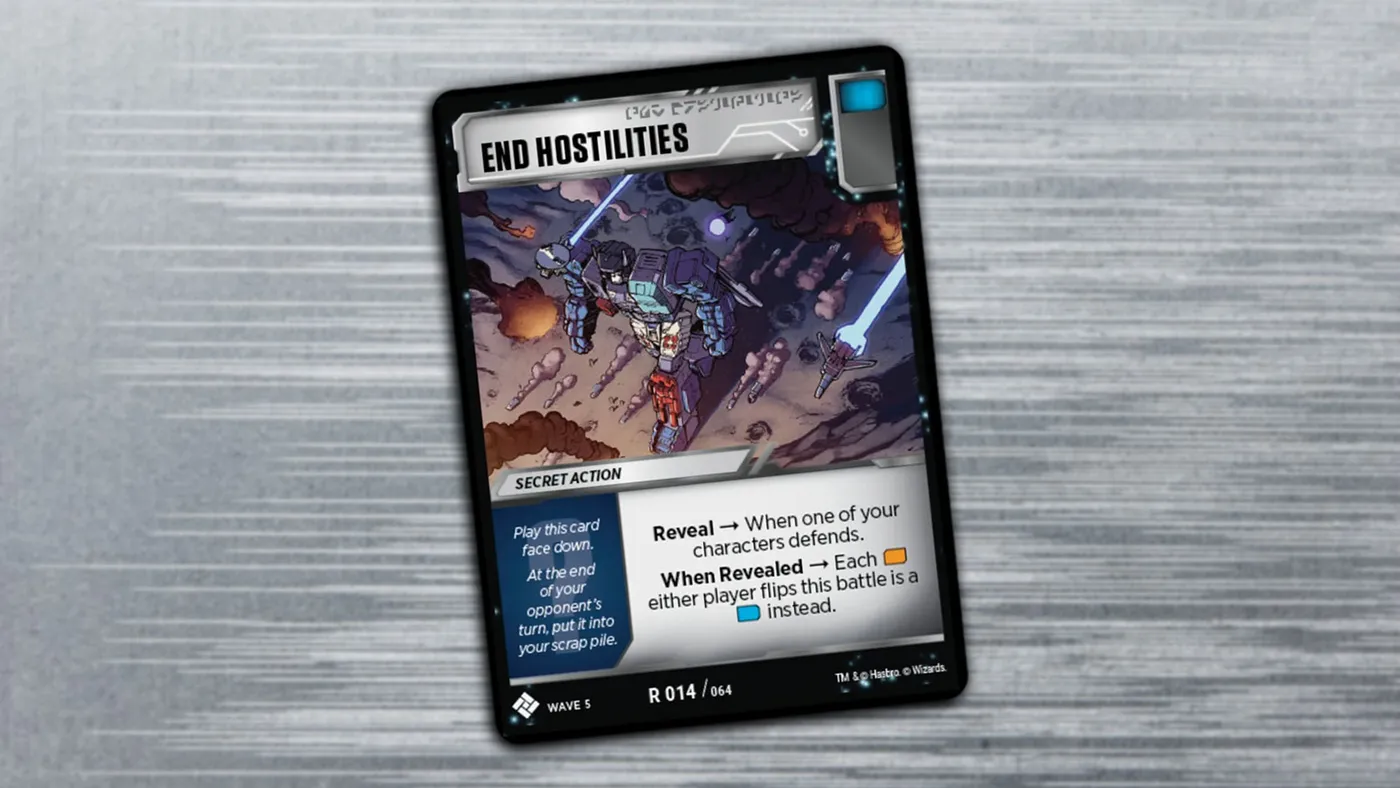
The pair
End Hostilities (Wave 5, R 014/064) is the other half. It is a 🟦 Secret Action:
Reveal → When one of your characters defends.
When Revealed → Each 🟧 either player flips this battle is a 🟦 instead.
Both saw heavy play once the wave arrived, for the same reason: each one turned off an entire color of battle icon. The surviving contemporaneous coverage is from the preview period rather than the format that followed. Ken Nagle, one of the game’s official designers, ran End Hostilities in a deck published five weeks before release, and a deck article three weeks out ran two copies and set out the logic:
I chose End Hostilities over some other defensive Secret Actions because it can be backbreaking in some scenarios, and even the base case is pretty strong against an Orange deck.
That is an evaluation made before anyone had played the format, and it reads as an anti-orange insurance policy.
Lined up side by side, though, the two cards are not the same size:
| Belligerence | End Hostilities | |
|---|---|---|
| Type | Action | Secret Action |
| Converts | 🟦 → 🟧 | 🟧 → 🟦 |
| How long | Until end of turn | This battle |
| How many battles | Every battle that turn | One |
| How many characters | Every character on both teams | The one defender |
| Played | On your turn, by choice | Only when one of your characters defends |
End Hostilities answers one attack. Belligerence answers the turn.
Why the asymmetry mattered
Both cards read as even-handed, because both say “either player.” On your own turn that symmetry does not exist. You are the attacker in every battle you start, so every 🟦 your opponent flips to defend becomes an 🟧 that adds Attack to a character who is not attacking, while every 🟦 you flip becomes more Attack for the character who is. The same sentence that makes the card look fair is what makes it one-sided.
A Wizards ruling widened the sweep further:
If I flip a 🟦 hybrid battle icon, does it become an 🟧 hybrid battle icon with the same trait?
Yes.
So hybrid icons convert too, keeping their traits. Nothing blue survives the turn.
That is what made Belligerence a serious tool for the wide orange teams of the era. A wide team attacks many times in a turn, and one card paid for all of those attacks at once.
The experience it produced
The cost landed on Tough decks and tall Tough decks in particular, both of which answer aggression by surviving it. Against Belligerence they watched attack after attack land while their defensive flips did nothing, with no decision available to them at any point, because the card had already resolved before the first attack was declared. Negative play experience of that kind is cited elsewhere on this page against solitaire-like turns; this is a different shape of the same complaint, where the opponent is not kept waiting so much as made irrelevant.
A deck archetype that cannot be defended for a whole turn is also a design constraint. Every defensive 🟦 card printed afterward would have to be weighed against one Action that switched the color off.
The fix is scope
Bellicosity (Jumpstarter Update Booster 2024 issue 1, R 01/2024; Org Wave 9V, R 002/008) keeps the conversion and the 🟧 icon, and takes away the reach:
Choose one of your characters. The first time it attacks this turn and you flip battle cards → Each 🟦 either player flips this battle is a 🟧 instead.
Three limits replace the blanket. One chosen character rather than the whole team, the first battle it attacks in rather than every battle, and that battle alone rather than the rest of the turn. What was a turn-long condition is now a single attack, which is the same size End Hostilities had been all along.
By organizer accounts the effect on the format was to make tall mixed-icon and Tough blue decks viable against the orange meta again. It was not a cure for that meta, and was never meant to be.
Texture: the rules argument
Worth recording, though it is not why the card was replaced. How the two cards interacted was disputed inside Aequitas circles and no roundup resolved it. Dan Arnold and Alpha Trion Protocols-aligned members argued that End Hostilities overrode an opposing Belligerence when revealed; Technomagus and Ark-aligned members argued the two cancelled each other out.
Nothing inside Aequitas decided it. Arnold eventually stopped attending its meetings, and Aequitas itself ended before a final ruling could be made, so the question lapsed rather than closed.
The answer came later and from a different body. Allied Crossplay ruled that the two effects cancel out, and transformerstcg.org imported that ruling; it is now the third of the post-cancellation rules changes:
If one card makes battle icons act as though they were another color and a second card makes them act as though they had not changed, the two effects nullify each other and the icons keep their printed color.
The rule is written against Bellicosity and End Hostilities and applies to Belligerence as well, so the question outlasted both the card it started over and the body that first argued it.
Status
Belligerence is legal only as Bellicosity. The original printing is not tournament-legal in either Constructed format. End Hostilities is unaffected and legal.
Further viewing
- Wave 5 Titan Masters Attack Spoiler: Belligerence, Blues on Attack, February 25, 2020. The reveal, three months before release.
Further reading
- Nagle’s Notes: Spymaster’s Ruse Deck, Ken Nagle, April 21, 2020. An official designer’s own list, running End Hostilities five weeks before the wave released.
- Sleight of Hand: Chromedome Part 2, Matt Smith, May 7, 2020. The preview-period case for End Hostilities, quoted above.
The Test Wizards Set Itself
When Wizards of the Coast banned Swap Parts it published its reasoning rather than simply issuing the ban, and the reasoning rested on three things it wanted the game to be:
a worthy expression of the Transformers brand and its characters, a fun fast exciting game you can play with your friends, and a game they can keep supporting into the future.
That is a usable test, so it is worth running every card on this page through it, including the one banned for never having been legal.
Two cautions before the table. Only Swap Parts, Press the Advantage and Multi-Mission Gear were decided by Wizards; the rest were decided by community bodies that were never bound by this statement, so this is a retrospective lens rather than a claim about how those later decisions were argued. And several cards fail a criterion by a margin, not absolutely, which the table cannot show.
| Card | Where it falls short |
|---|---|
| Optimus Prime // Inspiring Leader | None. The issue is administrative rather than design-related: a limited promo can exist, but tournament officials still need explicit direction on its legality. |
| Swap Parts | All three, by Wizards’ own account: characters set aside, the opponent reduced to a spectator, and nothing further printable in its space. |
| Press the Advantage | Future support. One faction stopped being worth building, and every remedy weighed would have narrowed deck building further. |
| Multi-Mission Gear | Fun, and future support. Wizards called the decks it fed “frustrating to play against” and closed the space behind it by ruling out further Upgrades that buy Actions. |
| Daring Escape | Fun. Wizards judged that it passed the third test, holding that an alternate win condition is a legitimate thing for a game to have, and banned the engine instead. |
| Sergeant Springer | Fun. A long solo turn the opponent watches, printed across three modes. |
| Peace Through Tyranny | Fun and future support. An extra turn is the widest swing available, on one of only four double-icon cards the game could afford to print. |
| Security Checkpoint | Fun and future support. The same pair from the other side: symmetrical on its face, one-sided in play, and another of the four double-icon cards the game could afford. |
| Mission Briefing | Future support alone. It “made many draw cards obsolete.” |
| Fusion Borer | Future support alone. It “effectively removes many other Weapon choices from deckbuilding considerations and play.” |
| Impetuous Stand | Future support alone, and the sharpest instance: cards that had not been written yet were being written around it. |
| Kreb, Brisko and Grax | Future support. Fifteen other heads became second choices. |
| Fangry // Sky Tracker | Future support. It became the default at its star count rather than one option among them. |
| Decepticon Quake | Fun. Cascades with no cap, and timing the official rulings had to revise. |
| Sky Shadow Sync | Future support alone. Nothing it does on its own is objectionable; it simply counted one star for three, and the format bent around the power of Sky Shadow itself and the ten stars that left over. |
| Horri-Bull // Ground Trooper | Fun and future support. The potential for a large amount of direct damage before attacking, and an uncapped trigger that holds shut every future ⬛️ battle icon card playable more than once in a turn. |
| Belligerence | Fun and future support. A whole turn in which the defender’s flips stop defending, for potentially multiple attacks. |
What the column shows
The third criterion does nearly all the work. Fourteen of the seventeen entries fall short on “a game they can keep supporting into the future,” and eight fall short on that alone, with nothing wrong with them that a player sitting across the table would have felt.
That is the crowding-out standard from the top of this page, in Wizards’ own words and years of hindsight earlier, and it catches both directions of it: the answers already printed that stop being worth playing, and the answers not yet written that have nowhere to go. Wizards framed it as a publisher’s problem, which is what it was for them, since their stake was in continuing to print sets. The community inherited the same problem in a different form, needing a card pool that could still absorb new releases.
The first criterion, a worthy expression of the brand and its characters, is the one almost nothing fails. Swap Parts is the lone clear case, and only because the deck it produced stopped attacking altogether and left its own characters tapped.
The card that passes each of the tests most emphatically is the one that was never legal to play. Optimus Prime // Inspiring Leader does little for Optimus himself: both of its abilities primarily help the rest of the team, it is a Leader in both modes, and the whole card is built around the Matrix of Leadership. As a statement about who the character is, nothing else on this page comes close. It is also the only entry nobody could bring to a table.
None of these cards misrepresent the fiction. They break the game around themselves instead, which is a reassuring thing to find at the end of a list like this: the problems here were design problems, not failures to understand what the game was about.
Every card on the Ban List is covered above. The Ban List remains the authoritative record of what is legal; this page only explains it.