

Meaningful Public Beta: Guidance on Ideal 3
Guidance on: The All Are One Ideals
This guidance explains how transformerstcg.org applies the All Are One Ideals to a recurring question of game design, organized play, and community governance. It describes the application; it does not amend the Ideals.
Primary Ideal: 3. We builders are pro-feedback
Related Ideal: 5. We builders have the sustainability of the game in mind
A Public Beta asks players to spend their time helping develop a game. That invitation carries an obligation: their participation must still have a realistic opportunity to change what they are testing.
Publishing cards, accepting comments, and collecting tournament data are useful parts of development. They do not by themselves make a development period meaningfully public.
The failure this guidance addresses is a public period that carries the name without the substance: the cards go out, feedback is invited, data is gathered, and nothing remains that the feedback could change. Players spend their evenings building decks, recording results, and writing up problems for a release whose important decisions were settled before anyone was asked. The work is real and the influence is not.
In brief
A Public Beta is an active development stage. Players taking part in one should expect:
- meaningful design questions to remain unresolved;
- feedback to be able to produce substantial changes;
- negative findings to receive serious investigation;
- important revisions to return to testing;
- major development decisions to be explainable;
- enough time for different players, decks, skill levels, and environments to test the material;
- the release to remain visibly unfinished until that process is complete.
There is no universal minimum number of months that makes a Beta legitimate. A short Beta can be meaningful for a small or narrowly scoped product, while a large Wave may need much longer. The question is functional:
Did the public have enough time and enough influence to meaningfully affect the finished release?
A public period used mainly to confirm, promote, or lightly tune decisions already made does not meet the transformerstcg.org standard.
Why Public Beta exists
Private development has unavoidable limits. A design team knows what its cards are supposed to do, and its members share assumptions, terminology, testing habits, preferred archetypes, and knowledge accumulated over the whole development period. Even a large internal group cannot reproduce every way the wider player population will approach a release.
Public Beta widens that environment. New players misunderstand cards in ways designers never anticipated. Experienced players find combinations internal testers missed. Casual players expose complexity and usability problems. Competitive players push efficiency. Deckbuilders approach archetypes from directions nobody in the room considered. Rules questions reveal templating weaknesses. Repeated games show whether an exciting interaction is still interesting once the novelty wears off.
Public feedback therefore serves a different purpose from internal approval. The community is being asked to help discover what the development team does not yet know, and for that to mean anything the team has to remain willing and able to act on what the community finds.
Standard 1: Important design questions remain unresolved
A project should enter Public Beta confident that its release is ready for broad testing. It should not enter Public Beta with every important decision already closed.
Questions that may reasonably still be open include whether an archetype is too efficient or too fragile, whether a character’s star cost is right, whether a stratagem creates unhealthy incentives, whether a mechanic is understandable in ordinary play, whether a card creates unintended interactions with older releases, whether particular decks have enough counterplay, whether cards meant for casual use become oppressive under competitive optimization, whether an archetype works across different skill levels, and whether an individual design needs substantial redesign or removal.
A team may hold strong expectations about the answers. Development would be impossible without hypotheses. Those expectations have to stay falsifiable: if evidence shows a foundational assumption was wrong, the project needs to be able to revisit it. A team that has already decided only small numerical adjustments remain has substantially limited what public testing can accomplish.
Standard 2: The scope of feedback is clear
Players should know what they are being asked to evaluate. A project may reasonably focus a test period on particular questions, such as balance, wording, mechanical clarity, matchup diversity, a newly introduced faction, changes made during the previous revision, or interactions with an established tournament environment. The development team should say which of those matter most.
That does not mean testers should ignore problems outside the stated focus. If a player finds that a core mechanic is fundamentally confusing during a balance test, the project should still hear it. If repeated testing suggests an archetype needs structural revision, the team should not dismiss the finding merely because it expected to be adjusting numbers.
The useful distinction is between focus and exclusion. Focus tells testers where information is especially valuable. Exclusion declares some conclusions unavailable regardless of what testing discovers. Public Beta should use the first carefully and the second sparingly.
Standard 3: Feedback can cause revision
Feedback has influence when the development team changes course because evidence changed its understanding of the release. That can mean changing statistics, rewriting abilities, changing star costs, replacing mechanics, redesigning or removing cards, adding counterplay, reconsidering intended archetypes, changing rules or templating, extending development, or returning a release to an earlier development state.
A healthy process does not promise that every suggestion will be adopted. Players disagree. Some proposed fixes create worse problems. Feedback may rest on too few games or an unusual local environment. Designers remain responsible for weighing evidence and deciding.
The standard is whether feedback can meaningfully affect those decisions. If the range of acceptable outcomes has already narrowed to minor tuning, public feedback has correspondingly little power. The Certified Community Release standard says the same thing in its own terms: community feedback must influence development, and a public period that only validates or promotes decisions already made does not qualify.
Standard 4: Negative feedback is investigated
Positive feedback is easy to accept. A feedback culture is revealed by what happens when players report that something is frustrating, confusing, too strong, ineffective, repetitive, or simply unsuccessful.
Negative feedback does not automatically establish that a card is defective. It establishes a question worth examining. The development team should weigh how many players report the problem, whether the reports arose independently, what level of play produced them, whether game records support them, whether the issue persists across different decks and matchups, whether it comes from unfamiliarity or survives experience, whether internal testing can reproduce it, and what a proposed correction would cost elsewhere.
Responses should address the substance of the concern. Statements about designer intent, previous internal testing, personal experience, or how much work is already finished may add context. They do not resolve contradictory play evidence on their own. The goal of feedback is discovery, and a result that challenges the team’s expectations is often worth more than one confirming them.
Standard 5: Significant revisions get another testing cycle
Revision is only half of iteration. A changed card is a new object, and it needs testing too.
A project should avoid the pattern test, identify problem, change card, release when the change is significant enough to alter how the card, its archetype, or the surrounding environment behaves. The healthier cycle is test, evaluate, revise, test again, evaluate again, and large changes may need several passes.
A redesign meant to fix one matchup can damage another. A reduced star cost can make an archetype viable while creating an unintended combination elsewhere. New counterplay can overcorrect. Cleaner wording can change an interaction players had already built decks around. Repeated revision cycles are a feature of serious public development: they show a project learning from evidence rather than only collecting it.
Standard 6: Important decisions are explainable
Public Beta does not require publishing every private conversation, unfinished idea, internal vote, or testing note. Players should still be able to understand how consequential decisions were reached.
For a significant change, that means saying what problem was identified, what evidence informed the change, what changed, what the team expects the revision to accomplish, and what players should test next. When substantial community concern does not produce a change, the project should be willing to explain why: broader data contradicted the concern, another interaction already addressed it, testing showed the proposed fix caused larger problems, the issue appeared only in a narrow environment, or more testing is still needed.
Transparency does not require agreement. It gives participants evidence that their work entered an accountable process. A feedback form disappearing into an unseen internal process tells players nothing about whether their participation mattered; visible revision history and development notes make that influence possible to evaluate.
Standard 7: Public Beta needs enough time
Card games generate information slowly. A single game can reveal an obvious rules problem. Balance takes much longer.
Players need time to read new cards, build decks, make mistakes, rebuild, learn matchups, find combinations, share what they find, challenge early assumptions, adapt to emerging strategies, and test revisions. The development team then needs time to evaluate those findings and act on them, and the community needs another opportunity to test what changed. For a large Wave, that can run to months, and a short calendar period is weakest exactly where the release is largest: the number of interactions grows far faster than the number of cards.
transformerstcg.org sets no universal minimum duration. A six-month Beta can still be poor if feedback cannot change anything, and a shorter Beta can be meaningful when the scope is narrow, the environment is well understood, and revision happens quickly. For scale, World|Strike spent roughly three months in Public Beta, and Waste|Lands roughly twelve after about six months of Pre-Alpha and Alpha development.
The standard is functional:
There must be enough time for public discovery, development response, revision, and meaningful retesting before the release becomes final.
What the record shows
Two episodes from the community era shaped these standards, and the first of them belongs to this organization’s own predecessor.
A card that skipped the review
Impetuous Stand was added to Turbo Revving Old Punks’ Phase One late in development, after the limited, weeks-long beta that the rest of the release had been through. It became the first community card banned from organized play, survived an unsuccessful rework, and eventually had to be replaced outright. A card that arrives after the testing window has closed has not been tested, whatever stage the release as a whole is in, and the cost of that omission fell on the shared card pool for years afterward. The full account is part of this site’s history, and Team Bayformers, the organizational predecessor of transformerstcg.org, was a participant in the development environment that let it happen.
A Beta that began after the decisions closed
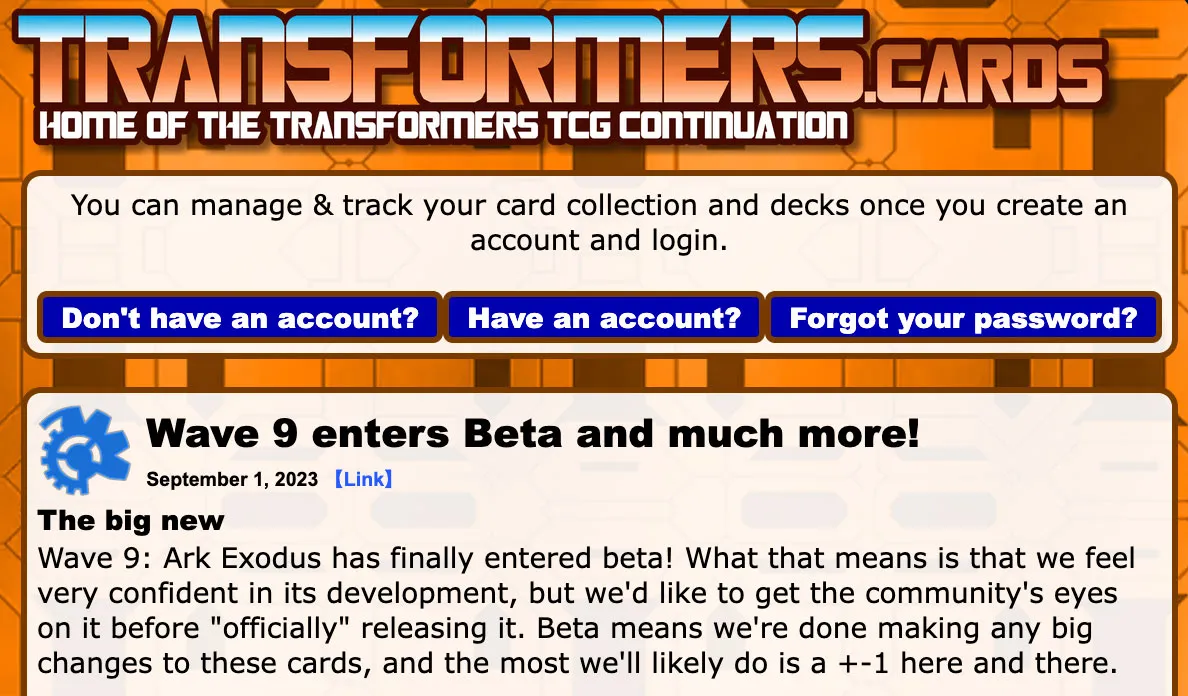
“Ark Exodus” is the clearer case of the failure this guidance is about. Announcing its Beta on transformers.cards on September 1, 2023, Z-R0E wrote that the team felt “very confident in its development” and that:
Beta means we’re done making any big changes to these cards, and the most we’ll likely do is a +-1 here and there.
The same announcement named the team’s two sources of data. The first was a feedback form, which it called one of the best sources it had. The second was a Full Constructed tournament opening for signups that day and starting two weeks later, where players were asked to consider including the new cards but told they did not have to.
So the problem was visible at the moment the Public Beta began: the community was invited to test a release whose developers had already described substantial revision as finished. The feedback channel was open; the range of outcomes available to that feedback was not. And the second data source was an event that did not require anyone to play the cards under test.
“Ark Exodus” released on October 26, 2023, less than eight weeks later. Duration alone does not establish the problem. The combination does: a large community release, major changes declared complete before public testing started, feedback solicited afterward, a tournament that did not require the new cards standing as the other main source of data, only minor adjustment expected, and under two months for the whole public phase.
That is better described as late-stage validation and tuning than as Public Beta. The distinction does not require assuming bad faith. The governance problem is that the process had already limited what contradictory evidence was permitted to accomplish, before the public was asked to produce any. Calling the stage Public Beta extended the invitation without preserving what the invitation implies.
Public Beta is allowed to find that development is not finished
One of the most important powers a Public Beta keeps is the ability to conclude: this needs more work.
Schedules matter. Artists, designers, organizers, printers, event planners, and players may all be waiting. None of that can determine whether the cards are ready. When testing reveals a substantial problem, the appropriate responses include delaying release, extending Beta, redesigning cards, removing unfinished material, reopening settled questions, and returning parts of the release to Alpha development.
None of those is a failed Beta. Each one means the Beta found something important enough to act on. A process becomes fragile when finishing on schedule matters more than learning from the test.
Feedback should come from more than one kind of player
Public Beta also widens who gets to influence development.
Competitive specialists are valuable testers, particularly good at finding efficiency, optimization, degenerate interactions, sideboarding pressure, and high-level metagame effects. They are one part of the player population. A release meant for the wider Transformers TCG community should also get real testing from casual players, returning players, newer players, experienced deckbuilders, players running unconventional strategies, physical-card players, online players, and people who care most about particular characters or factions.
Different players find different failures. A mechanic can be competitively balanced and unpleasant to use. A card can be obvious to its designer and confusing to a returning player. An archetype can perform acceptably in tournament testing while demanding such narrow construction that casual players find nothing to explore. A meaningful Public Beta treats those findings as development information too.
What feedback does not guarantee
Being pro-feedback does not mean governing by poll. Designers remain responsible for the quality and coherence of the release.
No individual tester gets a veto because they dislike a card. Large numbers of players can share an assumption that testing later disproves. Popularity does not settle balance, and an organized campaign is not evidence. The team’s job is to listen, investigate, test, decide, and explain.
Community influence means outside evidence can change the decision. It does not mean every outside preference becomes the decision. That distinction protects both sides: players get participation that can matter, and designers keep responsibility for the finished work.
The transformerstcg.org Public Beta standard
When transformerstcg.org calls a release a Public Beta, that is a development commitment. The cards are unfinished. Players may find problems we missed. Substantial changes remain possible. Testing can challenge our assumptions. Important revisions may restart part of the testing cycle. The schedule can move when the cards need more work.
Public Beta cards therefore stay visually and institutionally distinct from finished releases. They may still change in wording or balance, and they enter organized play only at events that declare the Harmony modifier, which tells organizers and players that the event includes material still under public testing.
Public Beta development also supports the Certified Community Release standards: sustained public testing, meaningful iteration, broad balance, accountable development, and long-term stewardship.
A practical test for builders
Before calling a project Public Beta, ask:
- What important questions are still unresolved?
- What could community feedback still cause us to change?
- Could evidence force us to redesign or remove something we currently like?
- Are we looking for findings that might contradict our assumptions?
- How will negative feedback be investigated?
- How will testers know what changed because of feedback?
- Will substantial revisions get another testing cycle?
- Have enough kinds of players had time to engage with the release?
- Does the schedule leave room for unexpected problems?
- Could we extend development if testing shows the release is not ready?
If the honest answer to most of those is no, the project is too late in development to describe what follows as a meaningful Public Beta.
Why this matters
Community development runs on donated labor. Designers donate it, artists donate it, organizers donate it, and so do the players who spend evenings building decks, playing experimental cards, documenting problems, filling out feedback forms, arguing about matchups, and testing the revisions that come back.
Calling a development phase Public Beta asks those players to contribute to the finished result. Their time should have consequence.
Ideal 3 commits builders to being pro-feedback because a continuing community game gets stronger when the people building it stay willing to learn from the people playing it. The strongest proof that feedback matters is visible change. A meaningful Public Beta leaves room for the community to surprise its designers, challenge their assumptions, expose their mistakes, and help produce a better release than the one that entered testing.